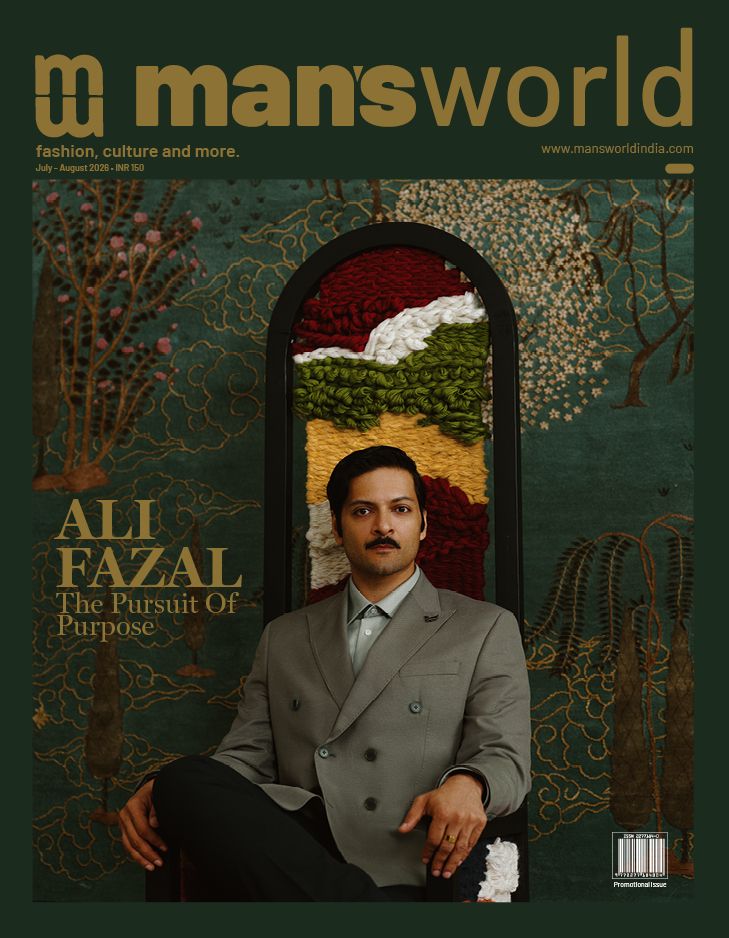
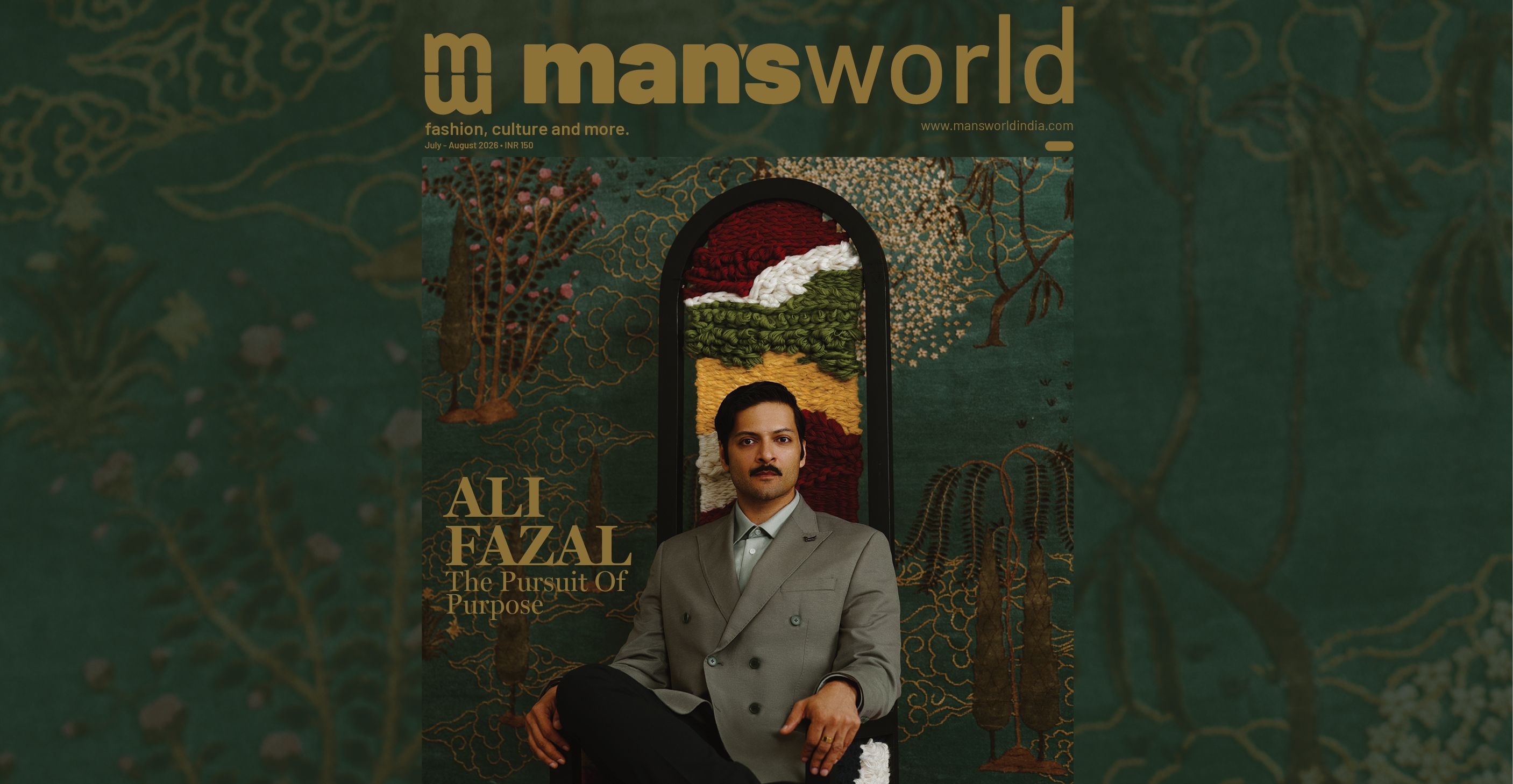
The narrow, puddled lanes weaving through Empire Estate in Lower Parel don't quite prepare you for what's tucked away inside. Hidden between cars parked haphazardly around the block, the Jaipur Rugs showroom exists in an entirely different reality. Step through its doors and the city noise disappears, replaced by an airy showroom where skylights flood the space with natural light. Mirrored staircases are draped in rugs and every corner feels more like an art gallery than a furniture store.
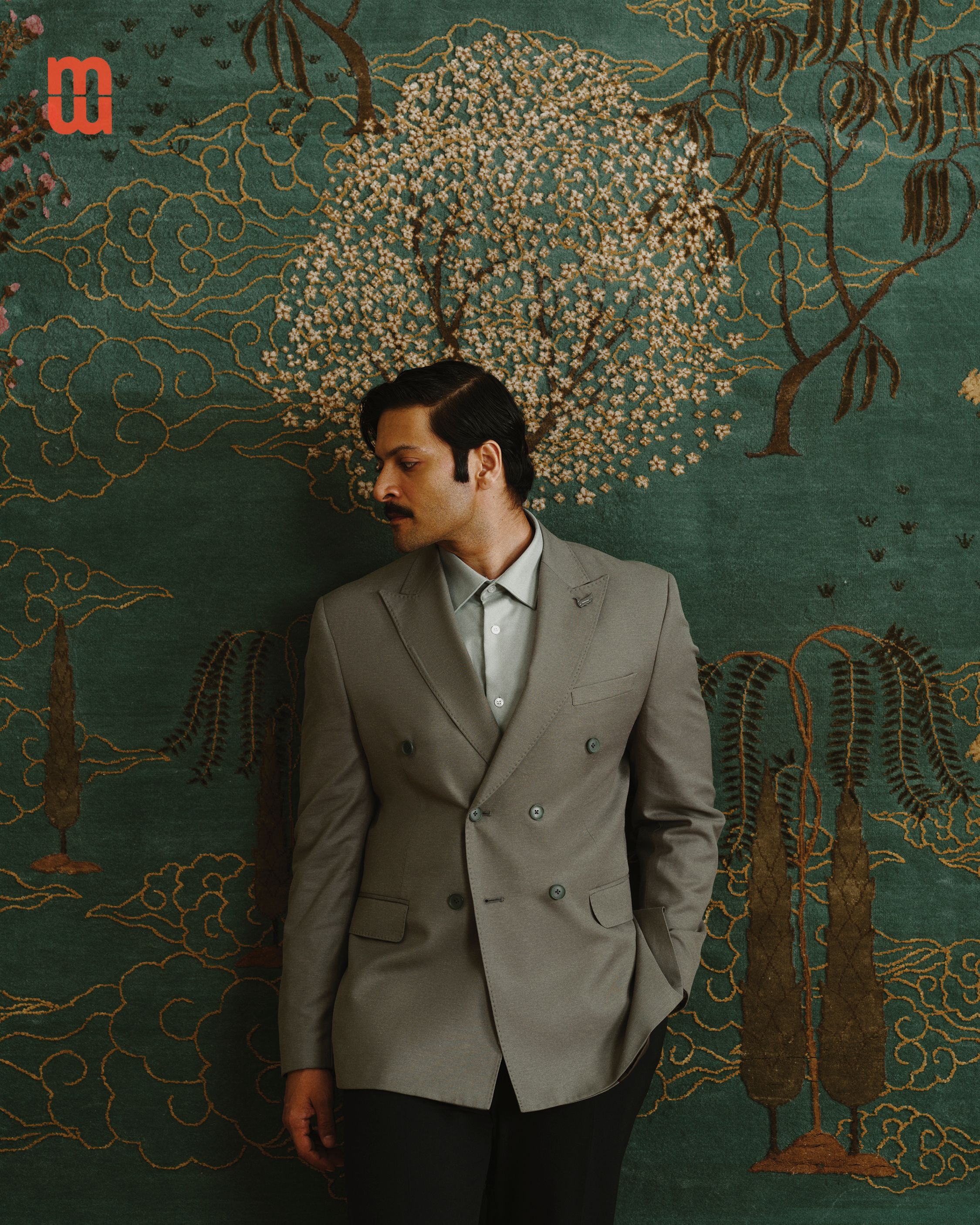
For the cover shoot, a part of the showroom has turned into our set with the rugs doubling down as the backdrops and the foregrounds. Blackberrys' racks of suits and apparel stand neatly arranged nearby, as the styling team debates which colours work best against the textures of the carpets. A steamer hisses away in one corner, lights are quietly shifted from one corner to the other and every few minutes, someone from the crew rushes off to put out another fire in hushed tones.
Then Ali Fazal walks in. No dramatic entrance. No convoy announcing his arrival. Just a laidback Fazal, his manager and a spot boy. Before anyone can formally welcome him, he's already looking around the showroom with the same curiosity as everyone else, stopping to admire the rugs before walking towards the styling area. The staff who had spent the morning helping set the space up suddenly freeze. Guddu Pandit has walked into the room.
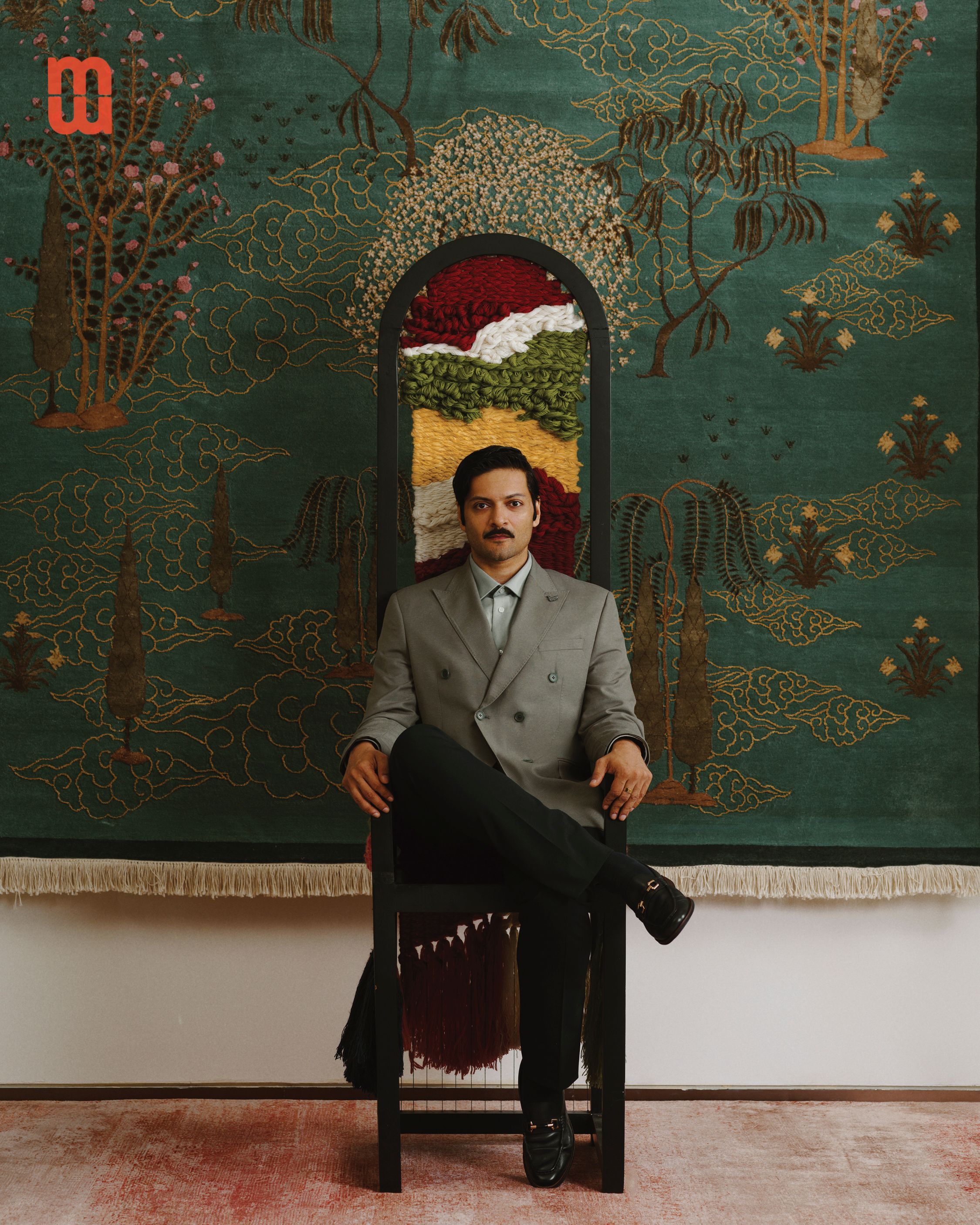
Fazal, meanwhile, seems blissfully unaware of his aura, walks straight towards the suits. Unlike actors who happily surrender themselves to stylists, he has opinions. He knows which cuts flatter him, which colours don't, and how he wants a suit to sit on his shoulders. After disappearing briefly into hair and make-up, he returns with a moustache, that wasn’t there before but somehow feels as though it had always belonged there.
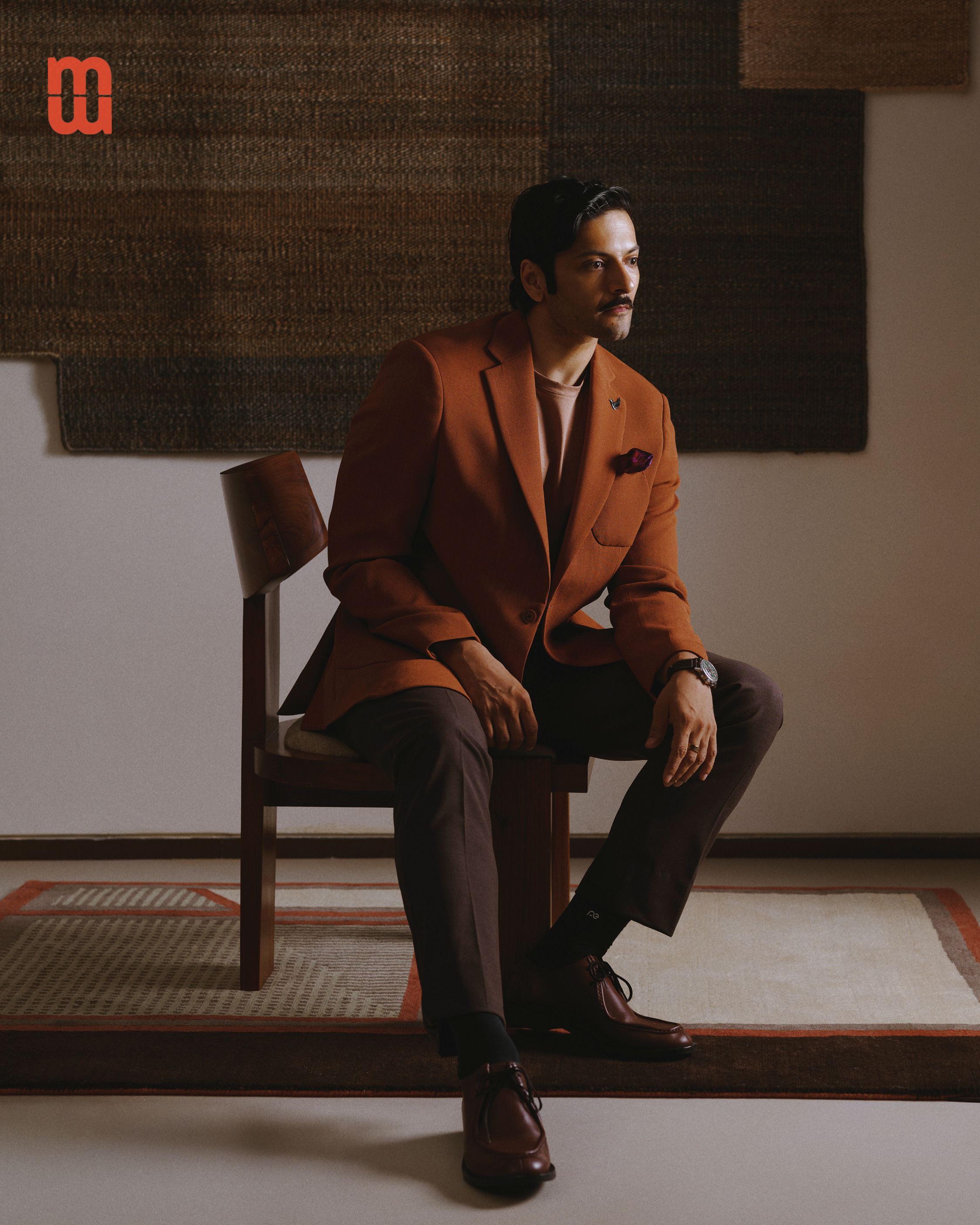
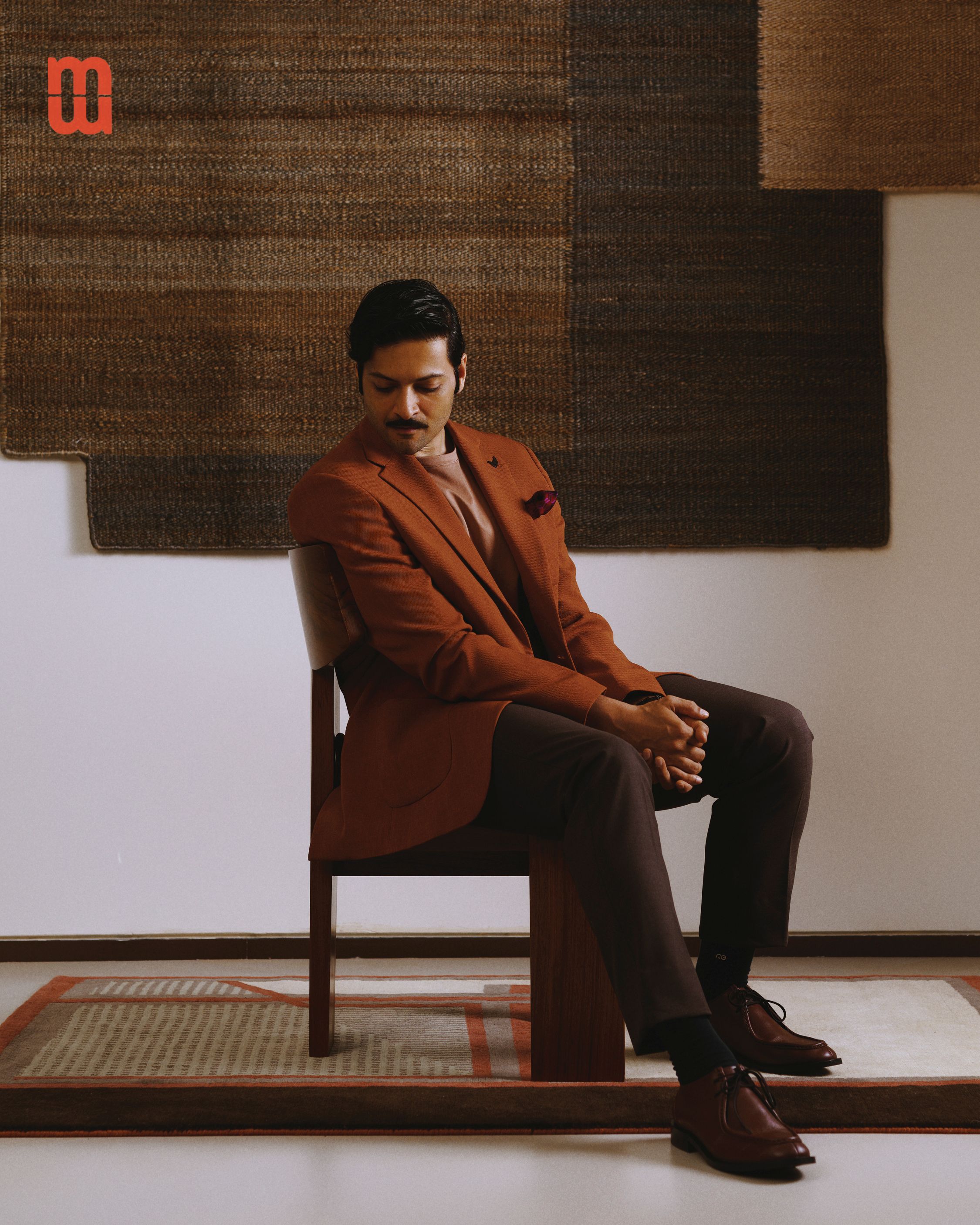
One fitting turns into another. Beige gives way to chocolate brown, then olive and ash grey. He owns the room with every look from Blackberrys, punctuated by the kind of relaxed confidence that explains why suits have become one of his signatures off-screen as well. On set, his swagger is nothing like it was when he walked into the store. The laidback ease gives way to complete focus. Sure, the suits help project his aura, but his instinct is equally sharp. He knows where the light is, how to angle himself towards the camera and, more importantly, how to convey sincerity through his eyes.
Watching him, you'd assume this was always the plan. It wasn't. "I think I was exposed to world cinema at a very young age without knowing it actually, and that is what has stayed with me over the years," he says later, settling into conversation between setups. "Like a religion, my mother would take me to the theatres at the end of every week... she would get these cassettes of all the regular classics... The Sound of Music, Chitty Chitty Bang Bang, The Guns of Navarone... and then once in a while there used to be something random like French cinema or something completely different."
"I grew up watching old Hindi classics also, but there was no plan of becoming an actor. This became like culture and it stayed in my subconscious. I suppose, somewhere you automatically start leaning towards all the things that you have experienced in childhood... somewhere it comes back."
Looking back now, it almost explains his career. Few actors of his generation have built a filmography as difficult to categorise. He has moved comfortably between mainstream Bollywood, streaming, independent cinema and Hollywood productions, without ever fitting a box but seamlessly fitting every mould. When asked how he chooses a script, he says, "I first ask myself, are these the people and the punctuations I want to be associated with for the next six months? Because, it's not just one-dimensional, right? There is a director's vision, a producer's vision, and then there are hundreds of people who are coming onboard and collaborating... Of course, the first thing is the script because it all begins from that first imagination of the writers, so it has to be [the] king."
That sense of intention wasn't always driven by purpose. “Straight out of college, having done just a few plays, my biggest thing was that I wanted a taste of world cinema. I wanted a taste of that feeling where you're standing and a bunch of people are watching you and in that moment, you have the power to control all these people's faces and the way they're going to contort, the way it's going to move, the way they will think. That's immense power, in that one moment. It's a lot of responsibility.”
Like most young actors starting out, Fazal's ambitions were once far more immediate—finding work, paying rent and making enough to support his family. Success, he says, has simply changed shape over the years. “The rest of it, is all paise kamane hai, ghar chalana hai. I had to pay rents, and I had to take care of my family. Slowly, I could take care of my family and then, your dreams become bigger. Now, I've just had a baby so, sometimes I think the world is fully complete and I might not want
anything more from it.”
But Fazal’s undying commitment to telling stories makes it feel more than career moves. Whether he's stepping in front of the camera or developing projects through Pushing Buttons, his production house he runs with wife, Richa Chadha, every choice begins with the same question: who is telling the story, and why?
“There are so many stories that are untold and that's where the responsibility comes, that you know, maybe there are some stories that only I can tell the way I can tell and there's a space for that in the world, there's a space for me. Because sometimes, we also have an imposter syndrome because so many wars are happening in the world. There's absolute destruction we have witnessed in the last 3-4 years. So, it makes you think, 'Yaar, am I even significant, you know… yahan hum baith ke noire aur art ki baat kar rahe hai, aur wahan jungen ho rahi hai.' Sometimes you have to realise that no, it is very important. It was very important that we made Girls Will Be Girls, a film that connected with people not just here but everywhere in the world and it was needed in a world where we have stopped feeling."
Perhaps that's why sincerity never feels like a performance with him. Every role begins with empathy, with understanding another person's fears, hopes and circumstances before trying to portray them. One of his first films introduced audiences to Joy Lobo in
3 Idiots—a character whose story continues to resonate with students living under immense academic pressure. Nearly two decades later, the conversations around students’ mental health and competitive education haven't changed nearly enough. "Oh, of course," he says, when asked whether playing characters fundamentally helps him be more empathetic to the realities they present.
"I'd be lying if I said it doesn't. I think, by default, our profession calls for compassion towards everything. We are constant observers of the world and of the human condition."
He pauses before recalling his own college years. "I was a science student myself... I knew so many kids from school who left immediately after 10th for Kota... I knew how much pressure they were under."
Years later, he found himself reconnecting with one of those classmates, now an engineer living in Mumbai. The conversation brought him right back to Joy Lobo. "In fact, I recently met one of my batchmates who's an engineer and is now in Mumbai and even he told me that Joy's character was very hard-hitting for him at the time. So, I know this pressure is very real."
That reality, he says, hasn't changed. "I was recently in my college, doing a talk at (St.) Xavier's, and I asked the kids and ghoom fir ke, pressure wahi exam ka hi hota hai. That's their life ka bada stress." For Fazal, the fact that Joy Lobo's story still resonates nearly two decades later is a reminder that stories don't exist in isolation from society and neither do the people telling them.
That idea resurfaces throughout our conversation, whether we're discussing cinema, celebrity, parenthood or the future of Indian storytelling. It informs the films he chooses, the projects he develops and even the way he views his place in the industry.
In a country where actors are often elevated far beyond entertainers, I ask him whether that influence comes with a responsibility to engage with the world beyond films, or whether audiences should simply allow actors to remain storytellers.
"No, not at all, we have to! See, it's a very thin line between the arts and politics, because our leaders are also figures people look up to. Hamare culture mein hai, there is that worship towards the people who are leading us and are a part of storytelling. So, we actors must engage. It is our social responsibility at some level. We have to connect! What do we mean when we say, 'Yeah, I hope my film connects with the audiences.' I mean, it's like, you can't take the artist out of the art, right? It's the same conversation—one goes hand in hand with the other."
Connection, however, has become increasingly difficult in an industry that's still trying to rediscover its audience. As streaming continues to reshape viewing habits and theatrical admissions remain unpredictable, the question isn't just about where stories are being told anymore, but where people are choosing to experience them. Fazal has had a front-row seat to that shift. Long before streaming became the industry's dominant force, he was among the first actors to bet on the format with Bang Baaja Baaraat.
Does he worry that audiences have become too comfortable waiting for films to arrive on OTT? “We are always going to evolve into better versions of our storytelling, and it's amazing that OTT could bring that out of us, but in the end, human nature craves community. We love community and the essence of community in the arts is when a bunch of strangers collect together in a meditative state, sit and have a shared experience. COVID totally isolated us from everybody. So that shared experience became a one-on-one experience with the television or your family units. But eventually, it's almost natural for us to want to belong.”
Fazal remains convinced that theatres will always have a place because of the shared experience they offer. It's fitting, then, that the project bringing Fazal back to cinemas is also an OTT show that audiences know him best for. Nearly seven years after
Guddu Pandit first entered pop culture, the character is making the leap from streaming to the big screen. “I had to do a lot of unlearning, man! I had to unlearn the whole thing, it's like imagine you live one life and then you just erase it and go back to square one, and you start again. But it's also such a weirdly, liberating feeling because it's like, oh okay, I don't have to live with that baggage of all those seasons anymore, and it brings back a part of Guddu's innocence that I'm reconnected with.”
But the industry's recent creative choices haven't always inspired that same confidence. At a time when familiar franchises, remakes and nostalgia-bating is rampant among new releases, ask him whether Bollywood has become too risk-averse and he says,
“The economy model is going through a very big shift. Right now, nobody knows what’s working. For the longest time, everyone was confused. Suddenly if something works, you have five kinds of similar projects released because at the end of the day, people want to put their money where they know it’s going to come back.”
For Fazal, the solution isn't necessarily bigger stars or safer bets. It's trust. Trust in writers, in directors, and perhaps, most importantly, in the willingness to let original ideas breathe before they're filtered through committees and market research. “I think
corporatisation is what is scary, because suddenly everything becomes about numbers, everything becomes about optics.” And so, now that he is also creating stories with Richa, through Pushing Buttons, he is just making the kind of cinema they grew up watching. “We want to break genres… we want to be able to collaborate with international productions and create stuff.”
In a our 2023 cover interview, he'd expressed how he’d like to build his production house like A24, the Hollywood production company behind titles like Everything Everywhere All At Once, Beef, Euphoria, Moonlight and Uncut Gems. And he seems to be following through with the kind of projects they have onboarded. “There's a very cool film in London that I'm working on. It's based on an off-broadway play, we are developing it, and I'm leading that [as the showrunner] as well as an actor. Besides that, we also have another film called Papita we’re working on with Akash Bhatia, who’s the director as well as a 2D animation series in the works.”
Besides that, Ali Fazal is a big believer in championing our own talent and stories. For years, Fazal has moved between Indian and international productions with an ease few actors have managed. But of course, it’s not as easy as he makes it look. Back in our 2022 cover interview, Fazal remarked that Indian actors often struggle internationally because "we don't really champion our own." Four years later, he admits the change has been gradual, but believes the momentum is finally building. “Maybe it slowly is changing. Or if not, then I know that I want to be part of that change or maybe lead it with many other filmmakers, because I think, we are making some really cool stuff on the international and on the Indian circuit as well. I think we just need to identify the money model and champion them all the way through. Films like All We Imagine Is Light went up to the [Golden] Globes, man! Recently, I sawa film called Balan: The Boy, written by Jithu Madhavan–brilliant film. I think it is one of the best films of 2026 and I would say that it should, hands-down, be our Oscar entry.”
For an actor who has spent the better part of the last decade balancing Bollywood with international productions, the question of where he belongs has naturally followed him. From Victoria & Abdul and Death on the Nile to Kandahar, Fazal has steadily built a global filmography at a time when Indian actors are finally finding more opportunities abroad. But visibility, he argues, isn't the same as meaningful representation.
“I think stories need to be carved out that way, and slowly it's happening on an international level as well. The focus is going to shift on actually making stories that involve our talent and are carved around them. It is going to happen,” he says convincingly. “It happened with Korean and Chinese cinema in Hollywood. We just need great backing.”
It's a philosophy that has also shaped one of the biggest career decisions he's made in recent years. In our 2023 cover interview, Fazal admitted he was seriously contemplating moving to Hollywood full-time, believing it would make navigating international work significantly easier. Today, after another string of global projects, that temptation has largely faded. “I think, at that time, I was contemplating and sometimes, I'm still very torn between these two worlds because one foot is there and one is here… But I'm happy I stayed. I know I want to tell stories from our Heartland. I know that there is so much to tell and the world is becoming smaller… I don't think I need to move there.”
That decision has also coincided with another life-changing role—becoming a father to Zuneyra Ida Fazal, which is now dividing his time in a whole new way. With Richa and him having successful careers, he says they’re figuring out how to set their schedules and work in a way that one of them is with her always, as she now begins school. Fazal is careful not to romanticise fatherhood, insisting that neither he nor Richa consciously sat down and re-evaluated the risks they were willing to take. Instead, life simply reorganised itself around her. "Maybe… by default," he says. "I don't think we have given it a thought given it a thought, we continue to work. But yes, our time gets a little divided because we have to be there for our daughter, and she's just started play school. So we keep dividing [it] in a way where one of us is always there with her."
It's apparent even during the shoot. Between outfit changes and camera setups, Fazal quietly keeps an eye on the time, hoping to wrap before Zuneyra goes to sleep. The shift in priorities shows up elsewhere too. When we last spoke, his dream car was a Ford Mustang. Since then, he's bought a BMW 7 Series. I ask if fatherhood had anything to do with it. He laughs. "No no, it's nothing like that, man! I'm sure I'll probably own a Mustang someday… One day.. I don't know. (Pauses) As much as I love cars, they're not my focus anymore. I think it's a privileged desire and my likes have changed a little. Right now, I just want to focus on making good cinema and investing in good stories."
This sense of responsibility reflects in all his investments beyond the screen, like Ehaab Couture, the chikankari label he runs with Richa. Rooted in his hometown of Lucknow, the label is his way of preserving a craft that has been passed down through generations while creating opportunities for the artisans who continue to keep it alive.
"I want to give back to my city (Lucknow) in some way or form. I think it's important that we champion karigars who have been relentlessly working, and it also works as a reminder that, sometimes it's okay to just stop and really enjoy the taste [of] good karigari, there's a process to it that takes time and the beauty [that] comes out of that is unmatched."
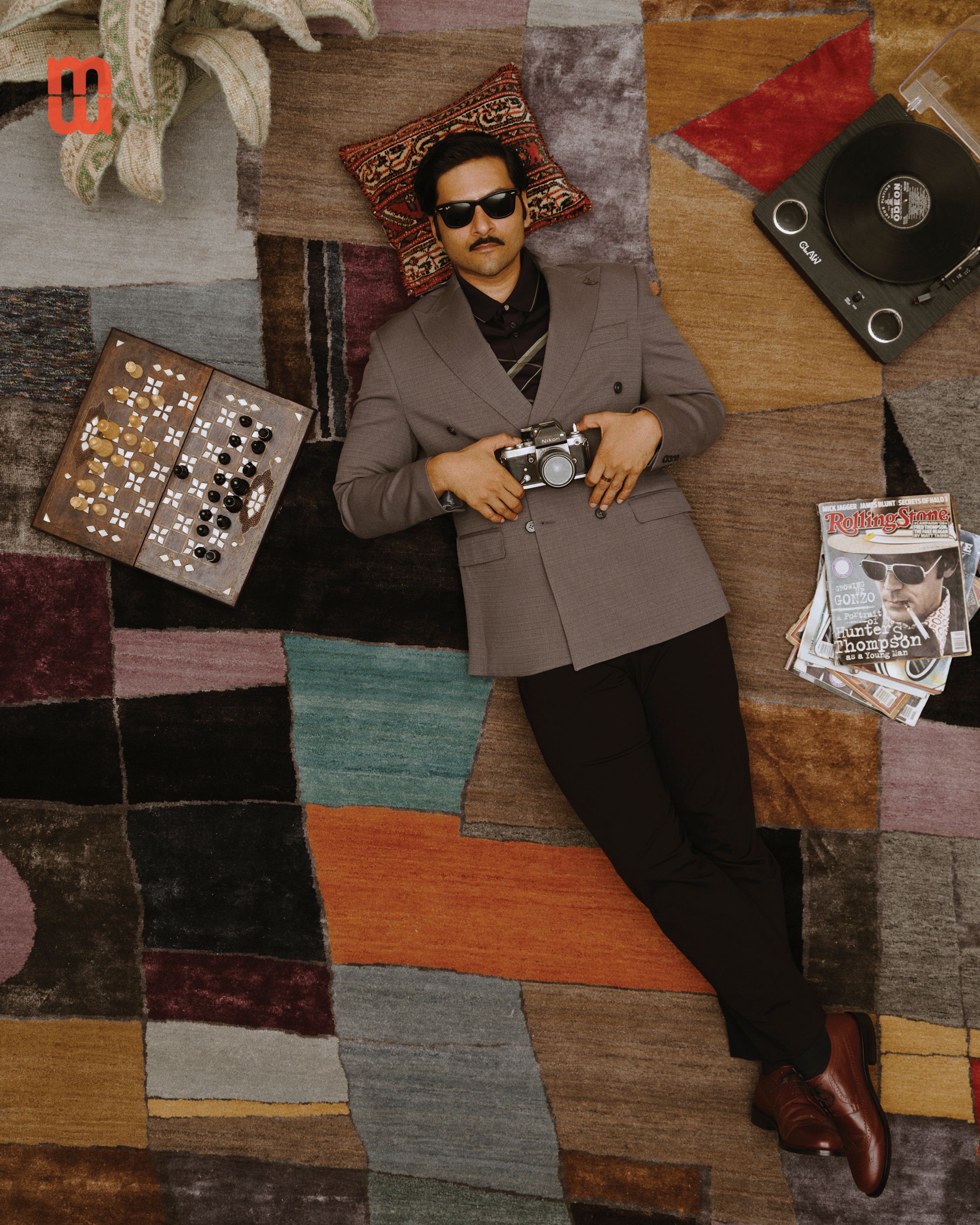
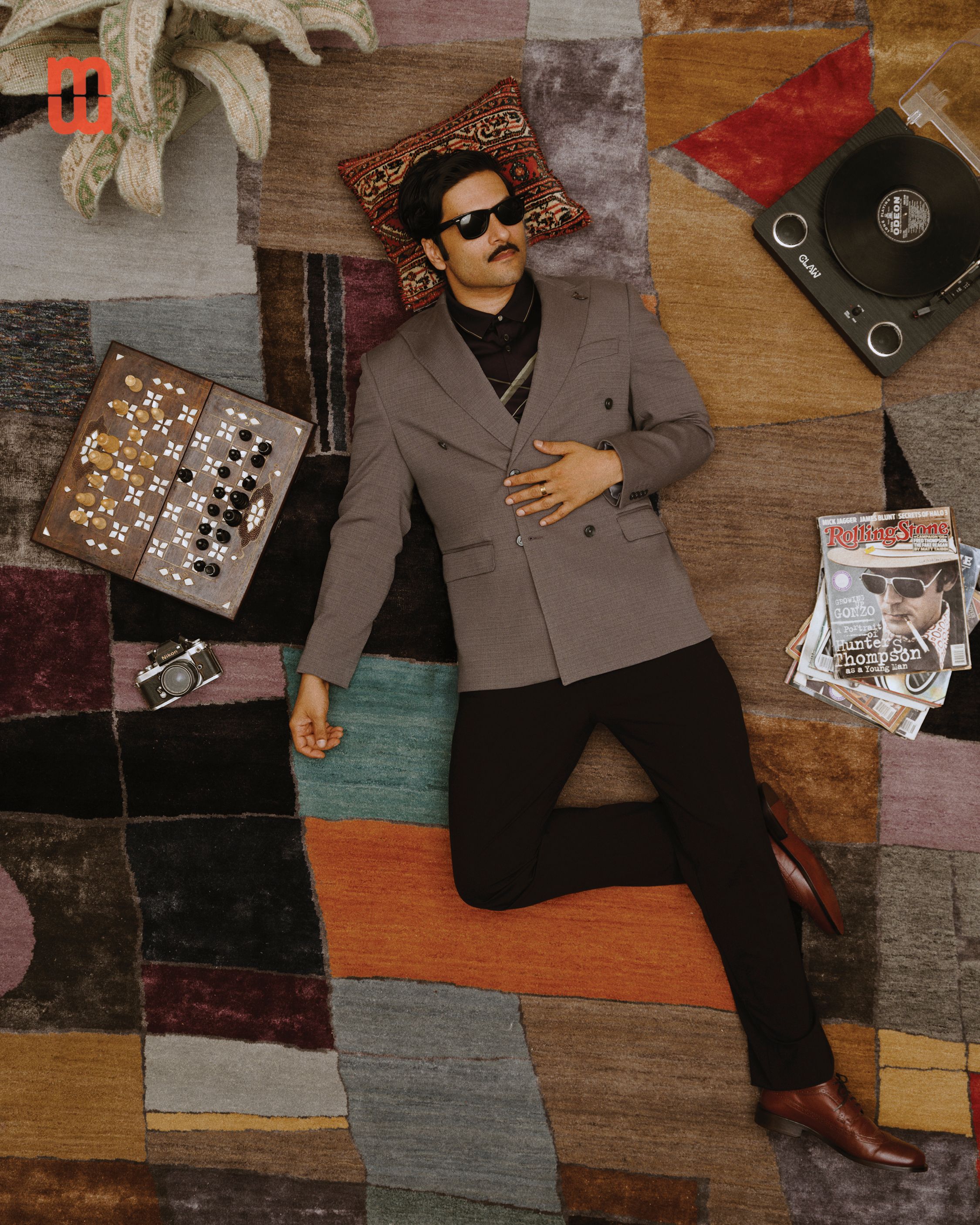
It's perhaps why, by the time we reach the final look of the day, Fazal seems just as fascinated by the setting as he is by the clothes. The last shot requires an elaborate overhead setup, giving the crew a few extra minutes to rig the camera. Rather than retreating to his phone or disappearing into the green room, he wanders back towards the rugs. He runs his hands over a few of the hand-knotted pieces, asking about the craftsmanship, the weaving techniques and where they were made.
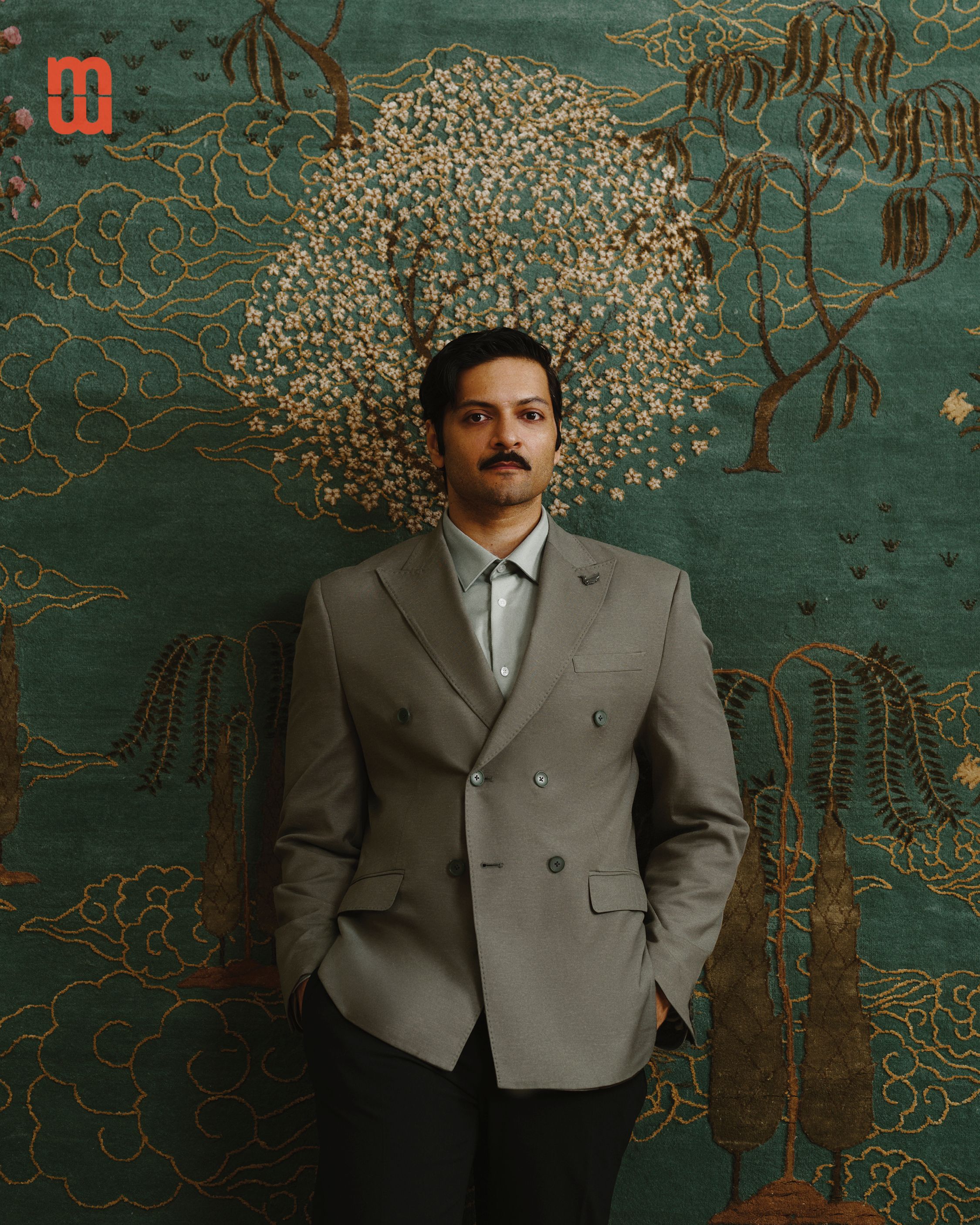
Before long, the conversation shifts from the shoot to which ones would work in his own home. Watching him slip so effortlessly between cover star, customer and, moments earlier, a father in a hurry to rush back home, I find myself wondering how much of every character he actually carries home with him. It's a question that becomes even more pertinent when the role demands living inside grief, trauma and emotional darkness, as it did in Rakht.
"I think the catharsis of that show and the story, we went through all that during the reading stage and at the workshop stages, which is where we usually dismantle the scripts and go into the deeper corners of those emotions and the experiences. But once the camera rolls, it's almost like tunnel vision, you stop all the noise of the world and of your own emotions at many levels, because I think the story and the characters really take precedence. It's important that you can switch off because you are attacking it every single day."
"Sometimes I feel, behind the face of method, a lot of people become assholes to people on sets. It's not very nice. You don't need to be an asshole to the person next to you just because your character calls for it, right? I think, there is a far more 'psychotic' way to approach acting—the way I do—that does not involve me being rude to anyone. I am slowly learning how to switch off once the camera stops."
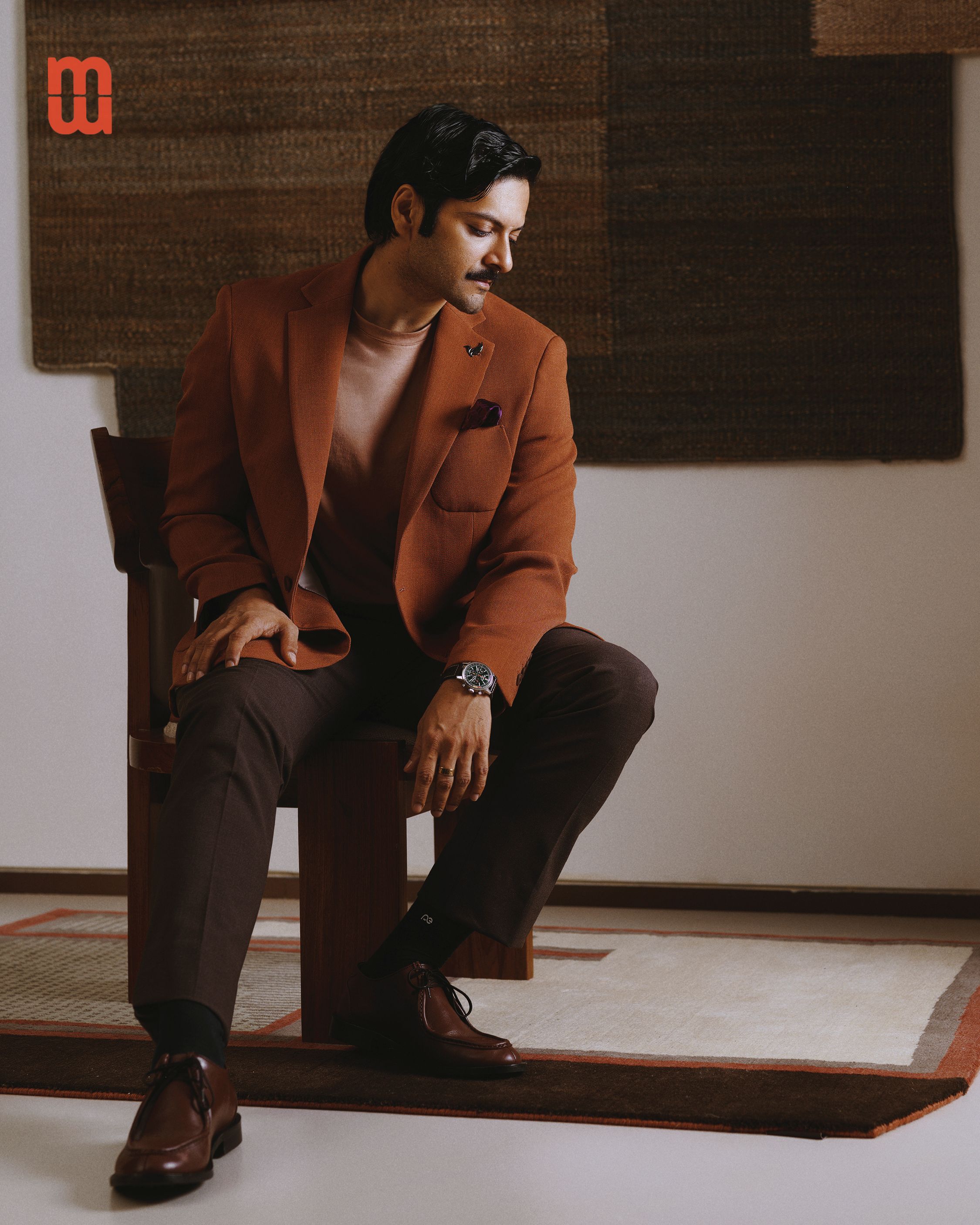
If there's one thing this conversation makes abundantly clear, it's that Fazal has little interest in repeating himself. Every role, every production and every investment outside cinema seems to be driven by the same desire—to keep finding stories that challenge him in new ways. So, what still remains on the bucket list after nearly two decades in the industry? "I would love to do a slick action film, something very John Wick–style. Or I’d love to be part of a really important film—maybe a biopic about a freedom fighter, someone who played a role in our independence. Having said that, I’m also a big lover of comedy and love stories. But at the end of the day, it all comes down to the right script and the right director."
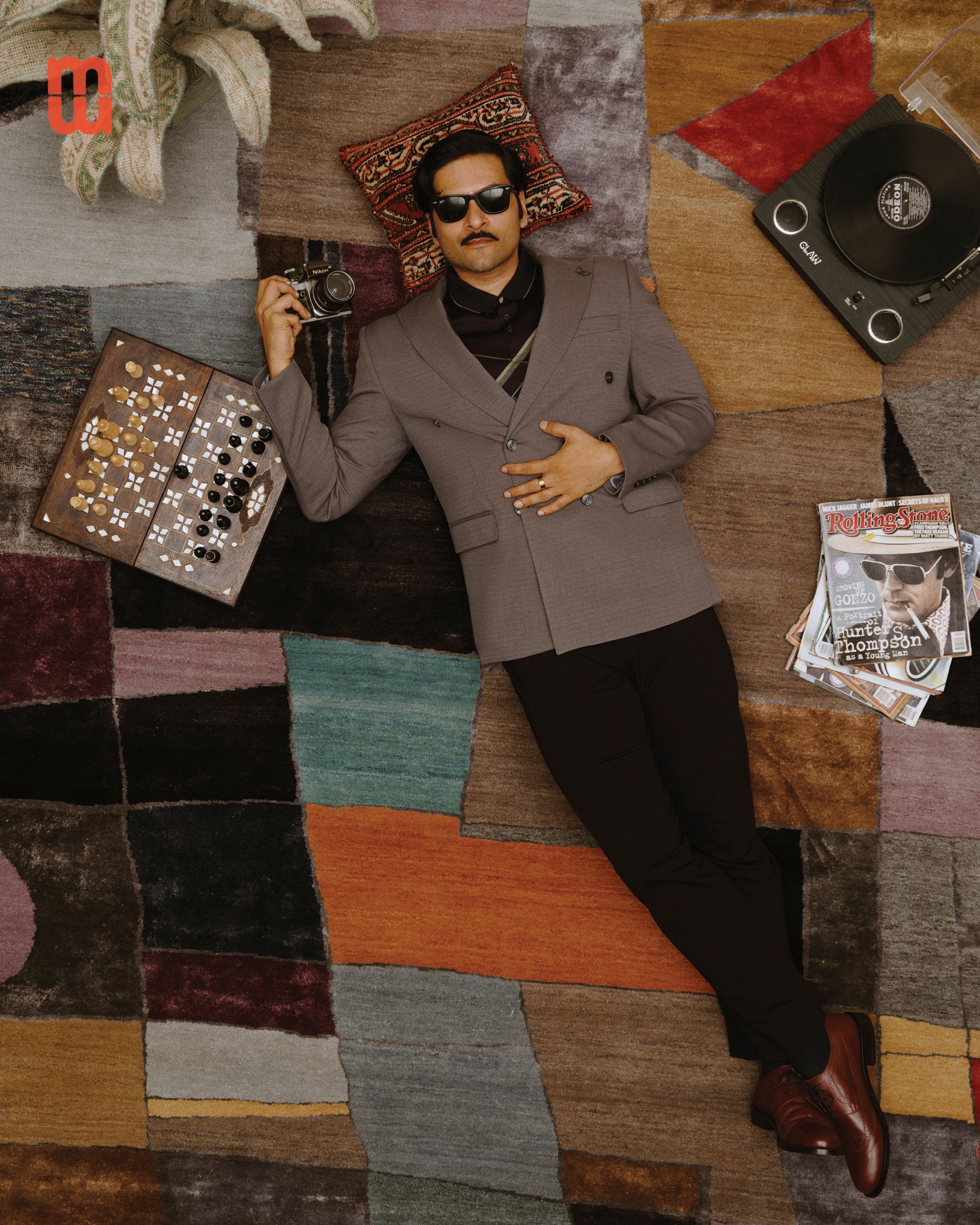
It's a fitting answer from someone whose career has been defined less by genre than by instinct. Whether it's a blockbuster franchise, an independent film, a period drama or a deeply personal production through Pushing Buttons, the throughline has never really changed. As our conversation winds down, I ask him one final question: what kind of an actor does he want to be remembered as?
He laughs. "Wow, this is like writing my obituary! Good God! I don't want to be remembered as anything... maybe my stories can do that for me or films that I'm part of can carry all of that forward. (Pauses) When the coming generations look back, at least I can hope that they don't say, ki, 'bhai, tum kya kar rahe the? Why couldn't you do more meaningful stuff?' That's what scares me."
CREDITS:
Photographed by Sarang Gupta
Styled by Edward Lalrempuia
Stylist Assistant: Chon Lm, Stuti Patade, Asu Longkumer, Kudrat Anand
Makeup Artist & Hairstylist: Netra Chavan
Artist Reputation Management: Hardly Anonymous
Location: Jaipur Rugs, Mumbai


