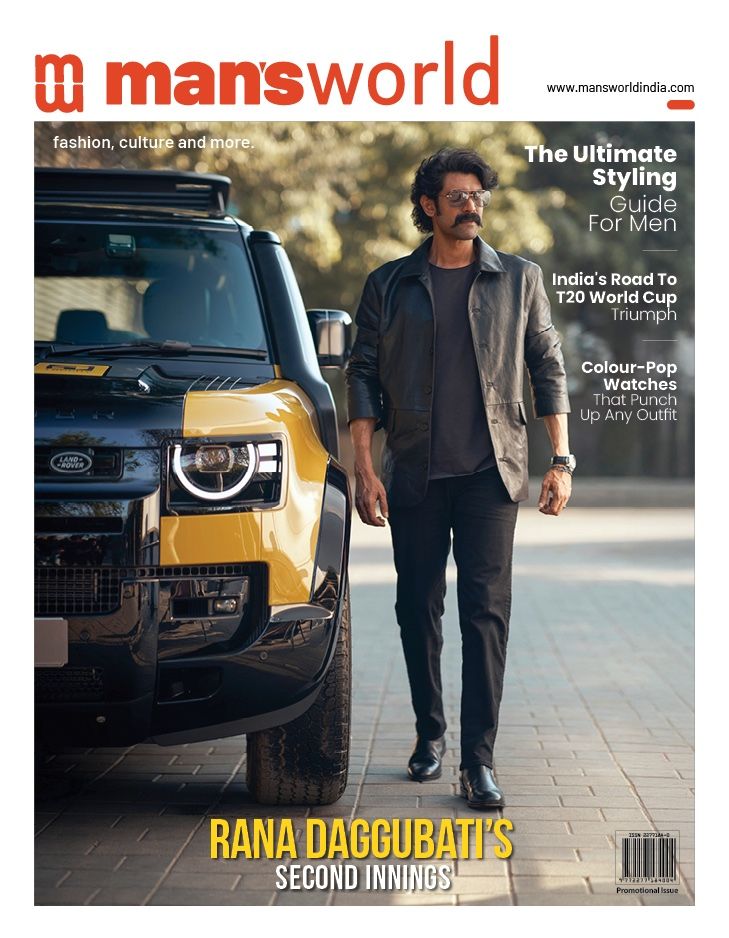
Rana Daggubati was probably the only contemporary actor from South cinema who had got the Hindi movie- going audience truly go weak in the knees. Back in 2011, when he made his Bollywood debut as a soft-spoken and laid-back local Goan musician, Joki, in Rohan Sippy’s Dum Maaro Dum, he didn’t come with a legion of rabid fan clubs that one today associates with the ‘Pan-Indian stars’. In fact, he didn’t even enter Bollywood as a ‘South star’; he was part of an ensemble cast led by Abhishek Bachchan and Bipasha Basu. But the tall, dark, and ruggedly handsome actor instantly became the national crush.
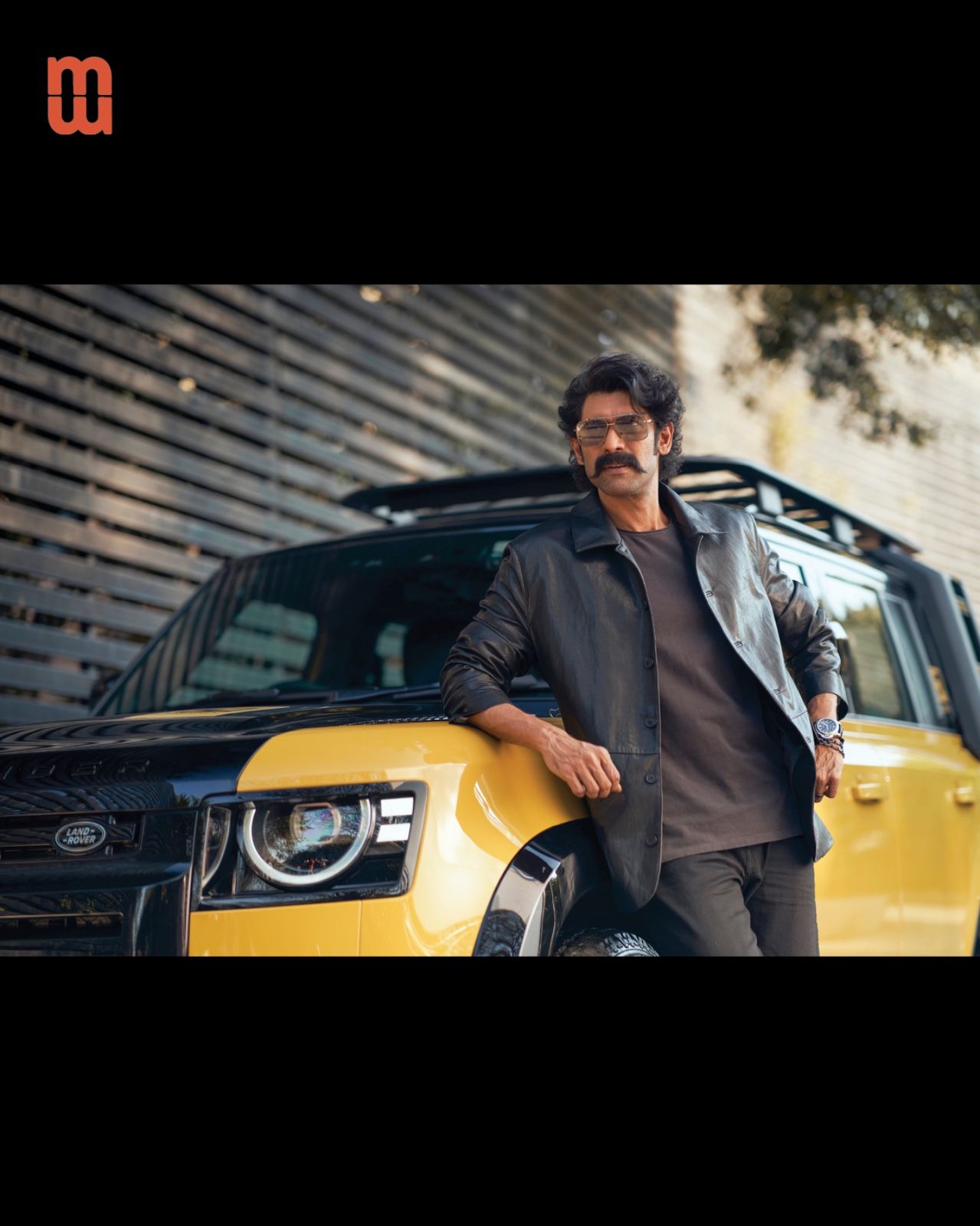
Jewellery: VRK by Khanna Jewels
But then, this freshly minted smouldering romantic hero disappeared (only to casually set the screen on fire with a brief cameo as Naina’s HOT photographer friend in Yeh Jawaani Hai Deewani in 2013). And in place of him, emerged a hunky action hero—while his turn as the encounter cop in Ram Gopal Varma’s 2012 action-drama, Department, didn’t get the kind of mass recognition one expected, he grabbed attention in Neeraj Pandey’s Baby. The 2015 release saw an even more bulked up Rana play the muscle man of an anti-terrorism squad. But nothing would have prepared the audience for what was to come later that year.
July 10, 2015, turned out to be a momentous day not only in the career of this blue-blooded actor, but also for Indian cinema. It was the day that the first instalment of SS Rajamouli’s two-part magnum opus, Baahubali, hit the screens redefining Indian cinema and establishing the blueprint for “pan-Indian” blockbusters. “We actually coined the term ‘pan-Indian’ for Baahubali!” quips Rana as he plonks himself on the couch of the sprawling suite of Taj Krishna in Hyderabad. Dressed in a black T-shirt and khaki trousers, and flaunting a brand-new handlebar moustache, the 6’2” actor (who looks every bit intimidating) is as candid as ever. “We didn’t want to call it a Telugu movie as we wanted it to reach a wider audience, and it was certainly not a Hindi movie…so, we came up with the term ‘pan-Indian’ movie. It sounded cool and we went ahead with it! We would mention Baahubali as a pan-Indian movie in every interview and the term just caught on,” chortles the OG pan-Indian star. Every revolution needs its own vocabulary and Baahubaliwas the revolution. And among other things, the movie also gave Indian cinema one of its most iconic villains.
Baahubali: The Beginning saw the softspoken hero, the ‘gentle giant’, turn into a larger-than-life supervillain Bhallaladeva—a celebration of brute strength driven by jealousy—a character that reminds one of Duryodhana. But unlike the primary antagonist of the Mahabharata, Bhallaladeva was also a master strategist which made him a much more vicious and layered character. Rana not only aced the character showcasing his acting prowess but also brought the required physicality. The actor debuted a massive and imposing physique as Bhallaladeva (he underwent a gruelling five-year physical transformation and reached 110–125 kg in Baahubali 1 and 108–110 kg in Baahubali 2. He, along with Prabhas became the first legit ‘pan-Indian’ stars.
He followed it up with The Ghazi Attack (2017)—a highconcept film with an indie soul that went on to become a commercial hit while picking up the National Film Award for Best Feature Film in Telugu. Marketed as India's first underwater war-at-sea film it was a bilingual production (much like Baahubali, it was shot in two languages simultaneously), and Dharma Productions handled the distribution of the Hindi version significantly scaling the film's reach. This movie proved that along with bigbudget tentpole movies like Baahubali, such high-concept movies made on a much lower budget can also enjoy a pan-Indian success.
But then…he disappeared. Again. And it won’t be until 2023 that I would encounter the actor. He made his OTT debut playing the titular character in Netflix’s R-rated series Rana Naidu (the second season dropped last year). Rana, who teamed up with his uncle Venkatesh Daggubati for this stylish adaptation of the American series Ray Donovan, gave a measured performance playing a Bollywood fixer whose job is to clean up his high-profile clients’ mess with cold precision, scrambling to keep his own family from crumbling.
Just before the series dropped, I had met the actor for an interview, and he had mentioned what had kept him busy in the meantime. He had launched Anthill Studios, a media-tech accelerator, and has invested in digital platforms including Gamezop and Ikonz. He bought a stake in Amar Chitra Katha with the aim of making movies on Indian history and mythology and stories steeped in Indian culture. And then there was Spirit Media; a company he had initially started as a VFX company—interestingly, Rana had started his career, not as a hero but as a VFX coordinator and has over 70 film credits as a VFX coordinator—through which he was developing and distributing films while working across publishing, talent, and new media.
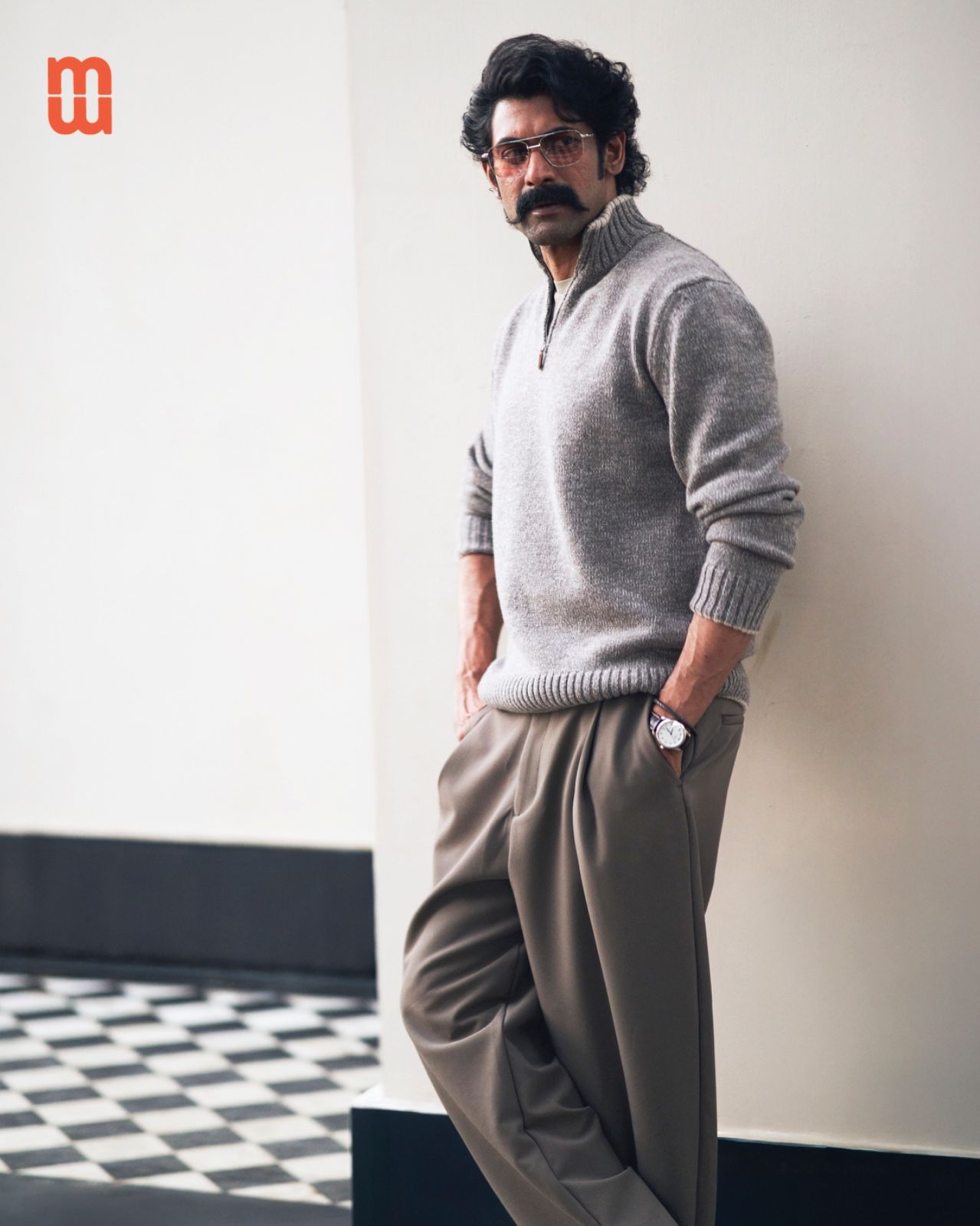
Sweater: Paul & Shark; Jewellery: VRK by Khanna Jewels
The next time I caught up with Rana, it was not as an actor but a producer and distributor. It was right before the release of Payal Kapadia’s All We Imagine As Light in 2024. His Spirit Media had taken up the Indian theatrical rights of the Cannes Grand Prix winner marking its entry into pan-India film distribution. “We are hoping All We Imagine sets some kind of precedent for us as distributors and exhibitors. We want to carefully track this film,” the actor and founder of the production and distribution company had then said. Armed with the learnings from the theatrical release of Kapadia’s movie, the company went on to secure Indian distribution rights of Rohan Parashuram Kanawade’s Sundance Grand Jury Prizewinning Marathi film Sabar Bonda (Cactus Pears) in 2025.
It might seem like a surprising move coming from an actor best known for a big-budget commercial blockbuster like Baahubali but way back in 2005, before he made his acting debut with Telugu-language political drama, Leader (2010), Rana had started off as an indie movie producer. “In 2004, I had made the film called Bommalata (A Belly Full of Dreams), it got a National Award [for Best Feature Film in Telugu], but I couldn’t secure a theatrical release for it,” he had rued when we had met in 2023 for another cover interview. Even though his family owns around 380-odd movie theatres in the state he has firsthand experience of the plight of getting an indie movie a theatrical release. “At that time there was no distribution platform, there were no OTT that would buy these kinds of movies. The only way to put these out was through film festivals. Doordarshan used to buy a few movies. It was a very small ecosystem,” he recounts. “Then in 2018, we released one indie movie called C/o Kancharapalem—it was a beautiful film, and we formulated a unique marketing strategy for it. It hit a slightly more mainstream sector than you normally would expect from such films. It made us realise that there is an audience for films like these, but these can’t be marketed the same way as the mainstream commercial movies. We also realised that apart from having a different marketing strategy, tailor made for these movies, we need to create a habit of watching such movie. So, we decided to initially try and put out about five to ten indie movies from across India,” says Rana explaining what got him into the indie space as a producer and distributor.

Sweater: Paul & Shark; Jewellery: VRK by Khanna Jewels
But it wasn’t easy and they are still in experimenting. “Currently, there is no set market, audience, or even media space for these movies—there are too many battles to fight,” he rues. “But we are trying our best to ensure that these indie films see a certain scaled release and then continue in the streaming world for a longer period of time. But it is not a one-size-fits-all model. Each film will tell its strategy. We are tracking what kind of audience we are getting in a particular locality, for these kinds of movies we need a focussed audience. Giving these movies a standard release across the city won’t really work, you have to find the theatres that cater to the audience of the film. Also, you can’t put these in big 500/600-seaters, you need to opt for smaller theatres,” he says.
Apart from championing independent cinema and becoming the key player in distributing award-winning indie films, Spirit Media collaborates with legacy brands including Amar Chitra Katha and Suresh Productions and Tinkle Comics. It is also all set to step into producing Hindi cinema this year. Its debut is a drama thriller based on Booker winner Aravind Adiga’s acclaimed novel Last Man in Tower and will star Manoj Bajpayee. The movie is part of a five-film slate which also included Spirit Media’s first major home production, the Dulquer Salmaan-Rana Daggubati-starrer meta period thriller, Kaantha (Tamil) released last November.
It is fascinating how he straddles both worlds—that of commercial mainstream and that of independent cinema. I point it out and he laughs, “There is place for every kind of cinema. I started my career by producing A Belly Full of Dreams and I acted in Baahubali, so I know both the worlds well!” Indeed, Rana knows the business of cinema. For the grandson of filmmaker Dr D Ramanaidu and the son of producer D Suresh Babu, it runs in his blood; having grown up in the industry, he knows it inside out. “I have not only seen the world of cinema from the inside, but I am also in love with this world!” he quips. And maybe that is what makes all the difference. His is a craft-meets-commerce approach—it is not just Excel sheets he is dealing with; he is striving for excellence.
Apart from running Spirit Media, he is one of the main creative forces behind Suresh Productions, one of the country’s largest production houses founded in 1964 by his grandfather. But why did he need to establish a separate production house? “Suresh Productions’ target is the family audience. It has made about 130 films, and you can watch each of those with your children and your grandparents. That company stands for that kind of cinema. It is a family brand, and I couldn’t disturb the brand with the stuff I wanted to do with indie cinema. So, Spirit became that brand. Now when it’s a Spirit media film, you know it is an indie movie while a Suresh Productions movies are big budget commercial family entertainers,” he explains.
Today, the actor has strongly established himself as a serial entrepreneur—apart from his film-related ventures, he has a diverse business portfolio that includes brands like Kingdom of White (a lifestyle brand), Ghost Kitchens (multi-brand cloud kitchen company), Ikonz (a Web3 company), Gamezop (a game development company), VS Mani & Co (a coffee and snacks brand), and The Sanctuary Bar and Kitchen (Rana’s sprawling childhood home in Banjara Hills transfromed into a high-end resto bar). His most recent venture is Loca Loka, an award-winning global tequila brand—it won Gold for Blanco and Silver for Reposado at the 2025 San Francisco World Spirits Competition—cofounded by him that had its India launch this November. “Before Spirit Media started, which is also a startup, I was part of a fund called Anthill Studios. I was not a regular investor, but my job was associated with fresh tech changes that can accelerate any media forward related to storytelling. Post that, I got into consumer brands and skincare, fashion, and alcobev became the next categories we picked up. My team says we have one leg in the future,” he chuckles.
So, is he moving away from acting to focus on his business? “I was into business even before I became an actor! I start filming my next in a couple of weeks. The focus is on doing quality work and hence it took some time. I spent six years on Baahubali as well, but that didn't make news. In fact, Baahubali was both a blessing and a curse for me. I want to keep up to that level of quality. I want to take up movies that excites me enough to jump into it. That is the reason I didn’t take up too much acting work. But this year I am doing two films...there is a big mythology film coming up,” says the actor.
Shortly after enjoying the massive success of Baahubali, he had a serious health crisis that involved a kidney failure and severe heart calcification. He had to go for a kidney transplant, and it was crucial that he took a complete break from work for a year. In a recent media interview, the actor had revealed that his health struggle had also caused a drastic weight loss, and he couldn’t see himself doing the roles he had signed up for as an actor post Baahubali. His physicality was always a big part of his onscreen persona. He returned advance payments for several films (including a wrestler-themed movie) and it took him some time to get used to ‘this new guy’. Actors are all about vanity, so coping with it wasn’t easy. “Such phases are like a resent button in your life. It pulls you back to the ground when you start flying a bit high, I guess,” he laughs. “Health has now become a priority. Earlier, I never thought of going for health checkups, I took my health for granted...I was young, I looked fit, what could possibly go wrong? But it did. In fact, it has changed my outlook towards health and fitness—earlier it was all about how I looked in front of the camera; body meant the visual. Now it is about taking care of the inner works. It is not just about hitting the gym, it is about your sleep cycle, food, and overall taking care of your health,” he elaborates, although he is looking hotter than ever now!
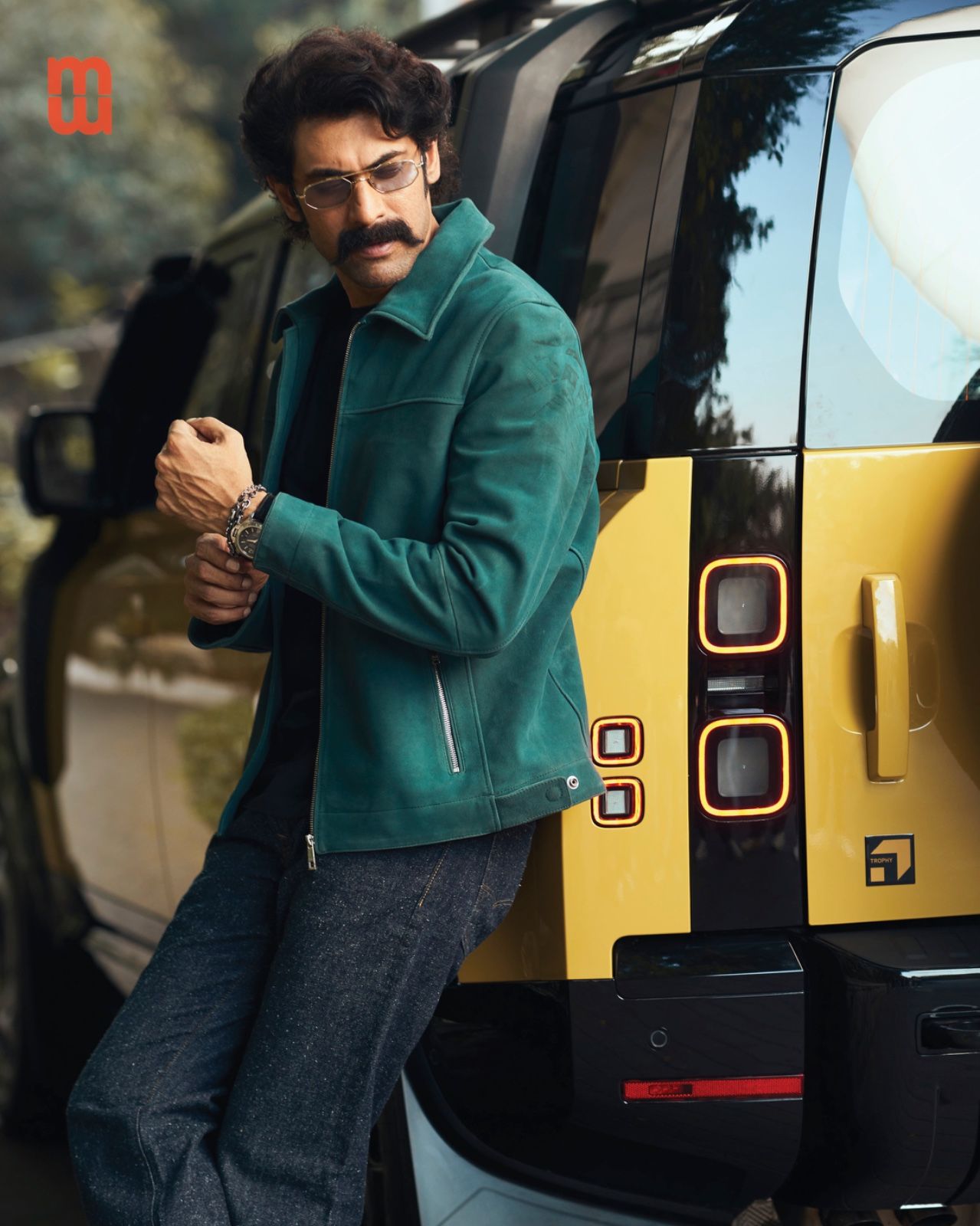
Jacket: Saint G; Jewellery: VRK by Khanna Jewels
So, was this pivot from acting to business a result of this health crisis? “That was “the reason people got to know about the business side of my work; I was doing it all all along!” he guffaws. “I still sit in the same office I started off as a VFX guy—I was the VFX company from that office, an actor, a producer, a tech company from the same office, sitting on the same desk!”
What it has done is that it has changed his perspective. “I have realised that my self-worth is about me and not about what others think of me,” he says. “I have also realised that everything is temporary, including you. And there is not much time. So, take up whatever really moves you or is really personal to you...whatever really means something to you. Leave the rest. You have limited time on this earth, don’t waste it on inconsequential things or people. Pick your battles. Run with things—it doesn’t matter if it is big or small—that gives you satisfaction and give it your best shot.” So, for Rana Daggubati, this second inning is about quality and not quantity; today he is in the pursuit of excellence. And in the process if this cinema obsessed tech guy is building a business empire, it is incidental (or so he would want us to believe!)
HOT TAKES ON CURRENT CINEMA
Today, even pan-Indian cinema is becoming formulaic. What is your take on this?
When we made Baahubali, the idea was not to make a ‘panIndian’ movie—the term didn’t even exist back then. We just wanted to make a great film. We were not even thinking of the audience; it is after the movie was finished, we started thinking if it can cater to audience beyond the Teluguspeaking audience. But the problem arises when you start thinking about the audience before you start making the movie—then you try to make a film that would also cater to the Hindi-speaking audience and in that process the movie loses a lot of its cultural context. The same is also happening for Hindi cinema. We are hardly coming across films that feel authentic. I am mighty impressed by Dhurandhar for it is one of the rare recent movies that keeps it real.
Why do you think that although today we are watching cinema from across the world on OTT, Indian independent cinema that the world is raising a toast to is still struggling to find an audience back home?
Many films that have become very popular in the world have not done well in their own country. It is not an India-specific problem. Many a times we don’t want to see our own realities. For example, in India, 70 per cent of the population earns less than Rs 100 a day…we are all aware of the kind of lifestyle and living conditions they can afford. But we don’t want to acknowledge or accept this reality of our country. We want to live inside a bubble. When this reality is shown on the big screen, which indie movies often do, it pricks that bubble, whereas mainstream commercial cinema shows a world that is happy and aspirational. You are willing to watch indie cinema from other parts of the world as those are not reflecting your realities—the distance helps.
Why do you think the Indian indie cinema, and not the mainstream commercial movies, are today grabbing eyeballs internationally?
Indie cinema travels better because it brings the nuances that mainstream cinema usually don’t—mainstream cinema work with the same genres across the globe. Be in mainstream cinema or independent cinema, if you can go deep into your cultural roots that cinema will always have the prospect to travel. Baahubali was as mainstream commercial cinema as it can get; it travelled so well because of it was pure to our culture, it was a very Indian movie.
Do you think OTTs are helping Indian indie cinema reach the audience?
OTT platforms are definitely giving it some play. I was very optimistic about Mubi doing more for indie cinema in India, but they made their operations much smaller in the country. Netflix is picking up some movies—but not as much as one would have hoped. One can’t blame them as their logic is that there is hardly any audience who would subscribe to watch these movies.
Cinema has now become ‘content’. What according to you is the future of cinema?
Industries are getting merged across the board. Post the rise of the digital phone and OTT platforms there has been a surge of ‘content’—all the stuff you see now can’t be termed as ‘cinema’. The democratisation of content on social media also means that there is no quality control as such–a rocket launch video can get one million views while a funny tiktok video can get 10 million views. Nobody knows what will blow up, but it seems that these days only short-form content sticks. Now, that is giving rise to micro dramas. It is a new art form. Whenever something new comes up, it takes some time to settle. Micro dramas will eventually develop their own style and grammar. There are new forms coming up—the rise of one doesn’t essentially mean the death of the other. The craft remains. But I do think that the heydays of cinema—when it was the main form of entertainment and people would leave everything to go to the theatres to watch a movie—is over. But elements of cinema are now getting consumed in other ways and are monetised differently. Today, there are reels based on cinema content; every cool dialogue gives rise to a range of memes—so cinema earning from these channels as well. The model of the business is changing. And with so many new technologies coming up, it will take some time to standardise what this change means.
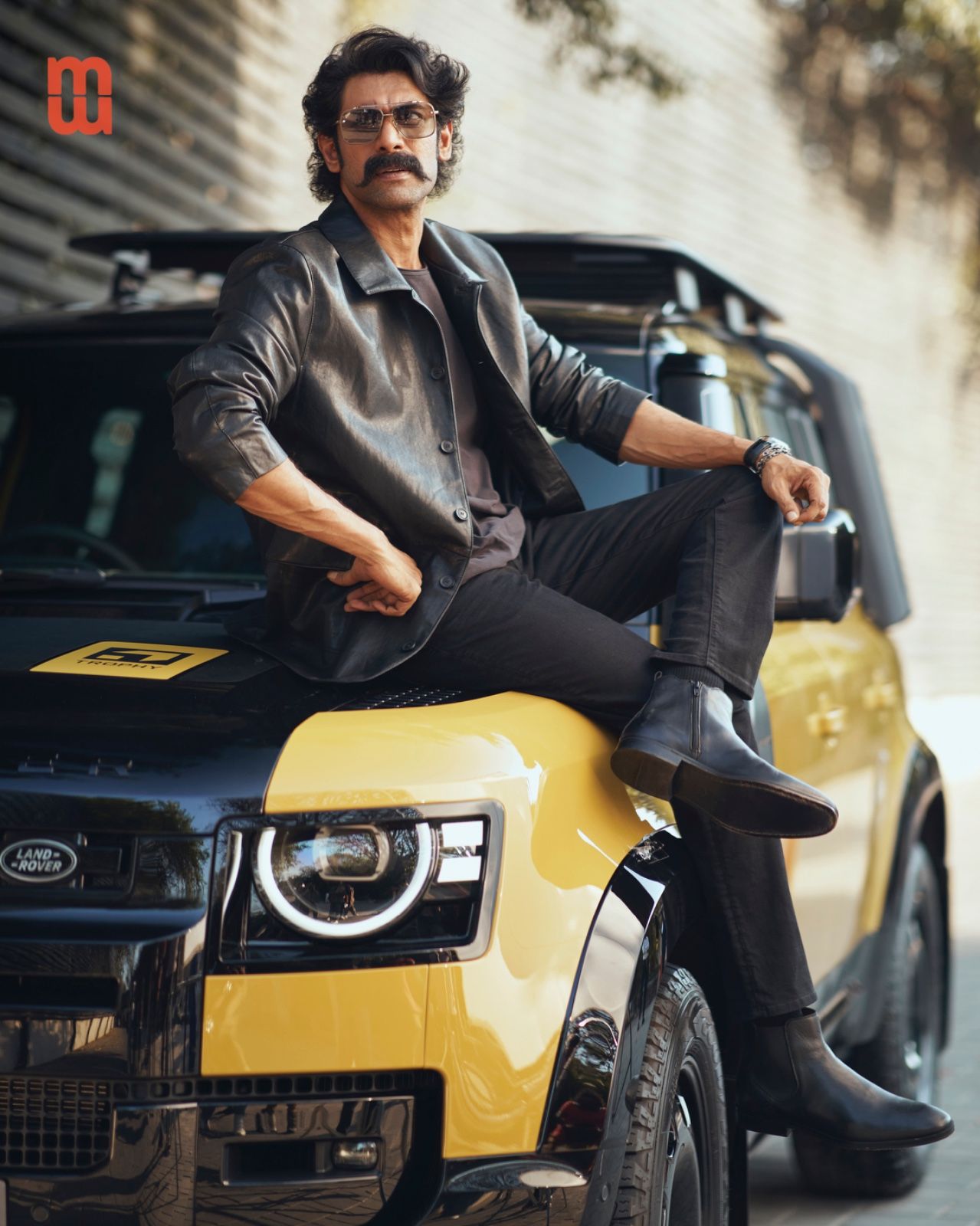
Jewellery: VRK by Khanna Jewels
You were part of the recent AI summit. According to you, what role will AI play in the cinema of future? Many are scared that AI will kill creativity.
I have been deeply involved in this for the last three years. It will become an efficiency tool—if an action film now takes 60 to 100 days to finish, with the help of AI I might be able to wrap it up in 30 days. There are pieces of cinema that it will accelerate. It can churn out details very fast which will make the pre-production research easier, quicker, and more thorough. It can bring down the pre-production time from three to four months to about 30 to 50 days. AI is already being used quite extensively in the post-production phase, especially while working with visual effects. Just as when Internet first came, it made things faster, AI will bring a bunch of products that will make our life faster. It will kill any job that is repetitive. AI can replicate things. It can do data scratching. But it will never manage to kill the creative process; creativity is not repetitive. The thing about cinema is if you like one film of mine, I can't make the same film again for you. It will not work. Anything to do with storytelling always is led from a personal space and a place of trauma. And tech can’t recreate trauma…or for that matter, emotions. Storytelling needs a human touch and that is something AI can’t replicate, yet.
CREDITS:
Photographed by: Ishan Giri
Stylist: Harmann Kaur
Makeup: Vijay Dhamne
Hair: Sakib (Aalim Hakim)
Manager: Vijay Chaganti
Styling Team: Pooja Karanam, Handy Pasweth, Ann Bhardwaj, Keshav B N
Location: Taj Krishna, Hyderabad


