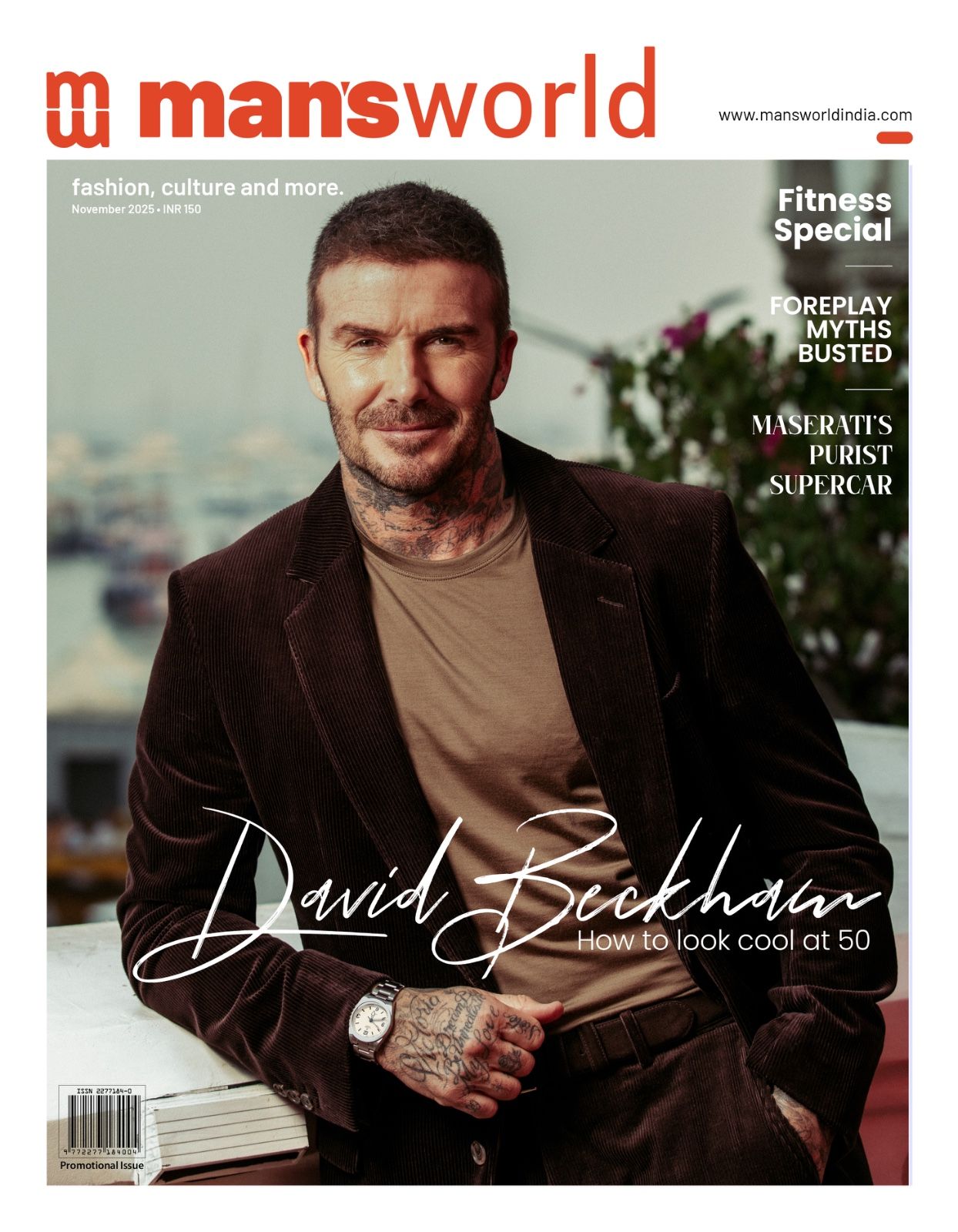
Two decades of watching football will teach you something about constancy—or rather, the absence of it. Players rise and fade. Clubs reinvent themselves or collapse under the weight of their own mythology. Managers are hired to save seasons and sacked before they can finish them. In twenty years, I have watched more than a thousand games, tracked perhaps a hundred world-class athletes, and witnessed only a handful earn the word legend without irony. Through all of it, one figure has remained: not always at the centre, but never entirely absent. Always, somehow, proximate to the story.
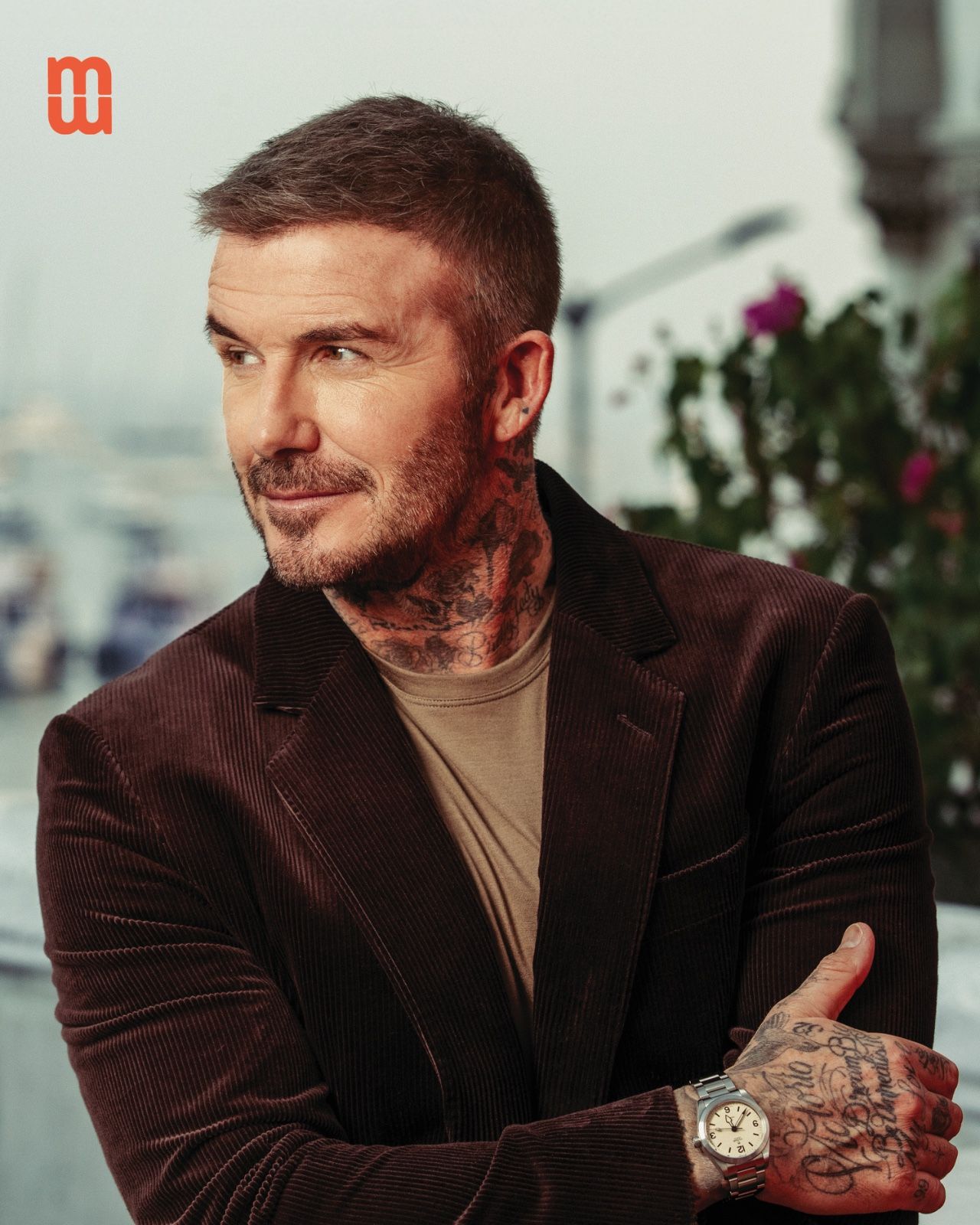
On the wrist: Tudor Ranger 'Dune White'
David Beckham was there when Manchester United completed the treble in 1999, his corners delivering both goals in that delirious Barcelona final. He was there in 2001, curling England into the World Cup with a free kick that felt like physics being politely overruled. He was there when Real Madrid assembled the Galácticos, when LA Galaxy gambled on soccer as an American spectacle, when Inter Miami—his club, built from a contract clause negotiated eighteen years earlier—signed Lionel Messi and shifted the centre of gravity of the sport once again. But Beckham stretches beyond the pitch: wearing a sarong to a party and generating more columns than cabinet reshuffles, pioneering footballer-as-brand when the concept was still nascent, posing alongside Victoria on magazine covers that redefined what a sporting marriage could look like. He has always been relevant.
However, when the email arrived—an invitation to meet him in Mumbai, where Tudor was hosting its first Indian event with their global ambassador, I felt the strange numbness that descends when something you've imagined too many times finally becomes real. The moment stayed abstract until I walked into the venue and saw that silhouette, I had watched through screens for half my life, sharper in a suit than any photograph, turning toward the room with a smile unburdened by the weight of being David Beckham.
"It is my second visit here in India," he told the assembled press at the Taj Mahal Palace in November 2025. "I was here two years back—I spent some time in Gujarat and a few days here in Mumbai. It's great to be back."
That first visit, in November 2023, had come through UNICEF—four days across Gujarat and Mumbai. In Banaskantha district, he met Rinku Pravibhai, a twenty-one-year-old who had escaped child marriage through a UNICEF-supported girls' group and now studied nursing. Days later, at Wankhede Stadium for the India versus New Zealand World Cup semi-final, he watched Virat Kohli score his 50th ODI century, breaking Sachin Tendulkar's record. The photograph that circulated afterward—Beckham and Kohli playing football together on the pitch before the match—captured how Beckham moves through the world: disarmingly present in moments that could easily become transactional.
Shah Rukh Khan hosted him for dinner at Mannat. "The only thing that outdoes Beckham's football," Khan wrote on X, "is his kindness and his gentle nature." It is a sentiment echoed by almost everyone who has spent time with him off-camera—this sense that the public persona and the private man have, over three decades, quietly merged into something coherent.
The Architecture Of Redemption
To understand why that coherence feels remarkable, you have to return to Saint-Étienne, 1998. David Beckham was twenty-three, and everything he had built was about to collapse.
The World Cup red card against Argentina—a petulant flick at Diego Simeone that earned him dismissal and, in the minds of millions, responsibility for England's elimination—transformed him from rising star to national pariah overnight. Effigies were hung outside pubs. Death threats targeted his infant son Brooklyn. Old Trafford's receptionist Kath Phipps later revealed she received envelopes containing bullets. Victoria Beckham, in the Netflix documentary, Beckham (2023) described her husband during that period as "absolutely clinically depressed" and "broken." Beckham himself said: "I wasn't eating, I wasn't sleeping, I was a mess... The whole country hated me."
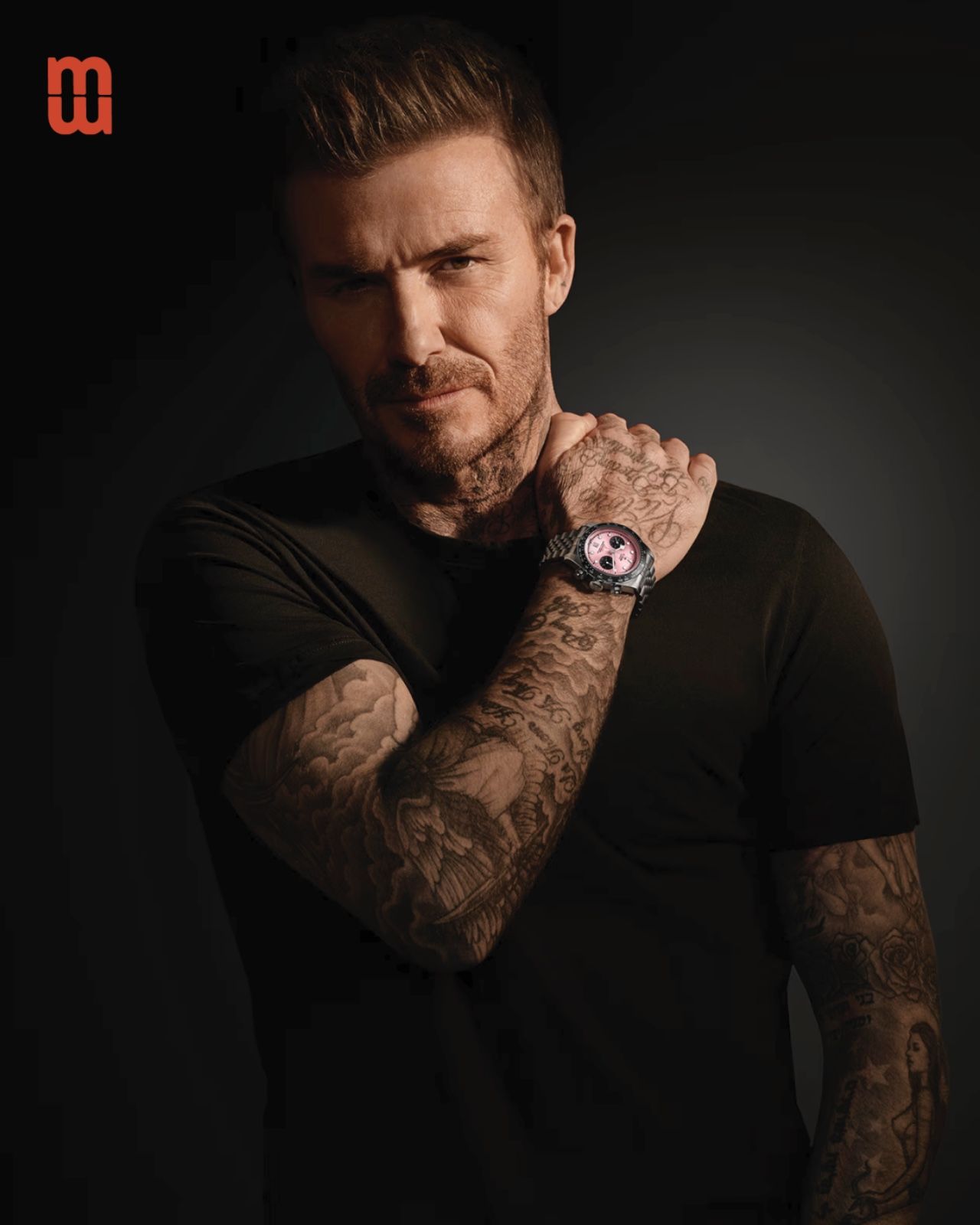
On the wrist: Tudor Black Bay Chrono 'Pink'
What followed was not rehabilitation through apology but redemption through obsession. The methodology had been established years earlier, in countless hours alone on training pitches after teammates had gone home.
That relentlessness became weaponised in the 1998-99 season. Nine goals and seventeen assists across fifty-five appearances. Eight assists in ten Champions League games. But the defining image came at Camp Nou in the Champions League final against Bayern Munich. With Roy Keane and Paul Scholes suspended, Beckham was pressed into central midfield. Bayern led 1-0 until injury time. Both winning goals—Teddy Sheringham's in the 91st minute, Ole Gunnar Solskjær's in the 93rd—came from Beckham's corners. He finished second in the Ballon d'Or, but the real prize was bigger: the first step back from the abyss.
The apotheosis arrived on October 6, 2001, at Old Trafford. England needed a result against Greece to qualify for the 2002 World Cup. Trailing 2-1 in the 93rd minute, Beckham had already failed with five long-range free kicks earlier in the match. From thirty-two yards, he curled an unstoppable strike over the wall into the top corner. He won the BBC Sports Personality of the Year. More importantly, he had completed the longest redemption arc in English football.
The Aesthetics Of Restraint
Beckham's style transformation too is a metamorphosis so complete, it's easy to forget the man who now embodies quiet luxury once stopped traffic in a sarong.
June 1998. The World Cup in France. The 23-year-old David Beckham strolled through the spotlight with a Jean Paul Gaultier sarong wrapped over his jeans—an outfit the tabloids immediately derided as a "Posh skirt.” The ridicule was instantaneous and merciless. But Beckham wasn't apologising. He never would. Beckham in those days treated fashion like a combat sport. Every hairstyle and ensemble was a bold declaration from a young man who wielded his looks with fearless confidence.
But the sarong was merely the opening salvo. Just one year later, the Beckhams arrived at a Versace party in matching head-to-toe black leather—an outfit so aggressively shiny, so defiantly tight in a baggy era, that even they now laugh about it. But there was something defiant in the gesture. He was pushing the boundaries of what a male athlete could wear, showing a generation of men that style could be brazen and playful rather than staid. The center-parted "curtains" that framed his face as a Manchester United starlet became a generational signifier. Barbers everywhere fielded requests for "the Beckham." He'd gel it into blond streaks, push it across his face, tuck it behind his ears—impractical for a football pitch, perhaps, but undeniably iconic. Then, in 1999, he sheared it all off. The bleached buzz cut was arguably the only time in British history a haircut made front-page news.The effect was seismic, kicking off what FashionBeans.com called "a mass emancipation from hairy heads everywhere." Men who'd never dreamt of a crewcut felt liberated by Beckham's example.
The experimentation only escalated. The mohawk of 2002 wasso audacious that Ferguson spotted the punkish spikes under a beanie before a match and promptly ordered him to shave it off on the spot. Beckham dutifully found clippers and buzzed it off. But Beckham would unveil the mohawk later that year for England anyway, helping drag a once-"unhinged" hairstyle into the mainstream.
And then there were the cornrows—a decision Beckham has admitted regretting, given the importance of the occasion. The braids adorned his head when he flew to South Africa to meet Nelson Mandela. "People ask if I have any regrets about my hairstyles," he later reflected on The Graham Norton Show in 2015, "and while I don't regret any of them, I do sort of regret the cornrows. The picture that I've got of Nelson Mandela is of me holding his hand with cornrows in my hair. That's my only regret."
Somewhere between the mohawk Ferguson ordered him to shave and the sharp Don Draper side-part of the recent past, Beckham underwent a subtle reinvention, deserving attention rather than demanding it. "Gone are the days where I'd be too daring," he reflected in Tudor’s Mumbai showcase, acknowledging his fashion approach has mellowed. "Fashion trends happen naturally," he explained. "I don't push any particular fashion look. I like what I am wearing, and I cut my hair the way I want to."
Then, with the ease of a man who has nothing left to prove, he says, "I do take advice from my wife, since I've been married to her for 27 years."
The admission is telling because the younger Beckham in the sarong and leather would have bristled at admitting he needed spousal counsel. But the man at fifty wears it as a badge of wisdom and partnership.
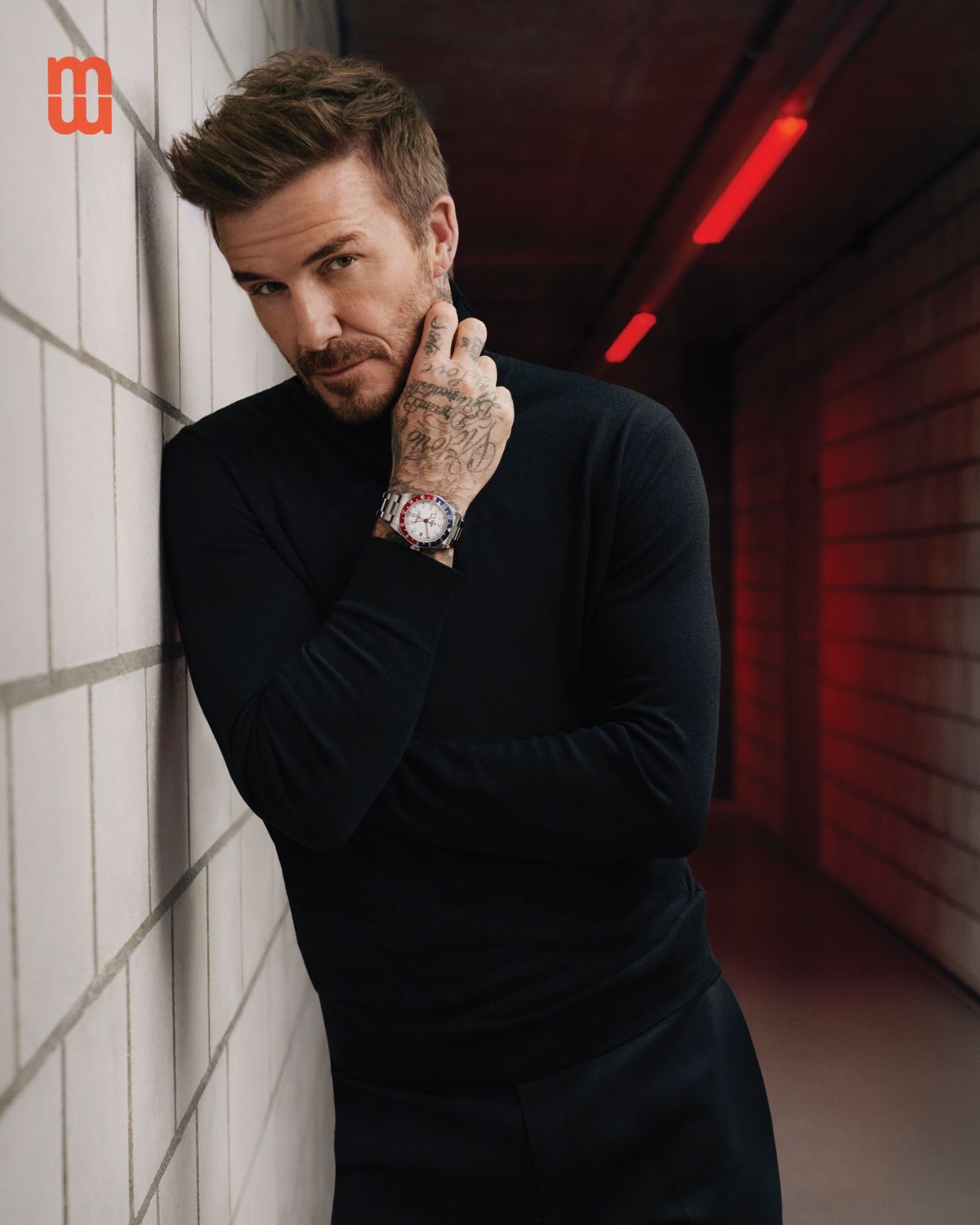
On the wrist: Tudor Black Bay GMT
This maturity finds its perfect material expression in his eight-year partnership with Tudor. Since 2017, Beckham has served as global ambassador for the Swiss watchmaker, and the relationship has been symbiotic—Tudor's "Born to Dare" ethos dovetailing with Beckham's persona, but with emphasis on heritage over flash.
When asked at a launch event to name his favorite Tudor model, Beckham hesitated. "Do I have to choose one?" he laughed. Pressed, he named the Tudor Ranger he was wearing: a simple steel tool watch with vintage roots. "It's the perfect, elegant watch," he noted, "special because of its history and heritage". The choice is instructive. Not the flashiest model, not the most expensive. Perfect. Elegant. Special for what it carries, not what it costs.
For his 50th birthday, Tudor created a one-of-one Black Bay Chrono encrusted with diamonds. Beckham debuted it at Wimbledon, where it glittered under summer sun, and watch aficionados immediately took note. Unique commissioned watches are rare from Tudor's parent company Rolex, making this gesture historically noteworthy. It was one institution tipping its hat to another.
And then, perhaps the most unexpected dare of all: the 2024 BOSS campaign that saw Beckham, at fifty, return to underwear modeling. The black-and-white shots—Calvin Klein-esque, Beckham in boxer briefs—went instantly viral. "They were nervous about asking me to get back in my underwear at fifty years old," he quipped to a British fashion magazine earlier this year, amused anyone might think he'd be offended. Far from it. "Really? I'm almost 50… Give me 14 weeks," he told them, per a British men’s lifestyle magazine. For 14 weeks he cut carbs, hit the gym daily, outworked men half his age.
Esquire UK dubbed him "the king of menswear" who "cracked open men's style in a way few celebs have in the last 30 years." The coronation showed an entire generation that masculinity could embrace fashion without losing strength—that a football hero could wear sarongs, neon boots, diamond earrings, matching leather, and still score from 30 yards out.
The Substance Beyond The Style
September 2022. A queue snaking through London in the small hours. Somewhere in that thirteen-hour procession of ordinary Britons waiting to pay their last respect to late Queen Elizabeth II stood David Beckham—cap pulled low, no entourage, declining the MP's offer to skip ahead. He shuffled through the night like everyone elsevisibly moved when he finally bowed before the coffin. No cameras summoned. No publicist orchestrating the moment. Just a man showing up, completely, without shortcuts, and not a celebrity.
"Today has been such an emotional day," he reflected, speaking to The Standard, after the ceremony, invoking his East London upbringing. For a boy raised by a gas-fitter father and a hairdresser mother who taught him patriotism and hard work, the moment was "truly humbling."
If humility has been one constant, the other is an ambitious drive that has built a business empire as well-tailored as his suits. DRJB Holdings Ltd more than doubled its net profit to $36.2 million in 2023, climbing further to $44.9 million in 2024. The portfolio spans fragrances, grooming products, eyewear, sports teams. He launched one of celebrity culture's first fragrance lines in the early 2000s, inked a major eyewear deal with Italy's Safilo Group, co-designed fashion collections with Hugo Boss, and co-founded IM8, a nutritional supplement venture, in 2024.
Most notably, Inter Miami CF, the Major League Soccer club he helped found in 2018. What began as a $25 million expansion fee—a perk from his playing contract—became an astonishing investment. By 2023, before Lionel Messi's arrival was even rumored, Inter Miami was valued around $600 million. After Messi signed, that valuation approached $1 billion. A 4,000 per cent return, though the numbers tell only part of the story.
In 2022, Authentic Brands Group acquired a stake in his company, valuing brand Beckham at an estimated half-billion pounds. Yet he insists accumulation has never been the animating force. "To me, charity work is the most important," he told the audience at Tudor’s showcase in Mumbai. At seventeen, touring Thailand with Manchester United, Beckham visited a UNICEF children's center. He describes the experience as life-changing. He became a UNICEF Goodwill Ambassador in 2005 and launched 7: The David Beckham UNICEF Fund a decade later. Through the fund, he's worked to combat child marriage, violence, and illness, directly impacting over a million children across Nepal, Indonesia, El Salvador, and Djibouti. In 2013, during his stint at Paris Saint-Germain, he donated his entire salary to a local children's charity. In January 2025, at the World Economic Forum in Davos, he accepted the Crystal Award honouring two decades of humanitarian work.
When King Charles III annointed him Sir David at Windsor Castle in November 2025, it came after years of delays. But in the end, the honour arrived, officially "for services to sport and charity," sealing Beckham's transition from enfant terrible of nineties football to elder statesman of British public life.
This ethos—earning visibility to deploy it for good—is explored in Beckham, the four-part Netflix documentary that became a cultural phenomenon in late 2023. The series drew over 24 million viewers in its first two weeks and earned five Emmy nominations, but its real achievement was narrative restraint. It allowed Beckham and his family to confront the costs of living under a spotlight that has sometimes burned them, without exploiting the pain for entertainment.
In one segment, the documentary addresses the tabloid-fueled allegations of an affair in 2004 that nearly ended their marriage. Beckham doesn't divulge details. In fact, he pointedly refuses to. But he admits, "I don't know how we got through it in all honesty." Victoria adds that "it felt like the world was against us… and we were against each other." The couple's restrained, pained recollections—acknowledging the darkest period without sensationalising it reflected a sense of authenticity that their glossy narrative had very real cracks.
One moment went viral immediately: Victoria reminiscing on camera that both she and David came from "working-class" families. David playfully pokes his head through the door: "Be honest." After a sheepish pause, Victoria concedes with a laugh: "Okay, in the '80s my dad had a Rolls-Royce." That affectionate ribbing became a meme, encapsulating the Beckhams' dynamic after 27 years together.
The Domestic Soul Of A Superstar
In his post-playing years, Beckham discovered a quieter rhythm at his rural estate in the Cotswolds. On weekends in the English countryside, you're likely to find Sir David in a flat cap and wellies, tending beehives he built with his sons or manning a massive barbecue by the lake. The pandemic hobby of harvesting honey evolved into BEEUP, a line of honey-based fruit snacks he co-founded in 2025.
His outdoor kitchen in Oxfordshire is chef's-quality—a £50,000 safari-style setup designed by his friend Guy Ritchie, complete with hardwood floors, retractable canvas tent, and a twelve-seat table. Every Saturday, Beckham indulges in an almost meditative ritual there.
His culinary devotion is rooted in nostalgia: his favorite dish remains the humble plate of liver and bacon with creamy mashed potatoes and gravy his mother Sandra cooked during his childhood. Despite access to the finest restaurants globally, he'd still choose a quiet Sunday roast with his kids over any Michelin-starred experience.
If there's one domain where Beckham has always been unabashedly himself, it's on the home front. Once described as "the paragon of the 21st-century dad," by The Father Hood magazine, he wears fatherhood more comfortably than fashion. His four children—Brooklyn, Romeo, Cruz, and Harper—are the centre of his universe, and he makes no attempt to hide it. "My children are my motivation," he said to the same publication. A scroll through his social media reveals him proudly posing next to a Lego castle he assembled until 1 am or reduced to happy tears as Brooklyn surprises him on his birthday after flying home secretly. On Father's Day 2025, he shared throwback photos alongside his tribute: "My most important and favourite job in life is being a dad. I'm so proud of all of you and like daddy (sorry boys) tells you every single day I will always be here for you no matter what."
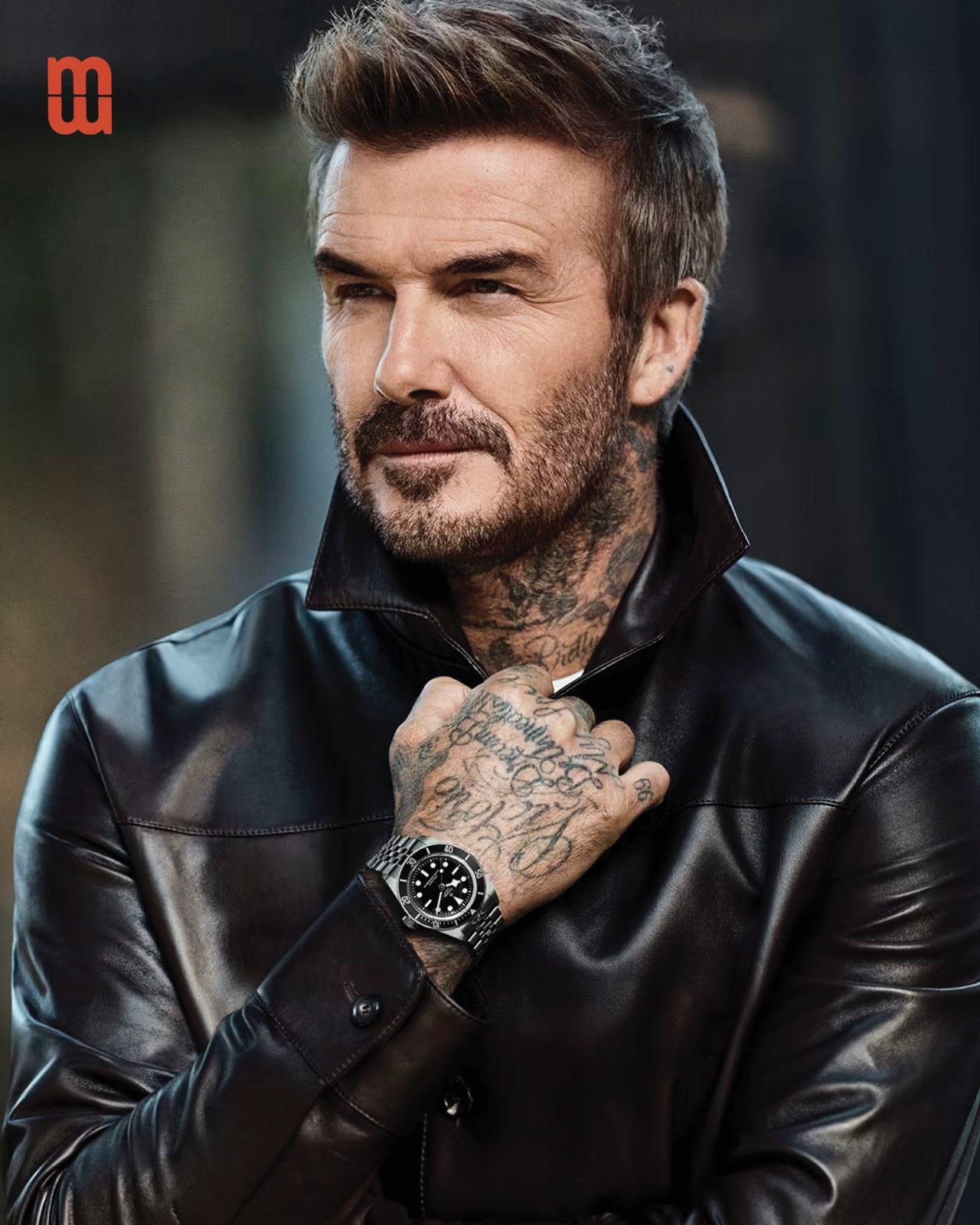
On the wrist: Tudor Black Bay
His Instagram reveals a father who makes heart-shaped salads for Harper's school lunches (posting with gentle concern that she might find the gesture embarrassing now that she's fourteen), who takes Harper to Miami Heat games and excitedly posts photos with rapper Central Cee, and who lets his daughter practice makeup on him—proudly sharing the results. When Harper filmed beauty tutorials for Victoria's makeup line, David reshared them with the simple caption: "It's called a beauty video for a reason," adding a pink heart emoji.
Ultimately, the substance beneath Beckham's style is defined by these choices. For all the tattoos, tailored suits, and magazine covers, Beckham's core appeal has always been authentic relatability—the sense that the superstar who bent free kicks like no other is, at heart, a down-to-earth East End lad who never forgot where he came from. Now, with a knighthood, a thriving enterprise, and a happy brood around the dinner table, Beckham's journey demonstrates that character is indeed destiny.


