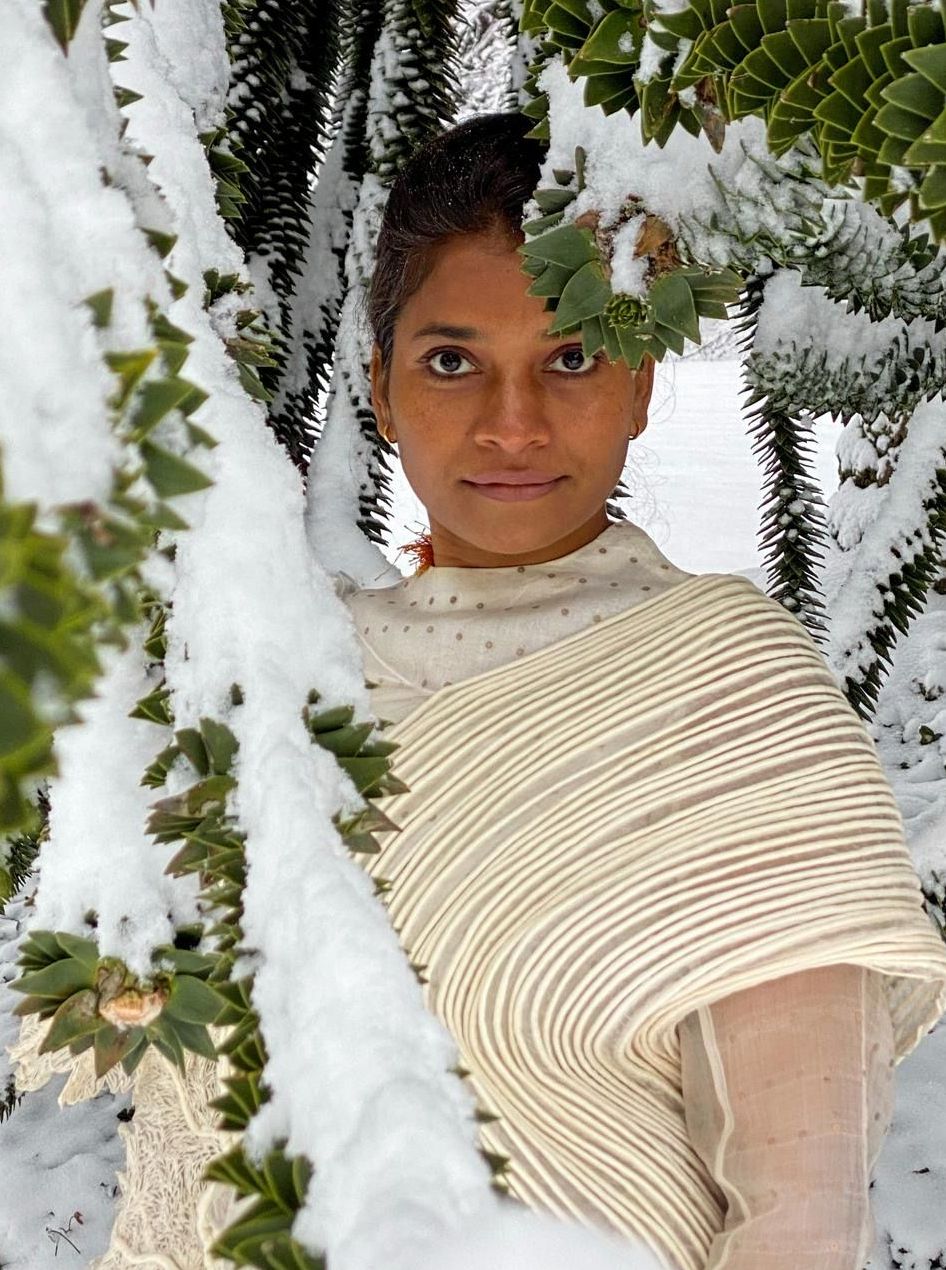
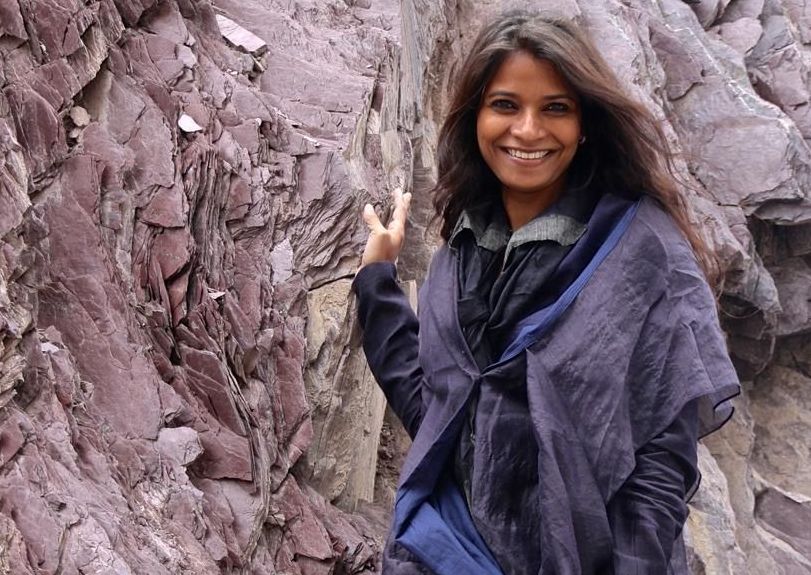
For Vaishali S, fashion has never been about speed or spectacle—it has always been about feeling, process and purpose. As her label celebrates its 25th anniversary, the designer looks back at a journey shaped by handwoven textiles, while stepping forward into a new phase with menswear. Growing up near Chanderi, early memories of watching looms being set up stayed with her, quietly shaping a design philosophy that would later challenge how luxury is defined in her mind.
This milestone year was celebrated with two evocative showcases—one staged on the historic steps of Asiatic Library, just minutes from her atelier, and another at the Italian Embassy—each echoing her belief that craft deserves architectural reverence. Built around handwoven fabrics, village-based artisans and zero-waste draping techniques, the Vaishali S label has stayed committed to sustainability long before it became a fashion buzzword.
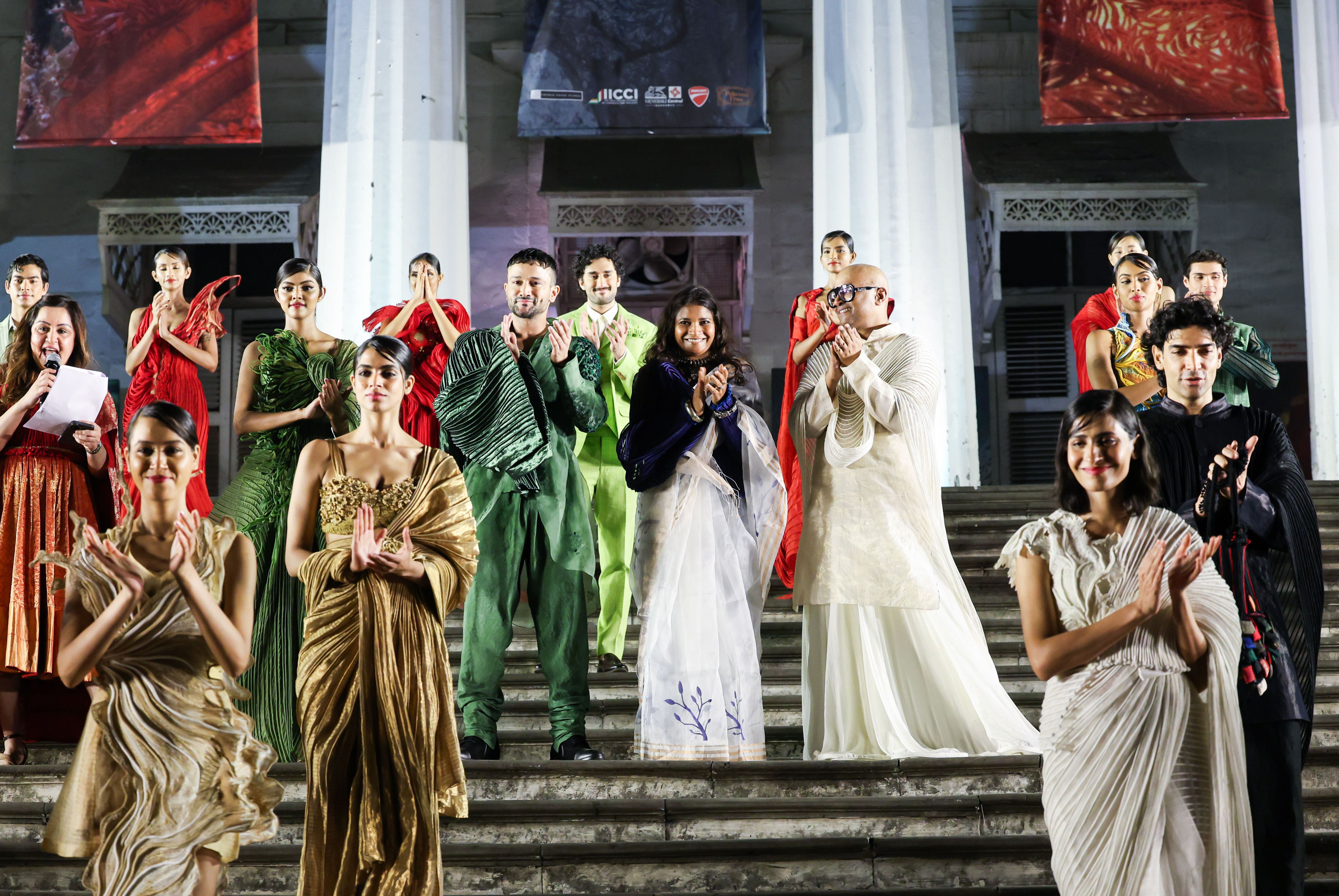
On the global stage, her achievements are just as distinctive. As the only Indian woman to showcase at Paris Haute Couture Week, she has brought Indian handloom into the world of couture, presenting it as modern, refined and deeply relevant today. With menswear now entering her design world, Vaishali S continues to evolve—slowly, thoughtfully and always rooted in craft. We spoke to her during her brief stopover in Mumbai, and here's how the conversation went:
Interview With Vaishali S
Q. Congratulations on your silver jubilee! 25 years ago, you decided to support handloom and hand-woven textiles and never looked back. What made you so passionate about this cause when you were a young designer making their way from Bhopal to Mumbai?
Vaishali S: I come from a very small town close to Chanderi. I remember, once I went with my mother to buy saris and there, I was struck at the ability and complexity of starting a loom… tying thousands of threads to the loom before even starting it, and then managing them almost without even looking.
It was only several years later, after running away from home to finish my engineering, that I stumbled upon a friend in Bhopal who was studying the unheard-to-me stream of fashion. That’s when I put one plus one together and the fire started, realising how those beautiful fabrics could make the difference to fashion, and how fashion could make those fabrics larger than only being sari fabrics.
Q. When you began, handloom textiles were seen as more traditional than luxury. What made you realise that the world could see it differently?
VS: In a way, they are still considered as traditional… at least in India. That is why I’ve almost been considered an outlier. I immediately fell in a sort of emotional alignment with hand-woven fabrics; I feel that them being made by hand means that they also carry feelings. Fashion, for me, has always been more of an expression of my feelings, my clothes were and still are the best canvas of expression. Luxury is something that needs to be a different experience, which feels bespoke and unique. So, I thought they could really become the future of luxury, which is what is happening: there is no hand-woven fabric that can be perfectly replicated.
Q. How did being an engineer academically help shape your journey in fashion and luxury?
VS: I think that starting as an engineer, in fact, helped me to have a fashion free mind and soul. I did my postgraduate and subsequent masters (degree) only several years after my brand had launched, and they were critical in giving me extra tools, while the creativity had come out by itself, totally wild.
Probably my engineering helped me to fall in love with the Indian draping and its possibility of being zero waste. I have always been amazed at the shapes that you can give by draping the traditional Indian way, and even today, it's still part of my process in the creation of the final garment.
Q. Which has been your favourite collection to date and why?
VS: Each collection I make is my favourite. As I said, they are my way of expressing the inner and professional path I am on, which is a seamless self-discovery. That is why, at the end of each collection, I feel like I reach a new stage of evolution. And that is why, the very moment I release it, I am crazily already thinking about the next one!
Q. Your pieces feel less like clothing and more like handwoven heirlooms. How do you preserve slowness and intention in today’s fast-paced environment?
VS: I don’t disturb the process at all. My weavers still all live in their villages and homes. The creation and building of the garments are also still all done by draping, which itself has a sense of slowness and peace. This is the reason why you feel a different pace when you see and wear my garments and hand-woven fabrics do transmit feelings. And that is why I give transparency to my process through my QR scanning technique that gives visibility to all the phases of the garment and thread.
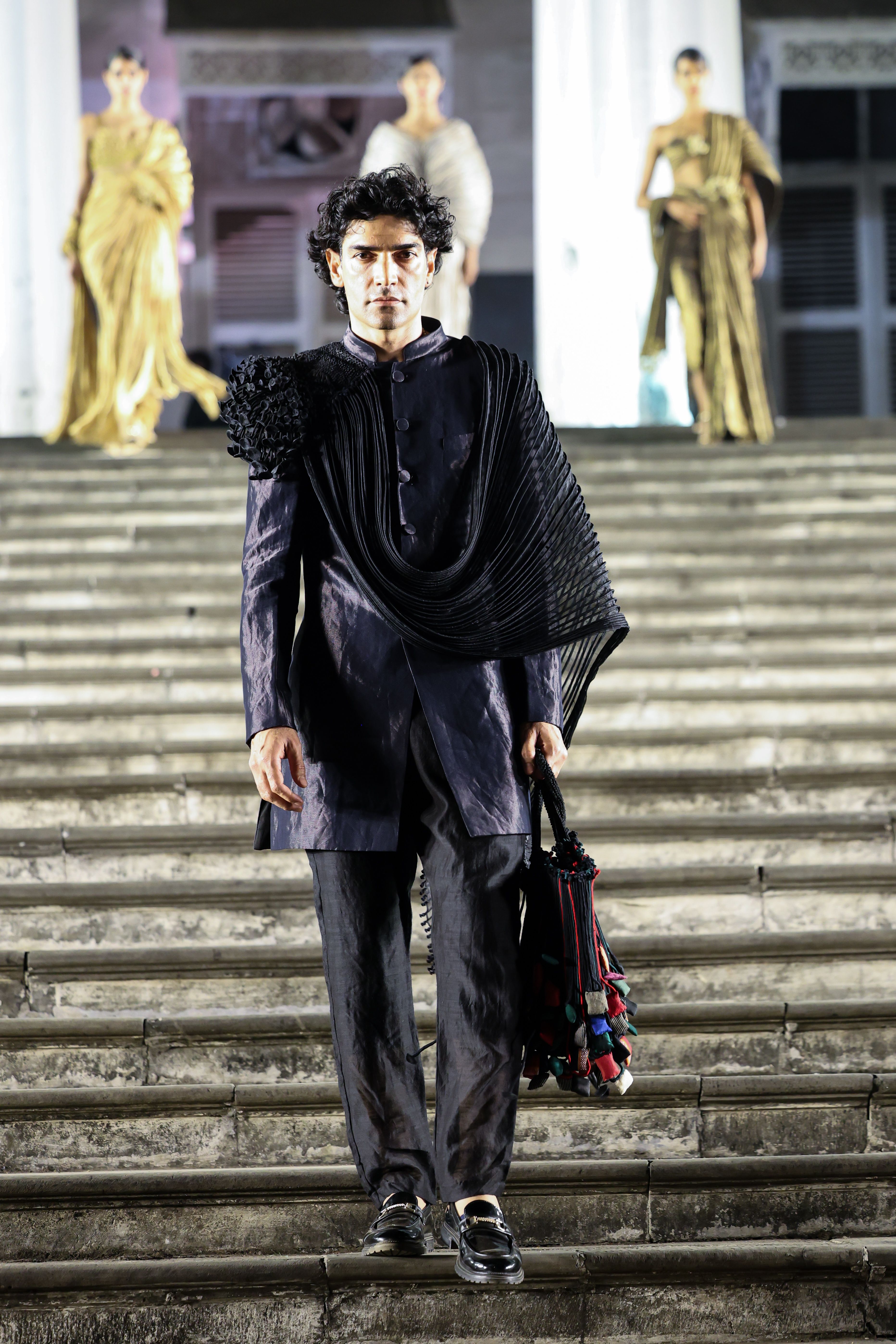
Q. Your brand strongly believes in sustainability and follows zero-waste practices Can you give us an example of how you followed through on those principles for your new rare underwater series?
VS: It is much more than belief–my brand was born out of sustainability and zero-waste, which ultimately is the village way of life that I have always followed. My brand has also always been inspired only by nature, and so is the new underwater series.
It all happened when I first went to swim in the ocean and immediately decided I wanted to do my diving certification. The moment I put my head under water I. discovered a magical world I had never even dreamt of. Once I was back in Mumbai, it took me only one week to put down the whole concept of the collection and it was actually difficult to limit the styles, for the many ideas that this generated in me.
Some time later, when back in the ocean, we thought to try and bring one garment underwater and see how it looked. The result was astonishing, with fish of all sorts and even shrimps landing on the garments, as if it had real corals and underwater elements. That is when we spent two weeks bringing down several garments and entertaining all sorts of fish, including two sharks that wouldn’t leave us alone!
Q. You presented this new collection in Mumbai at the iconic Asiatic library and it's a homecoming for you of sorts, considering you started your label in Mumbai first. What are some big changes you see in buyers and purchase patterns now vs then?
VS: Yes, Mumbai is the city that has given me everything and the Asiatic Library is a 3-minute walk from my store and on the way to my atelier. Today, people are starting to dare more. They want to be unique and they are attracted to colours. Even in weddings, people are being more daring with colours and moving away from the traditional ones. People also know more about fabrics and hand work, so they understand the difference of a good garment.
More and more, especially the younger generations, they care about what is behind the garment and that is why I have started to put a QR code on my labels. One can scan these and see the artisan working on the fabric and garment, as well as check out the sustainable process that is followed.
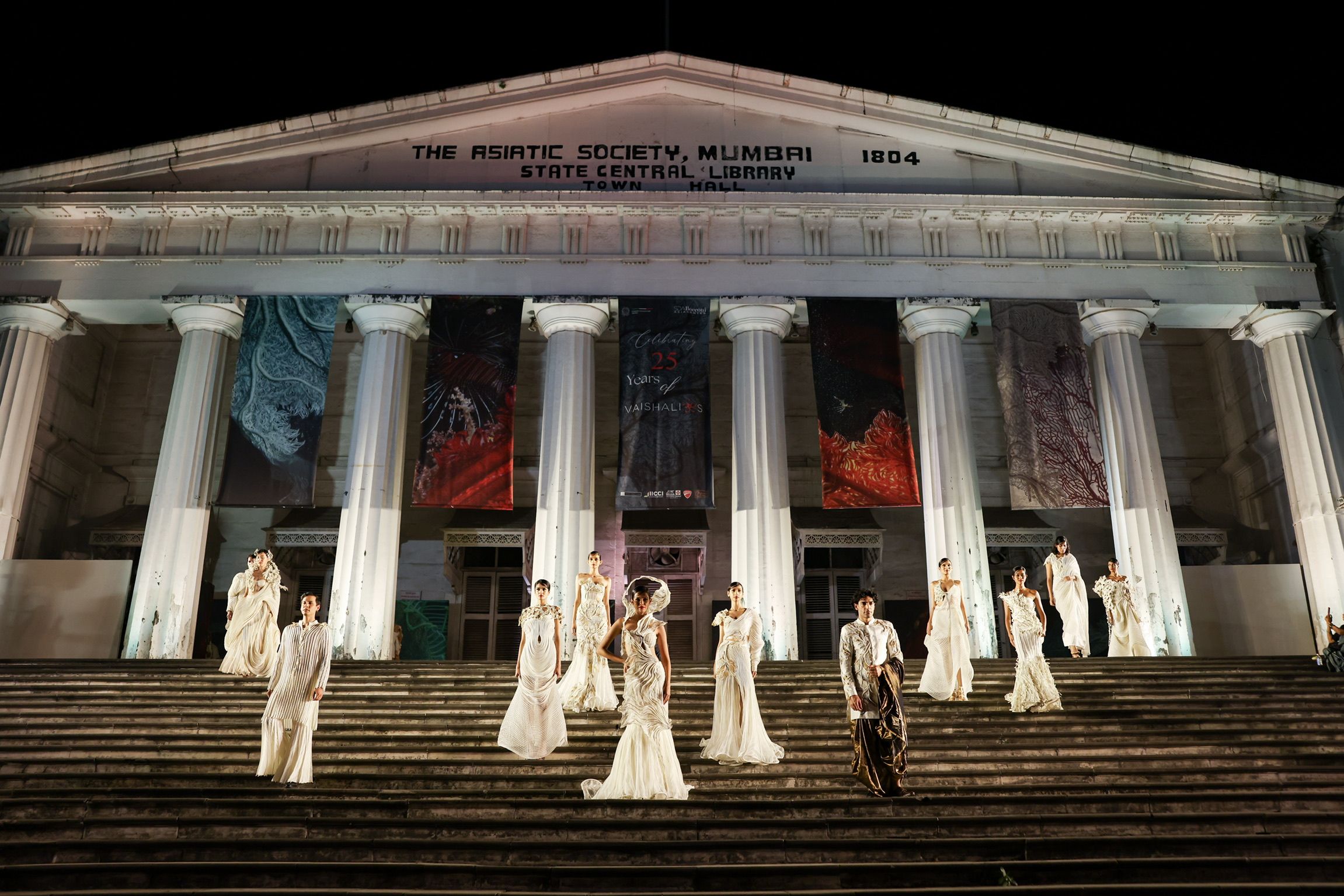
Q. How do you integrate innovation in a space rooted in heritage?
VS: You know my garments and my research of the tridimensional experience… like the cording technique I have developed helps give daring silhouettes to the otherwise very flowy hand-woven fabrics.
I also experiment a lot with fabrics. Some examples would be inserting metal threads in my weaving, or changing the weights of the looms in order to hand weave even the fragile pashmina, or searching only for sustainable silk and how to weave it nicely. It is constant research to stay ahead.
Q. You’re a first of many–first Indian woman to showcase at Paris Haute Couture Week, first Indian woman to be a part of the Milan Fashion Week and the first to be inculcated into the Inner Sanctum of the top 30 designers in the world. What does this extraordinary legacy mean to you?
VS: It means a lot because this has also meant positioning our Indian hand-woven textiles in this unreachable Sanctum. It was the core of my mission, so for me, it is a sort of huge accomplishment. But I am not stopping there. I have also opened a store there, in Boulevard Saint Germain! And I will keep going on. I think it is also very important as a woman, and I see the kind of respect and emotions that young women across India show to me when traveling.
Q. And to that end, how do you maintain the authenticity of indigenous textile craft while presenting it to global high-fashion audiences accustomed to spectacle?
VS: My garments will always have the traditional hand-woven fabrics of India, with garments made by draping in the traditional Indian way. This doesn’t mean they will not be glamorous, tridimensional and even aspirational. Thanks to small innovations, silhouettes and details, they’re enough to appeal to the global audiences and the younger generations.
Q. What has been the most unexpected reaction to Indian craftsmanship on global runways? With Indian fashion getting more and more attention globally now, what’s the one thing global clientele always expects for pieces from Indian designers?
VS: If I think about me, the most unexpected and proud reaction has been from the media during my first Paris Haute Couture Week, when they reacted by saying that finally Haute Couture was back in Paris! Yes, because Haute Couture is about heritage, workmanship, innovation, sustainability and slow bespoke fashion. Isn’t that indeed the definition of Indian fashion?!
Q. You’re venturing into menswear this year, what compelled this expansion after 25 years?
VS: Everybody has been after my life for it! I needed to mature for that. It took time. And then, suddenly–as with everything for me–the time came. It is only fair that men can also find garments for them based on the Vaishali S values.
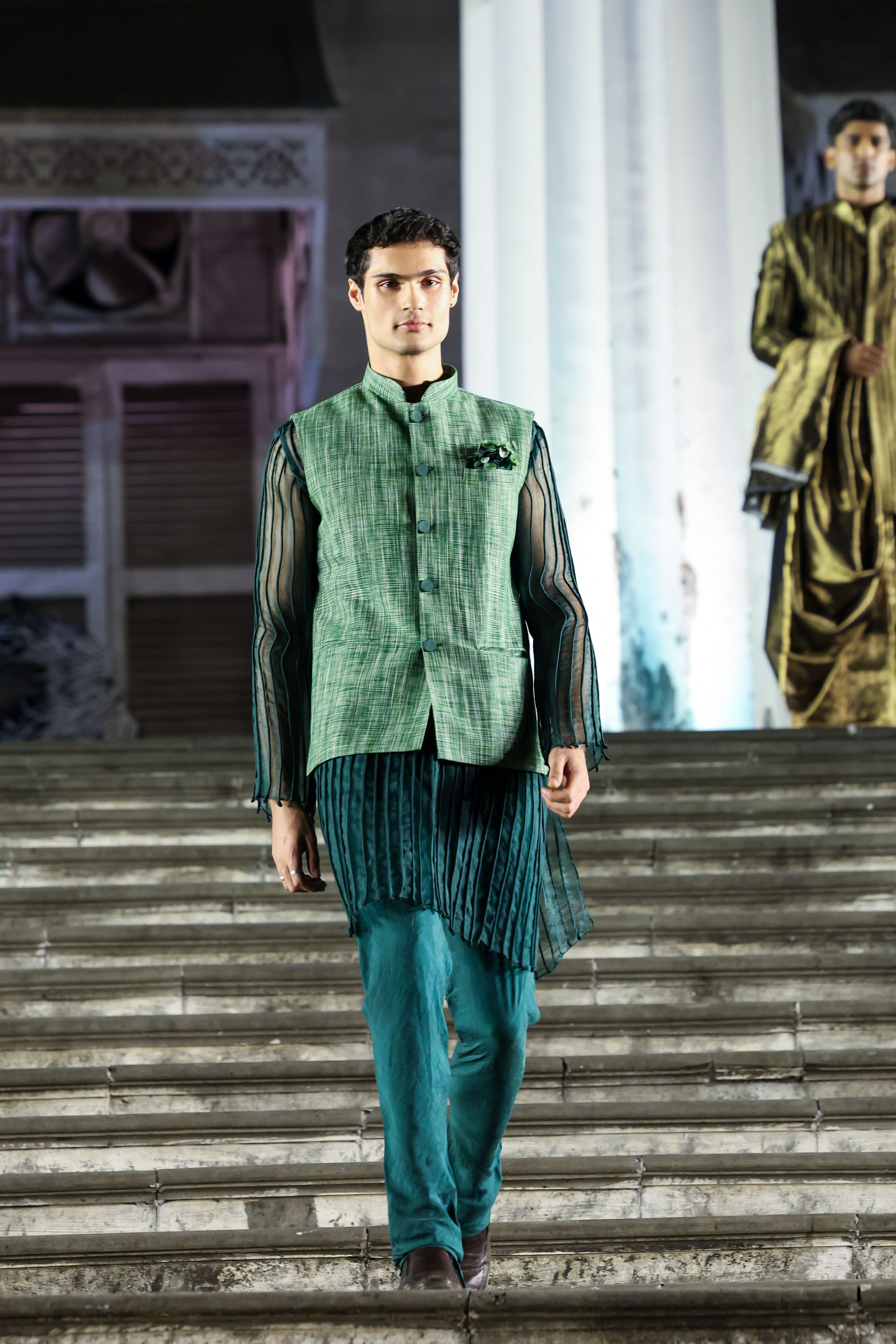
Q. Will menswear be a completely new canvas for you or would you like it to be an expansion of your current design language?
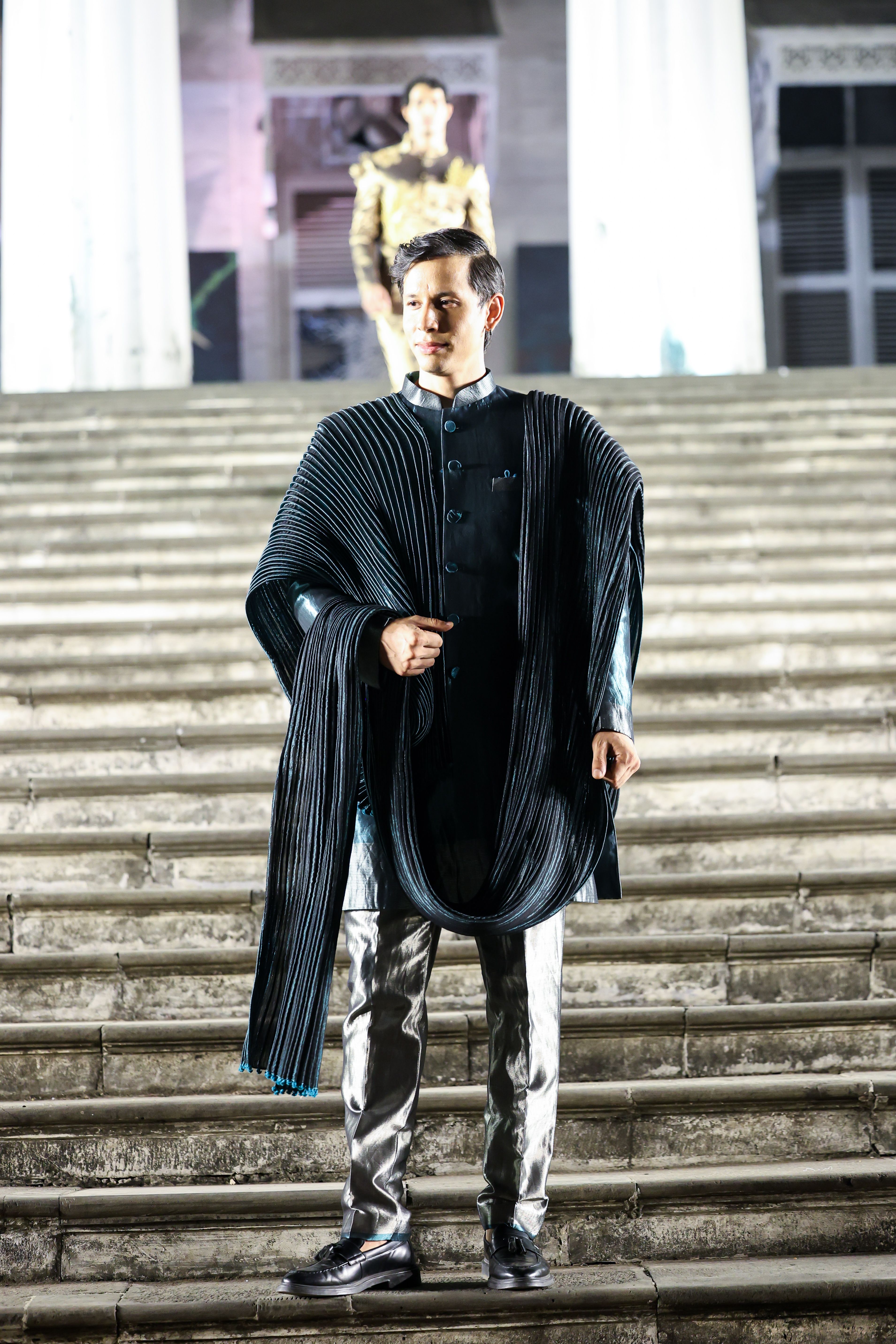
VS: It is both. It is an expansion into my way of thinking khadi: hand woven, sustainable. Because clearly, it will always be based on that.
At the same time, it is a new canvas. It is a new line with new needs, new colours. Where this path will lead, I still don’t know, as usual. But clearly, it is a path that has been opened and where my creativity will start to flow too. This first collection will be a founding one, fixing the basics of khadi and colours that I like to stress on anyway.
Q. Do you think that the menswear scene globally is ready to embrace Indian textiles and handloom art?
VS: Definitely yes. It will be niche at first, but I believe men are even more sensitive to the content behind a garment that defines them and is chosen carefully to be worn for longer.
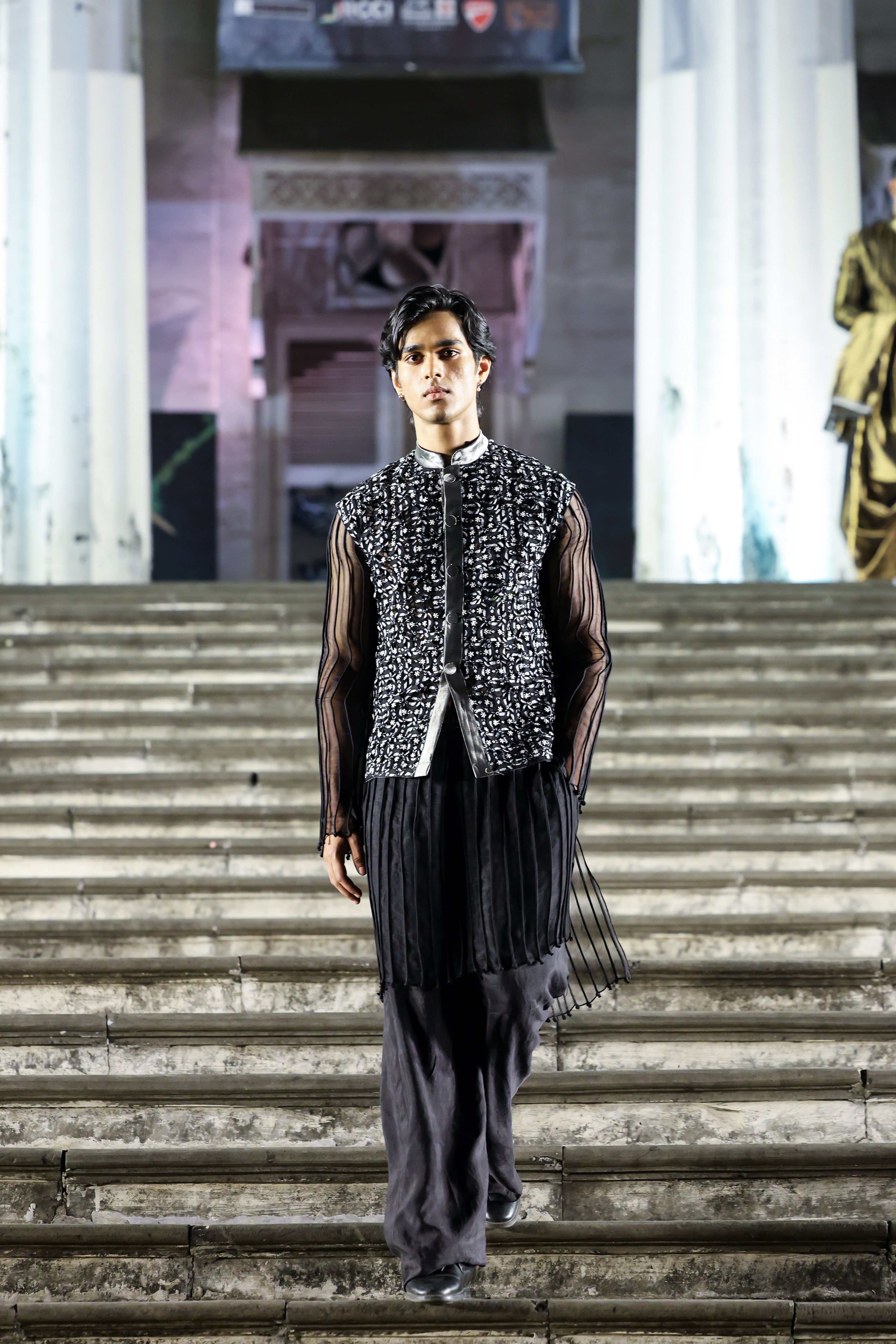
Q. What kind of men do you see wearing Vaishali S menswear?
VS: A man that is very sure of himself and doesn’t shy away from wearing colours. A man that likes to wear meaningful garments that are modern but with strong roots.


