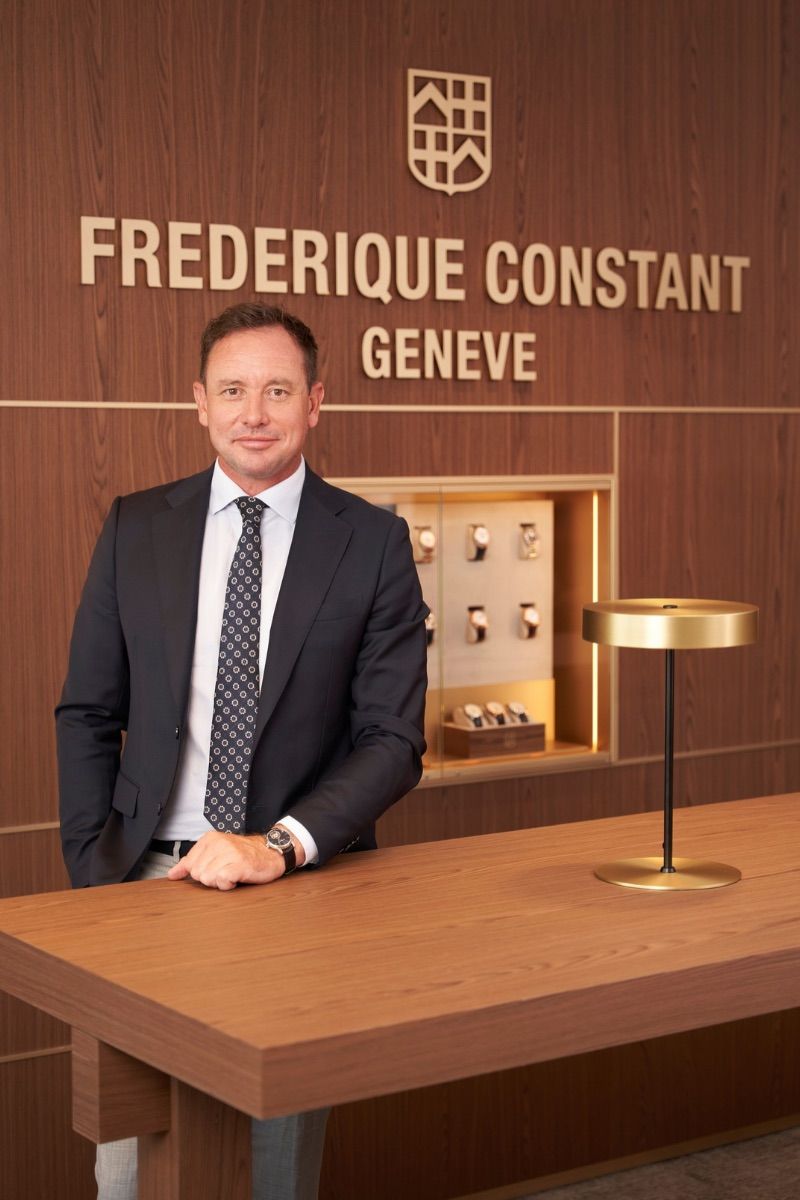
At just 38 years old, Frédérique Constant is something of a youngster in an industry where centuries-old histories are practically a prerequisite for credibility. Yet, since its founding in 1988, the Geneva-based watchmaker has carved out a distinctive position for itself, offering everything from classical moonphase watches to manufacture perpetual calendars and tourbillons at prices that frequently undercut more established competitors. Under CEO Niels Eggerding, that pursuit of accessible watchmaking has gradually evolved into something more ambitious, with greater attention to movement development, contemporary design and the expectations of an increasingly informed audience.
At Watches and Wonders 2026, the brand introduced a comprehensively updated Classic Worldtimer Manufacture, featuring a smaller 40mm case, a cleaner dial and the new FC-719 calibre with a 72-hour power reserve. The company also continued expanding its distinctive Classics Manchette collection, tapping into a growing appetite for unconventional case shapes and expressive designs. Following a particularly successful showing in Geneva, we caught up with Eggerding to discuss the decisions behind these launches, the challenges of improving established complications, and why Frédérique Constant's future depends on appealing to both first-time luxury buyers and seasoned collectors.
It's been a year since we last met, and Frédérique Constant has had a rather eventful Watches and Wonders. You've also significantly expanded your presence at the fair. How did the week go, and what was the response like?
It was very good. We had around 1,100 meetings, which is already an extremely high number. I've been attending and organising watch shows for 25 years now, and I have to say that this was the best show I've experienced in that time. We were initially a little sceptical because of everything happening globally, but the feedback was extremely positive. There are always things that can be improved, of course, but expanding our space turned out to be the right decision at the right moment. The overall mood was very positive, despite everything happening around the world.
What were your biggest takeaways from this year's fair? Did you notice any changes in the way brands and retailers were approaching the market?
What I noticed was that many brands were relatively cautious with their introductions. There were certainly some extraordinary watches, but generally speaking, brands were being more careful. I think there's a growing awareness of the importance of volume, and pricing has become extremely important. Quality matters, of course, but so does offering the right value. That's where we are particularly strong, and I believe it's one of the reasons we had such a successful show. Retailers were looking for products that combined quality with sensible pricing, and that's something we've always focused on.
The Classic Worldtimer Manufacture has been around since 2012, which is almost as long as your association with the brand. It's also one of your most recognisable watches. When you're updating something that's already successful, how do you decide what needs to change and what should remain untouched?
That's a very good question because improving a bestseller is always a dangerous exercise. We looked very carefully at feedback from our consumers. Over the past four or five years, I've become increasingly convinced that the customer needs to be central to product development. Of course, they shouldn't dictate absolutely everything you create, but their feedback has to be taken seriously.
With the Worldtimer, we analysed the criticisms of the existing model. The first concerned the dial, particularly the date display, which overlapped visually with the city disc. The second was the size. At 42mm, customers increasingly felt that the watch was too large, and many wanted something closer to 40mm. The third concerned the movement. Today, people expect a mechanical watch to offer at least 60 hours of power reserve. You want to be able to put your dress watch away for the weekend, wear something sportier, and pick it up again on Monday without having to reset it. So we developed a new calibre offering 72 hours of power reserve.
Worldtimers can sometimes be quite busy watches, given the amount of information they need to display. With the new model, you've removed the date indication to create a cleaner dial. Did you receive any pushback from customers who preferred having that additional function?
I've seen perhaps one or two comments about the removal of the date, but I think some people haven't realised that we're continuing to offer the previous Worldtimer as well. Both versions will remain available. Personally, I think the new design is much more balanced. Removing the date means the entire dial is visible, and the world-time display becomes much cleaner and easier to appreciate. We've also elevated the dial finishing, which adds to the perceived value of the watch. The feedback we've received has been overwhelmingly positive. Another important addition is the bracelet. We hadn't offered a particularly strong bracelet option for this collection in quite some time, and the new interchangeable design has been extremely well received. In fact, the bracelet version has been our bestseller.
You also introduced a diamond-set Worldtimer limited to just 88 pieces. It's a rather different interpretation of what has traditionally been a very classical complication. How did you arrive at that particular combination of colours and materials?
We wanted to create something special, and the edition was limited to just 88 pieces. It's already sold out from our side. The idea was to give the watch a slightly feminine character without making it exclusively a women's watch. I would happily wear it myself. We'd been considering light blue for some time, and I think it works beautifully with the diamonds. You have the sunray finishing on the dial, the diamond-set bezel and a combination of light blue and darker navy blue on the strap. Everything comes together very nicely. I've always liked that particular shade of blue, and you'll see us exploring some more interesting colours in the future.
Speaking of watches traditionally associated with women, the Classics Manchette has become a particularly interesting collection. We've seen more men embracing smaller, rectangular and jewellery-inspired watches. Was reaching a younger, more adventurous audience part of the original thinking behind the collection?
When I was younger, I remember telling my mother that shopping for men was rather limited. You had your jeans and a few other things, whereas women had so many different styles and options to choose from. I think men are finally becoming more liberated when it comes to design, and they don't necessarily want to be restricted to certain shapes or styles.
When we introduced the Manchette, we didn't approach it simply as a feminine watch. We wanted to create something bold, with a desirable vintage character, inspired by designs from the past. More importantly, we wanted to reach a younger audience and allow them to choose what they liked, regardless of whether a watch was intended for men or women. Today, we can see that this approach has worked. We've managed to engage younger consumers, which is particularly important for a brand like ours. If you're not Rolex, Audemars Piguet or one of the very large established names, you have to find ways to differentiate yourself. The Manchette has helped us do precisely that.
I've also noticed Frédérique Constant becoming increasingly adventurous with its use of colours and stone dials, particularly malachite and turquoise. These designs have been appearing across several collections. Are there any other interesting materials or stones you're considering experimenting with?
You'll see some interesting developments this year. Stone dials have been a trend for several years now, and we're certainly seeing more brands exploring them. It's something that continues to interest us, and we're looking at different possibilities. I think there's still plenty of room to experiment with colours, materials and combinations that make the watches more distinctive.
Coming back to movements, the new Worldtimer's 72-hour power reserve follows a similar upgrade to your perpetual calendar. There seems to be a deliberate effort to improve the everyday usability of your manufacture calibres. What does that process involve from an engineering perspective?
One of our most successful movement families is the 700 series. It's used across several important collections, including our pointer-date moonphase, Worldtimer and perpetual calendar watches. We wanted to bring more value to these movements, so I challenged my team to improve their power reserves.
However, there were some very important conditions. The movements had to remain easy for our watchmakers to assemble and service. We also had to consider industrialisation because we produce these movements in significant volumes. The existing mechanism was already very robust and reliable, and I didn't want to compromise that. Ideally, we wanted to retain around 96 per cent of the existing components.
The team therefore concentrated on the mainplate and the barrel, which is essentially the movement's source of power. They created a little more space for the barrel and incorporated a longer, thinner mainspring. This required adjustments to the mainplate and just a few wheels within the movement. That allowed us to increase the power reserve while preserving much of the existing architecture.
Reliability was absolutely essential throughout this process. When you're producing movements on a relatively large scale, you have to be extremely careful about introducing changes. We wanted the improved movement to remain efficient to assemble, straightforward to service and compatible with much of our existing component stock. It's not simply about achieving a longer power reserve. It's about doing so without sacrificing the qualities that made the original movement successful.
India has become an increasingly interesting market for luxury watches, and I've noticed that Frédérique Constant's moonphase models seem to have developed a particularly strong following here. Having been present in the country for more than two decades, how would you describe the Indian customer today?
We've been present in India for more than 20 years, so we've had time to establish awareness of the brand and develop a customer base. Traditionally, our customers were largely between 35 and 50 years old, but we're definitely seeing that audience become younger.
Younger consumers are becoming wealthier, and more of them are capable of spending €4,000 on a watch. That's where I believe Frédérique Constant has an important role to play. We want to introduce these customers to the brand relatively early in their journey into luxury watchmaking.
We offer innovative, high-quality products at what I believe are fair and accessible prices. That makes us particularly well suited to a growing economy such as India. Retail is expanding rapidly, and we're working with our partners to increase distribution and develop the brand further. We're also organising more events and opportunities to engage directly with customers. India is becoming an extremely dynamic market for us, and it's one we'll be concentrating on over at least the next five years.
Frédérique Constant will celebrate its 40th anniversary in 2028. For a long time, we've described it as a relatively young watchmaker, but the company has achieved quite a bit in those four decades. Looking towards the next ten years, what do you want the brand to stand for?
I think we want to continue creating exceptional perceived value. We want people to look at our watches, appreciate the quality and craftsmanship, and be genuinely surprised by the price. But at the same time, we want to create desirability.
On one side, you have the core collections, the watches that people can discover and purchase through our retailers. Those are extremely important. But above them, we also want to create exceptional timepieces that appeal to knowledgeable collectors.
Five years ago, we didn't necessarily have the same following among serious watch collectors that we have today. Now, collectors are genuinely interested in seeing what we're going to introduce next. That's important because these people are influential within the watch community. Other enthusiasts look at what they're collecting, which brands interest them and why they're making certain purchases. That creates credibility and desirability among a much wider audience.
I want us to continue developing that side of the business. I want to push our quality even further and create more desirable watches for collectors, while ensuring that the craftsmanship and reliability of our everyday collections continue to improve. Ultimately, I want genuine watchmaking quality to remain accessible to a broader group of luxury consumers.
We often discuss Frédérique Constant in terms of its value proposition, but some of your most complicated manufacture watches approach €30,000. That's quite a different proposition from the accessible luxury watches most people associate with the brand. Who is the customer buying these pieces?
It's someone who genuinely appreciates and understands watchmaking. Typically, these customers already own collections of expensive watches from some of the industry's most established brands, but they're looking for something different, perhaps something a little disruptive.
They're also people who enjoy talking about watches. They might attend a dinner or a party wearing something that attracts attention precisely because it's unusual. Someone notices the watch, asks about it, and suddenly there's a conversation about the movement, the complication or the brand behind it.
That's where Frédérique Constant has become increasingly interesting to collectors. Our designs catch people's attention, and when they begin looking more closely, they discover the technical capabilities behind them. We produce exceptional movements and sophisticated complications, but our prices remain comparatively accessible.
Even for someone who already owns a substantial collection, these watches can represent something distinctive without requiring the same expenditure as a comparable piece from a much larger luxury house. They get a beautiful, technically interesting watch that they can enjoy, discuss and introduce to other collectors. That's something we're seeing more frequently, and I believe it's becoming an increasingly important part of our identity.


