
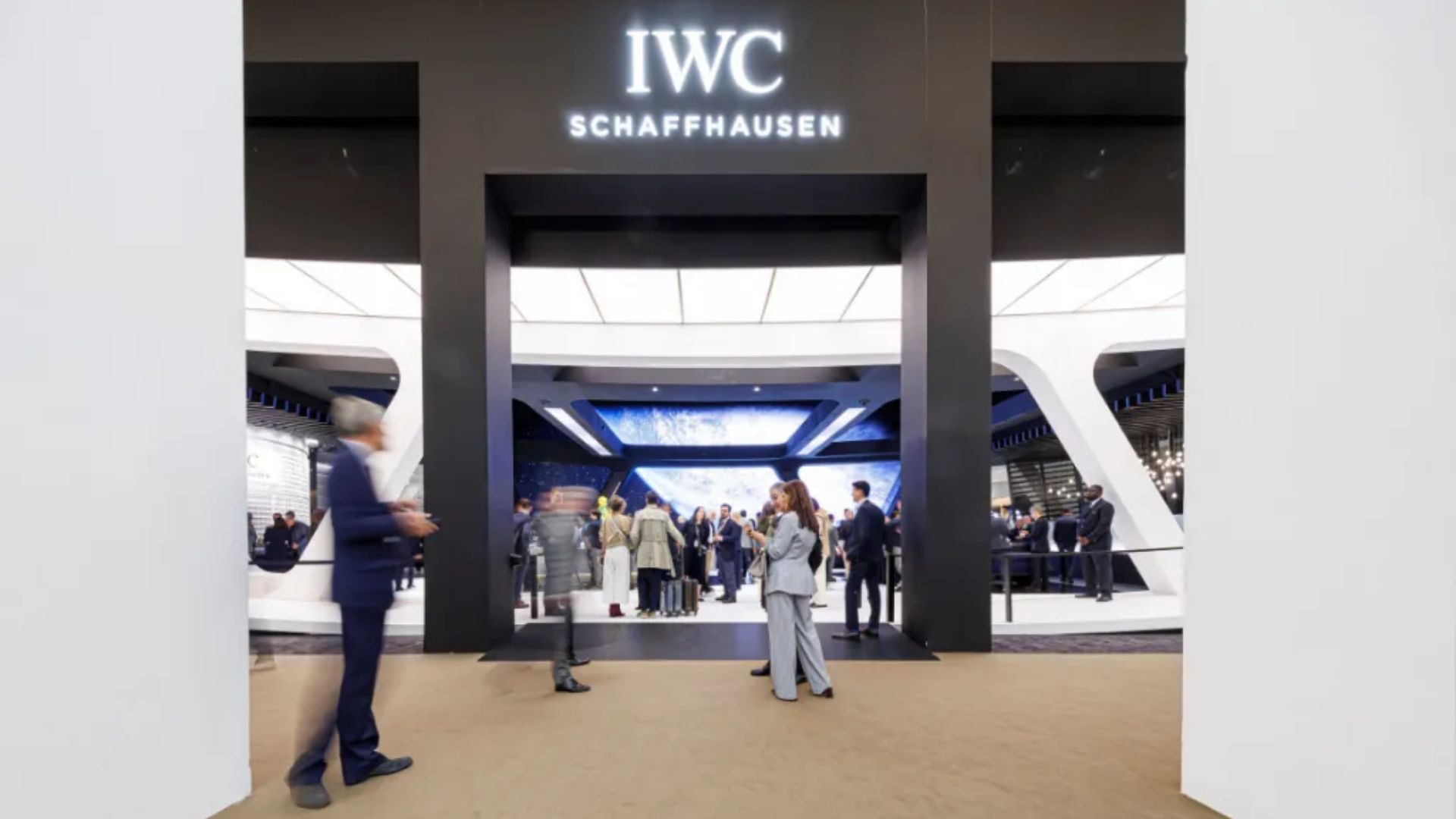
IWC Schaffhausen has never really been the sort of watchmaker that survives on decorative whimsy alone. The house has its polished moments, of course, and it can dress up a Portugieser or Portofino with the best of them, but its natural habitat has always been a little more functional. Cockpits, workshops, engineering desks, expedition kit, things with screws, tolerances and a reason for being. At Watches and Wonders 2026, that side of IWC came into particularly sharp focus.
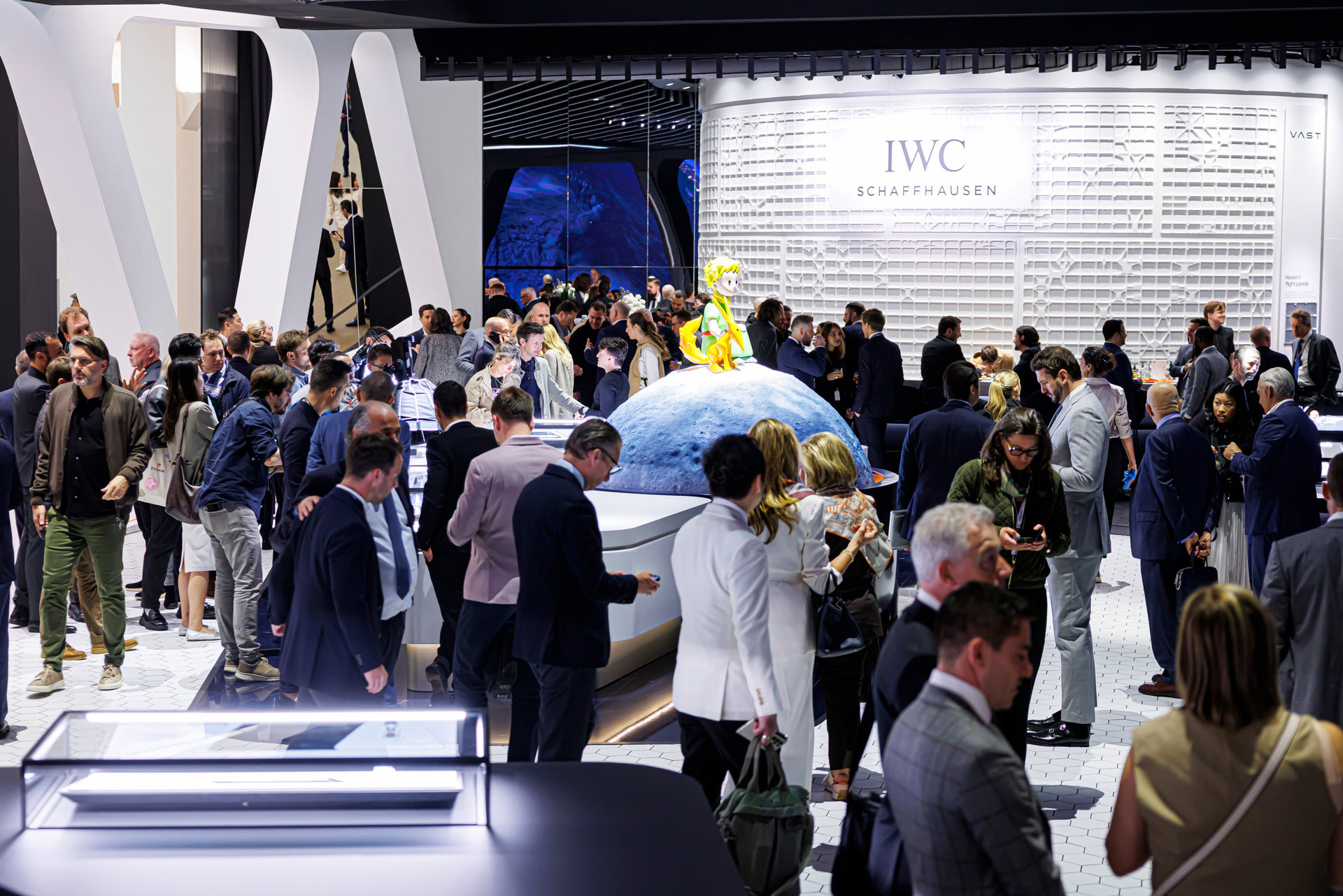
The headline releases were spread across two of the brand’s strongest modern pillars: Pilot’s Watches and the Ingenieur. The Pilot’s Watch family marked 20 years of IWC’s Le Petit Prince line with a broader anniversary collection, including blue-dialled Mark XX models, chronographs, a compact Automatic 36, and a particularly striking white ceramic Chronograph 41. At the more technical end sat the new Big Pilot’s Watch Perpetual Calendar ProSet, a major reworking of IWC’s famous perpetual calendar architecture, now capable of being adjusted both forwards and backwards through a synchronised gear-based system. Then there was the Big Pilot’s Watch Perpetual Calendar Ceralume, a 46.5mm watch that appears to have asked the simple question: what if the whole thing glowed? If that sounds like IWC was having fun, the Ingenieur side of the room suggested it was also doing some careful housekeeping. The Gérald Genta-inspired line, relaunched to much attention in recent years, expanded with a dark green ceramic Automatic 42, new 35mm references, a titanium perpetual calendar, and a full-gold Ingenieur Tourbillon 41 limited to 100 pieces. It is a delicate game. Push a revived icon too slowly and it risks losing momentum. Push it too far and suddenly the watch stops feeling like itself.
The outlier, and perhaps the most revealing watch of the lot, was the Pilot’s Venturer Vertical Drive. Developed with private space company Vast, it is billed as IWC’s first tool watch made and certified for human spaceflight. More importantly, it removes the crown entirely. Instead, its functions are controlled through a bezel-operated system designed to be usable with astronaut gloves. It is the kind of watch that could easily have collapsed into concept-watch theatre. Instead, it gives IWC a neat bridge between its aviation past and a possible space-age future.
To understand how IWC thinks through that balance of heritage, function, ergonomics and spectacle, we spoke to Christian Knoop, the brand’s Chief Design Officer. Knoop has helped shape IWC’s modern design language across collections, but what stands out in conversation is not just the usual design-office language of codes and proportions. It is his belief that engineering, when done properly, does not sit apart from emotion—it creates it. Excerpts:

IWC has always walked a fine line between engineering-led design and emotional storytelling. When you approach a new watch, which comes first, the technical brief or the narrative?
What I have noticed over the years is that genuinely strong engineering tends to generate its own emotional narrative, almost automatically. When Kurt Klaus developed his original perpetual calendar mechanism in the 1980s, for example, he was solving a technical problem: how to account for varying month lengths and leap years with a calendar mechanism consisting of wheels, levers and switches. But the moment you wear a perpetual calendar on your wrist, you immediately feel drawn towards the story it has to tell, the intricacies and irregularities of the Gregorian calendar, translated into a purely mechanical programme made up of countless parts.
A more recent example is the Pilot’s Venturer Vertical Drive. It features a unique rotating bezel system that replaces the crown, a highly engineered solution born from the fact that astronauts must be able to operate it while wearing space suits with gloves. On Earth, you will probably never find yourself in that situation, but still, people feel drawn to this watch because it is the first of its kind, purpose-designed for spaceflight, and certified by our partner Vast. So, the technical brief and the narrative often are intertwined.
Ergonomics often gets overlooked in luxury watch conversations, but it’s central to daily wear. What are the most important considerations you and your team focus on when refining case proportions and wearability?
Ergonomics are absolutely central to daily wear. Comfort is a major part of the experience. There are different aspects to consider. One aspect we are looking at is lug-to-lug distance, which is often more important than the case diameter. A 41mm watch with long, straight lugs can feel quite large on the wrist, while a 42mm model with shorter, slightly curved lugs may feel much more compact and ergonomic.
Another aspect is the thickness of the case, especially as complications are adding depth to the movement. And then there is the weight. Materials play a significant role. Titanium and Ceratanium® make a big difference in daily wearing comfort, as they are considerably lighter than stainless steel. We spend a lot of time and effort on improving comfort and ergonomics. For the re-launch of the Gérald Genta-inspired Ingenieur, we manufactured countless stainless steel prototypes and wore them on the wrist to see how they felt. It was a long process with countless iterations before we achieved the desired result.
Material innovation has become a key part of IWC’s identity, from ceramics to titanium and proprietary alloys. How do you decide when a new material genuinely adds value versus when it risks becoming a gimmick?
Over more than four decades, IWC Schaffhausen has built extensive expertise in the field of advanced case materials. Our journey started in the early 1980s, when we presented the first wristwatch with a titanium case and bracelet. This milestone was followed by the first watch with a black zirconium oxide ceramic case in 1986. Since then, we have continuously expanded our expertise.
An example that I am particularly proud of is Ceratanium®, because it represents a real engineering problem solved at the material level. We wanted to combine the lightness and structural integrity of titanium with the scratch-resistance of ceramic, two properties that do not naturally coexist. Developing a proprietary alloy that delivers both required years of research. In terms of design, it also enables us to create all-black watches without using a coating for the first time. Recently, we have used Ceratanium® to create a striking all-black execution of the Portugieser Chronograph. By stripping away all colour, the Portugieser Chronograph Ceratanium® enables a surprising new perspective on the iconic chronograph design.
Looking at the Watches and Wonders 2026 releases, how do you ensure continuity across core collections like the Pilot’s Watches or Portugieser, while still making each iteration feel fresh?
The word we use is “design codes”. Each collection has what you can call its design vocabulary, a set of proportional relationships, dial architectures, case silhouettes or finishing details. It’s this vocabulary that makes a Pilot’s Watch instantly recognisable as a Pilot’s Watch. As designers, we protect each collection’s design codes. But within it, there is enormous creative room.
Take the Pilot’s Watches collection, for example. The aesthetic codes are clearly instrument-led: it is about high-contrast dials with a clean hierarchy of information and perfect legibility in all lighting conditions. But then, there is an almost infinite number of creative expressions, ranging from 36mm to 46mm case diameters, many different dial colours, materials including steel, 18-carat 5N gold, platinum, ceramic and Ceratanium®, and a complete selection of complications, like chronographs, a timezoner function or a perpetual calendar. Yet every Pilot’s Watch is instantly recognisable as an IWC Pilot’s Watch. And this is when you succeed at making each iteration feel fresh while ensuring continuity.
Ceralume turns the watch into something that behaves differently in daylight and darkness. How do you keep that from feeling like a concept piece rather than a usable instrument?
Legibility continues to be the number one real and practical requirement for an instrument watch. Luminous ceramic essentially follows that logic, to the extreme. First of all, it is a logical continuation of our four-decade long venture into different types of ceramic, which has included everything ranging from black zirconium oxide ceramic to coloured ceramic and even a ceramic matrix composite material.
Second, it’s creating a surprising new engineering answer to the number one functional requirement for a pilot’s watch: the ability to read and operate your watch in the most extreme conditions, including complete darkness.
With the ProSet perpetual calendar, the mechanics have been completely rethought, but the dial still looks familiar. How do you design for innovation without disrupting what people recognise?
With the Perpetual Calendar ProSet, our engineers have successfully solved one of the last remaining challenges in perpetual calendar design: forward and backward adjustability through a single crown position. This is a functionality that our previous perpetual calendar cannot offer. Due to the very design of the module, it can only be adjusted forward. Yet the characteristic dial layout with four subdials and a four-digit year display has become a design signature of IWC’s perpetual calendars.
When we engineered the new Perpetual Calendar ProSet, we decided to keep that familiar dial layout on the outside. However, on the inside, no stone was left unturned. Our engineers have created a completely new module design, based entirely on bidirectional gears and protected by five patents. As some of the new components feature intricate geometries, they must be manufactured with utmost precision. This is why we use the LIGA process, and advanced microstructuring technology based lithography and electroplating. The journey from the first idea to the finished product took our engineers almost a decade.
The Ingenieur now spans ceramic, titanium, and high complications like tourbillons. At what point does expanding a collection risk diluting its original identity?
The risk is real, and it is worth taking seriously. When a collection tries to be everything it eventually becomes nothing in particular. The safeguard for the Ingenieur is its design DNA, which is extremely strong and unusually specific. Gérald Genta created bold visual codes such as the screw-on bezel, the structured dial and the integrated bracelet. And these codes give the watch a character that is almost self-defending. Any iteration that genuinely carries these features, regardless of the size, material or complication, will instantly read as an Ingenieur.
That being said, we expand and extend the collection with great care and attention to detail. An example is the new Ingenieur Tourbillon 41. A tourbillon in an Ingenieur case makes sense to me if the watch is still, fundamentally, an Ingenieur in its expression. And the same applies to the new Ingenieur Perpetual Calendar 41 in a full titanium execution: it continues to be instantly identifiable as the IWC Ingenieur, sporty, elegant, architecturally bold, and undeniably rooted in the unique visual signature Gérald Genta created 50 years ago with the Ingenieur SL.
The Venturer Vertical Drive removes the crown entirely and rethinks how a watch is operated. When function changes that drastically, does design follow or lead?
In this case, function led the way. The crown was removed because the brief was clear: to design a watch that can be operated while wearing gloves. In that context, a traditional crown is not just inconvenient but inaccessible. The rotating bezel system was the engineering solution to that specific requirement. The role of our designers was then to integrate it, to make the watch feel coherent, purposeful and, ultimately, beautiful.
What I find interesting about the Pilot’s Venturer Vertical Drive is that the absence of a crown has become a design statement in its own right. The case profile is cleaner, the flank of the case with no protruding elements has an uninterrupted quality that is quite striking. Something was removed out of a functional necessity, and the result is visually more resolved than before. In the end, the Pilot’s Venturer does not look like a watch with something missing. It looks like a watch that was always meant to be exactly this way. And this is why, going forward, it perfectly represents our vision for the next space age.


