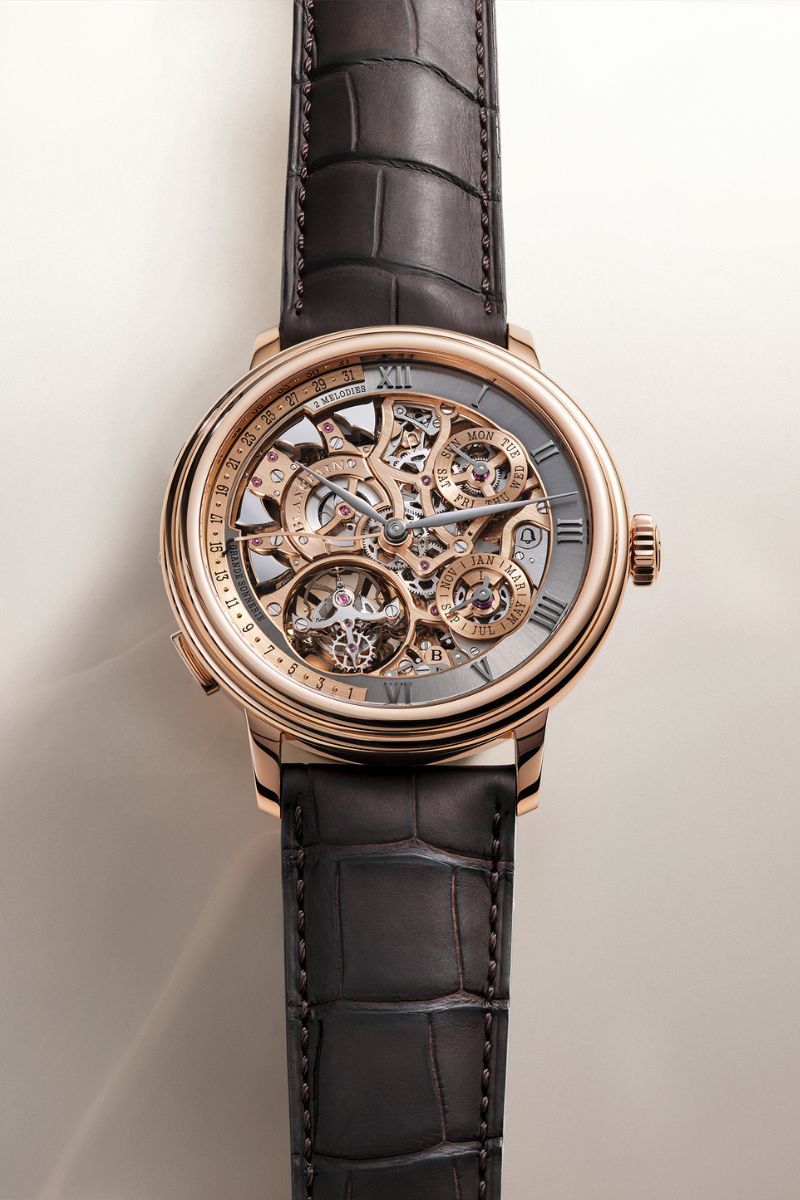
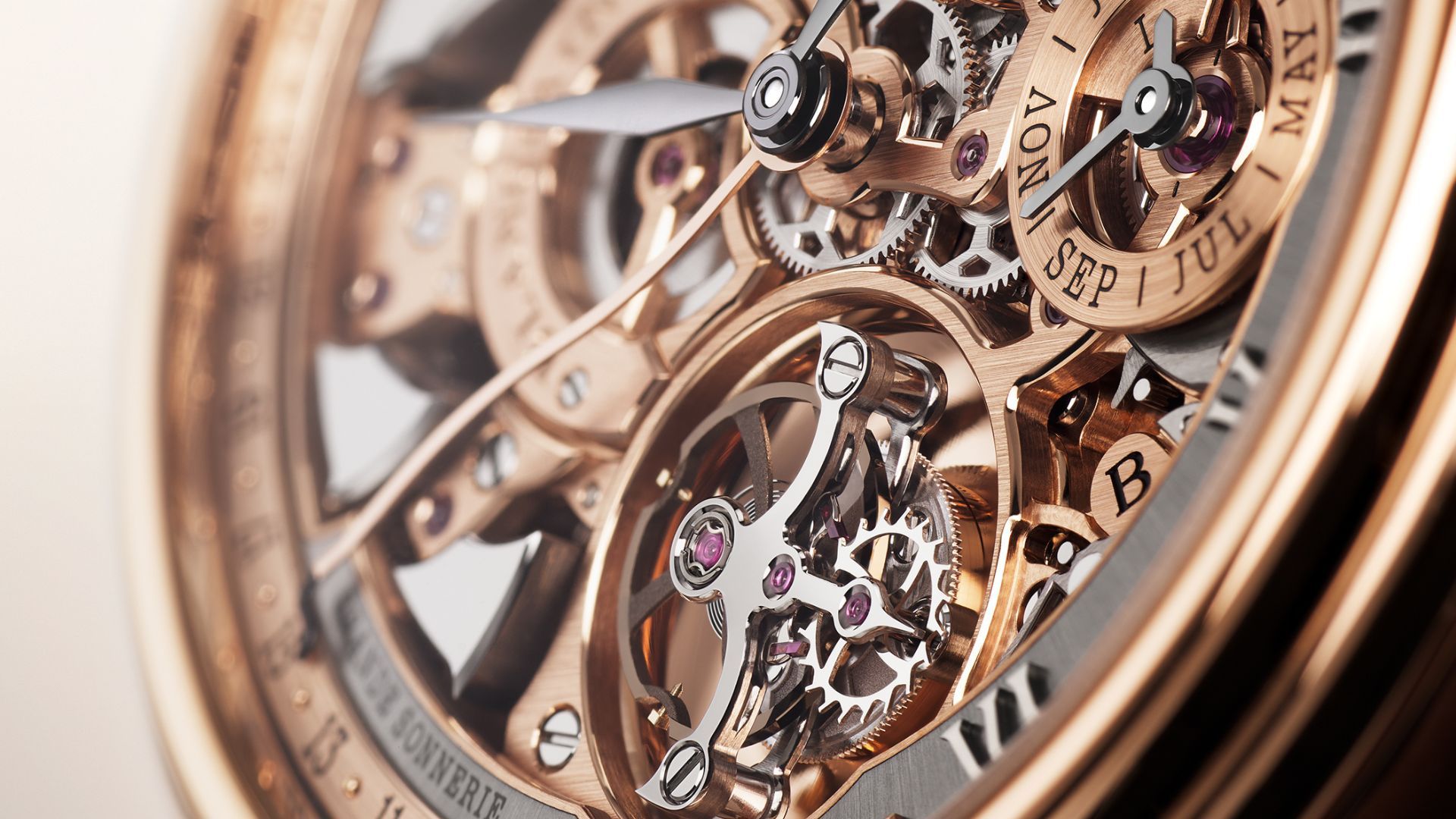
Grand complications feature prominently in the history of Blancpain, most notably the 1735. The most complicated automatic winding wristwatch of its era, the 1735 featured a minute repeater, split second chronograph, perpetual calendar and tourbillon. Today, the stunning Grande Double Sonnerie is the culmination of eight years of intense research and development, showcasing the expertise of Blancpain's master craftsmen, encompassing 1,200 technical drawings, 21 patents with 1,116 components. Out of a total of 1,116 components, 1,053 components are all entirely designed, produced, assembled, and decorated in-house.
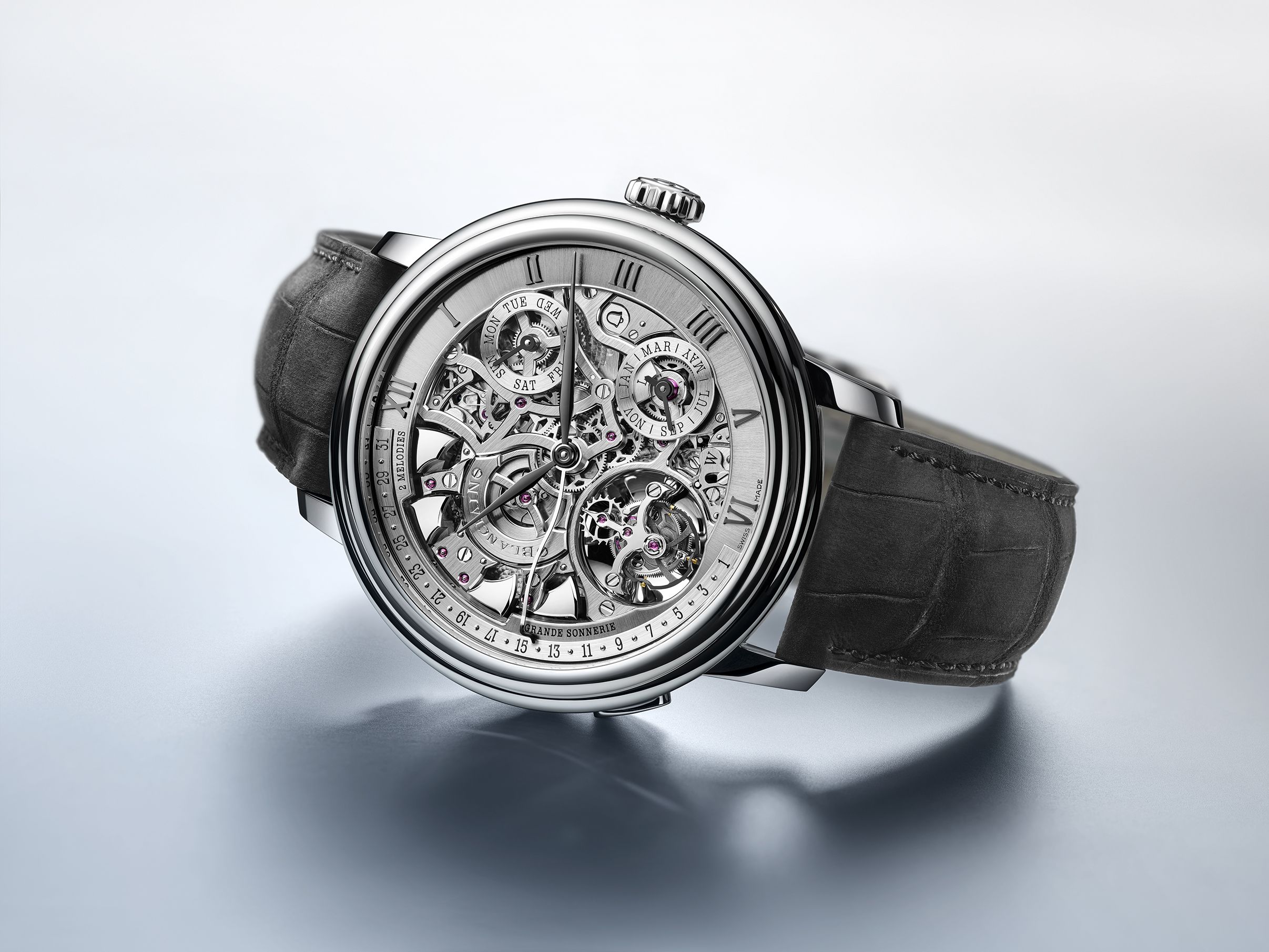
Mark A. Hayek, CEO & President, Blancpain, inspired the maison's watchmakers to develop a Grande Sonnerie equipped with four notes instead of two notes. He proposed to sound time with two different melodies played with four notes: the classic Westminster chime and an original composition from Blancpain. When the idea was proposed it seemed impossible to achieve it but the Grande Double Sonnerie has indeed become a reality and a watchmaking first. This new Blancpain two melody Grande Sonnerie, Petite Sonnerie and Minute Repeater has been combined with a Flying Tourbillon and Retrograde Perpetual Calendar, truly breaking new ground in the world of Grand Complications. The wearer can select from the two melodies by switching back and forth via a push of a button on the case.
Minute Repeater Craftsmanship
The journey to create the Grande Double Sonnerie was long and arduous, requiring meticulous attention to detail and a passion for perfection. It began in the lab with the research and technology of the sound besides incorporating the other complications of the perpetual calendar and tourbillion.
Firstly, let's try and understand the concept of sound. Today, the chiming of time is celebrated as a novelty complication, but it was a necessity in olden days, when in the absence of electricity and modern lighting, time had to be read with help of sound. Today a minute repeater is an ornament, signalling that the timepiece is among the rarest of watches and as such, a status symbol. The sounding of time with large monastery and village clocks in the 14th century became fundamental, exceeding in importance the display of time with hands and dial; the organisation and regulation of the patterns of life for all of those living and working nearby depended upon this. It is that heritage of sounding the time in passage that lies behind the Grande Sonneries. The Westminster, one of the two melodies of the Blancpain Grande Double Sonnerie, dates to 1793 to Cambridge's Church of St. Mary's the Great. Its adoption for London's Big Ben led to the name by which it is known today.
Yet for the right melody, even greater precision is required. In Blancpain's own laboratories, engineers provided the analytical data and technical insights that guided the master watchmakers. With their traditional savoir-faire, they could then make microscopic adjustments—on the order of a micron—to the shape of the teeth within the Sonnerie mechanism. This collaboration between advanced technology and artisanal craftsmanship has ensured a perfectly regular tempo, held within a tolerance of a tenth of a second. Four notes (E, G, F, B) are produced by four distinct hammers. An acoustic membrane integrated into the bezel enhances sound transmission, ensuring remarkable tonal quality well beyond mere volume.
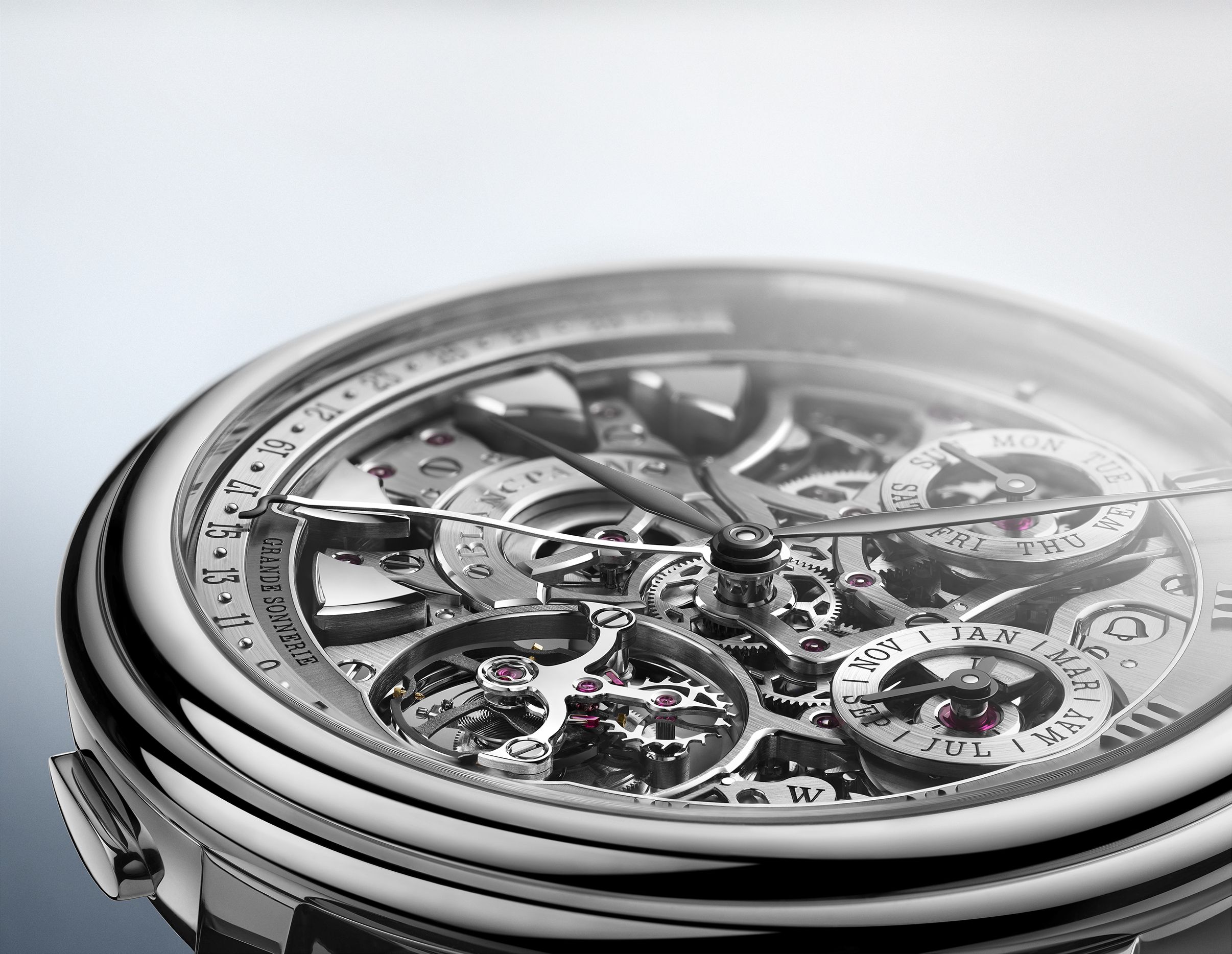
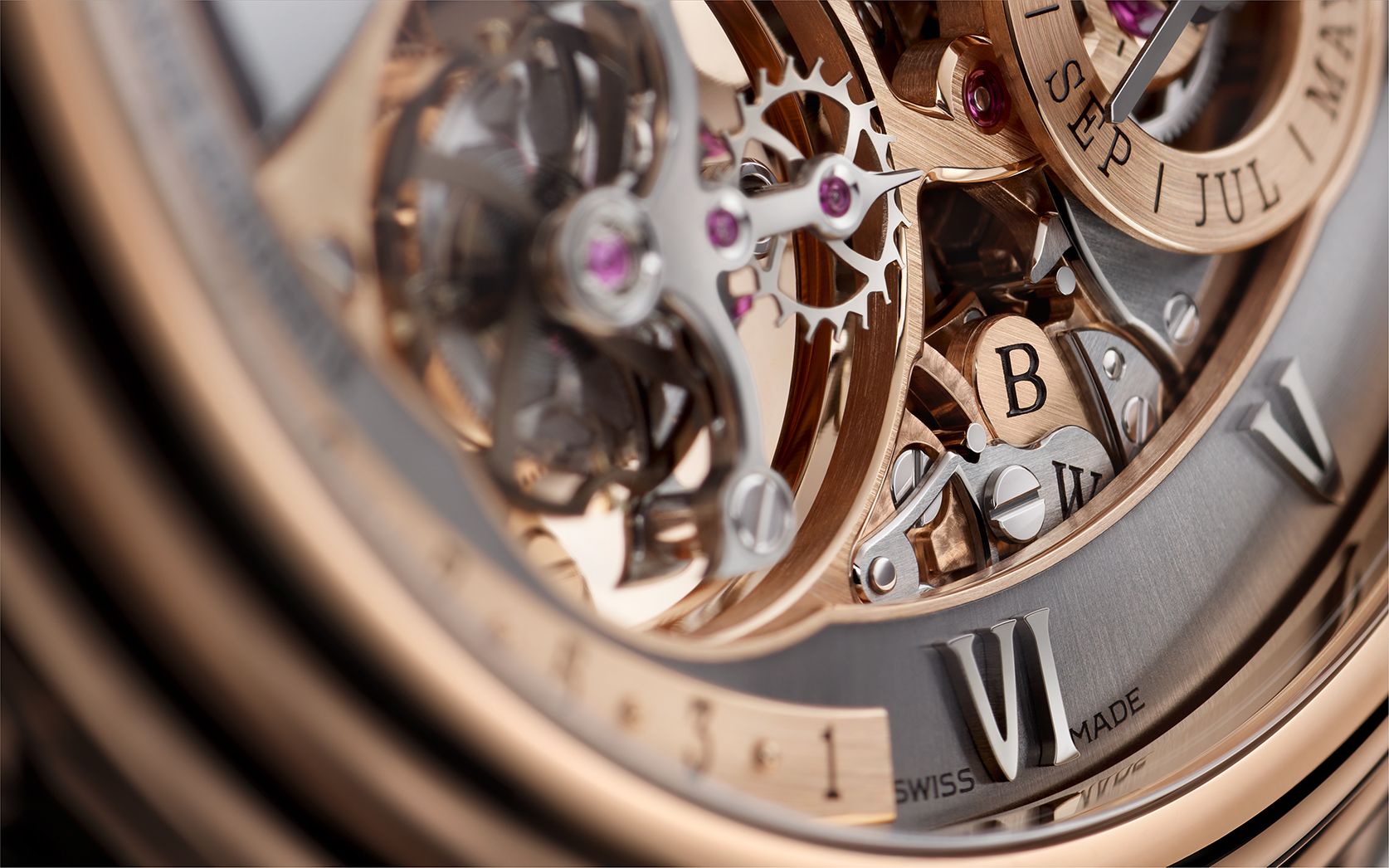
Once the laboratory work was complete, the focus shifted to decoration, a discipline that has long pushed the boundaries of craft. What began as a functional measure to reduce friction within a movement evolved into a hallmark of identity and pride. Today every serious watchmaker invests deeply in its savoir faire and the artisans who sustain it. For the Grande Double Sonnerie, decoration had to be impeccable, both on the visible surfaces and within the hidden architecture of the calibre.
In pursuit of the most sophisticated sound possible, the team needed to choose a metal that could deliver the right tonal qualities. Blancpain selected 18 ct gold for the mainplate and bridges. Its warmth and natural resonance offered a richer acoustic result while presenting a formidable challenge to the craftsmen. Gold is significantly softer than brass or German silver, making it far more delicate to machine and finish, and leaving no forgiveness for error. Yet its polished surfaces glow with a depth and radiance those metals cannot match.
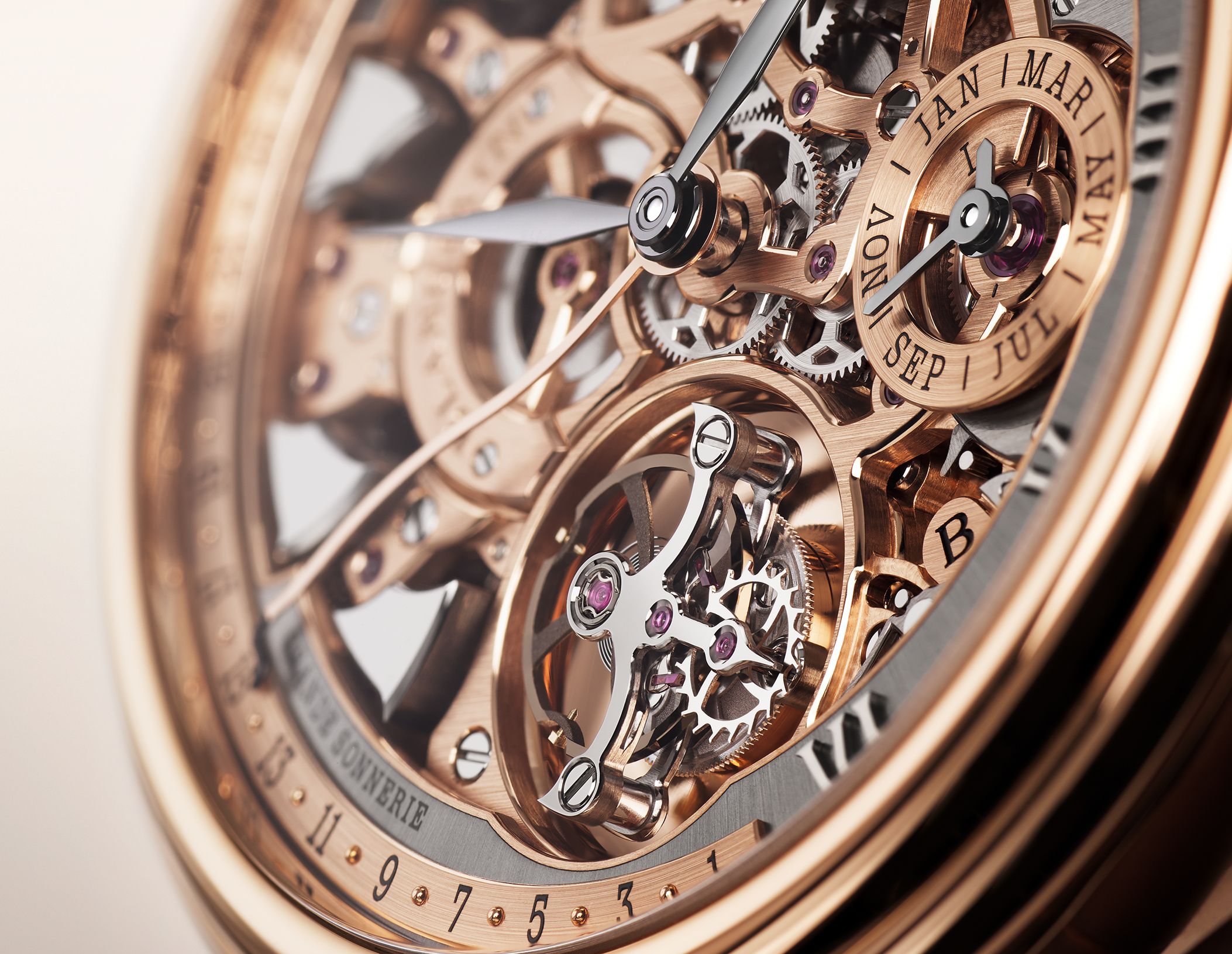
The Grande Sonnerie is also fitted with gold sounding rings, chosen after extensive research and material testing. While various alloys were evaluated, gold consistently produced the most refined and balanced acoustic performance. Its presence here is not a gesture of opulence, but the outcome of methodical experimentation and an uncompromising pursuit of perfect sound. In total, the movement features 26 bridges, each crafted in 18 ct gold. The Grande Double Sonnerie also included traditional hand finish of anglage (135 inward angles), perlage, mirror polishing, diamond milling, and straight graining, in Blancpain's finishing workshop in Le Brassus.
What sets the Grande Double Sonnerie apart from other complicated timepieces is its wearability. This is not just a museum piece; it's a watch that can be worn and appreciated on a daily basis. Despite the extreme complexity of the movement, the watch remains highly wearable, with a diameter of 47 mm, a lug-to-lug of 54.6 mm, and a thickness of 14.5 mm. This wristwatch has two selectable melodies, chosen via a pusher on the case the classic four-note Westminster chime and an original Blancpain melody composed by musician Eric Singer. Ultra-exclusive among wristwatch Grande Sonneries, it plays all four quarters on the hour, offering an extended performance.
It also has Retrograde Perpetual Calendar entirely reimagined with a new construction, fully integrated into the movement, and equipped with Blancpain's patented under-lug correctors, redesigned to allow easy fingertip adjustment without tools. Normally for such a function to be included in a grand complication, one has to implement the calendar mechanism on a different plate from the mainplate of the movement. This usual approach would not work here due to the open architecture of the Grande Double Sonnerie as a dedicated calendar plate would cover and block the view of the Sonnerie. Hence, Blancpain undertook the approach of fully integrating the calendar into the movement, avoiding the standard approach of a separate plate.
The date indication is positioned along the left perimeter of the movement, while the day of the week, month, and leap year are displayed on two dedicated sub dials on the right side. Normally, Blancpain's patented under-lug correctors are integrated into the case, with small springs ensuring their return. This allows for easy adjustments with just a fingertip, without the need for any tool. For the Grande Double Sonnerie, however, the presence of the membrane required the system to be re-imagined: the correctors, along with their return springs, have this time been integrated directly into the movement — an unprecedented solution that combines ease of use with technical elegance, true to Blancpain's spirit. Then comes Blancpain’s emblematic flying tourbillon the world's first, unveiled in 1989, updated with a silicon balance spring and a 4 Hz frequency. It also has five safety systems integrated into the movement to prevent damage from incorrect handling.
The Personal Touch
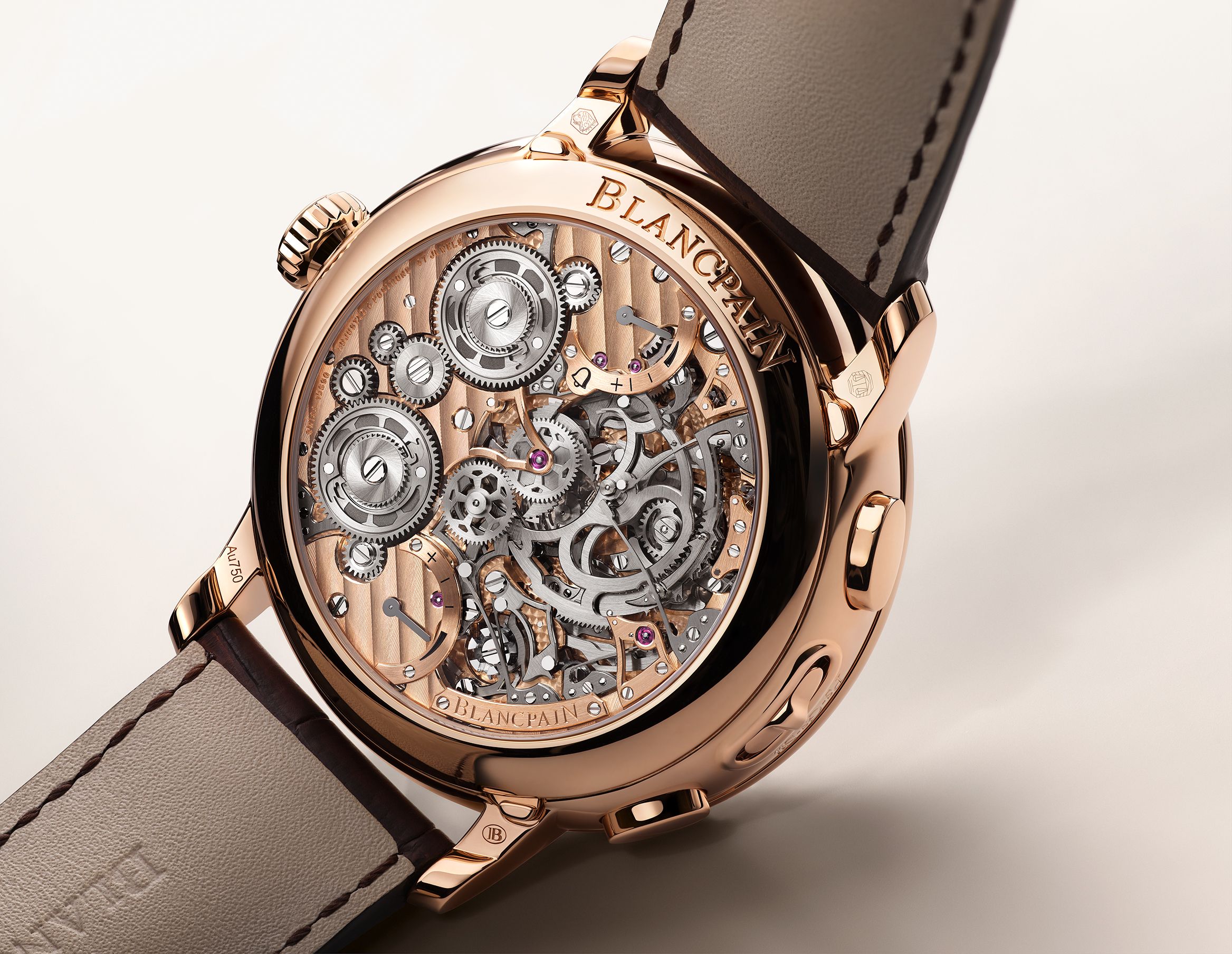
All this would be impossible to be achieved without the two watchmakers, Romain and Yoann, who have brought the Grande Double Sonnerie to life. They have spent more than a decade with Blancpain. Both of them have worked on the two timepieces, one in rose gold and the other in white gold. Each timepiece has taken 12 months of work in assembling it from A-to-Z by each of them. Both of them had to not only plan how to assemble the timepiece but also design and create special tools for getting it all perfect.
As each watchmaker finishes his timepiece, Romain or Yoann then hand engraves his signature on the back of the gold Blancpain plaque and mounts it upon the movement he has built. It's the synthesis of a watchmaking effort best summarised in Hayek's words: "The Grande Sonnerie is one of the most difficult complications to create; it is the queen of watchmaking complications. I wanted a Grande Sonnerie that the owner could comfortably wear. Not an exercise that would merely reside in a safe. Two melodies with real musicality. And above all a watch that would make you smile as it sounds the time, that would trigger real emotion. With the elaborate sonnerie opened for view, to be admired as its four hammers sound its melodies, a gorgeous gold movement bursting with the innovations of its 13 incorporated patents and finishing taken to the maximum, we hope to touch the hearts of the most passionate connoisseurs.
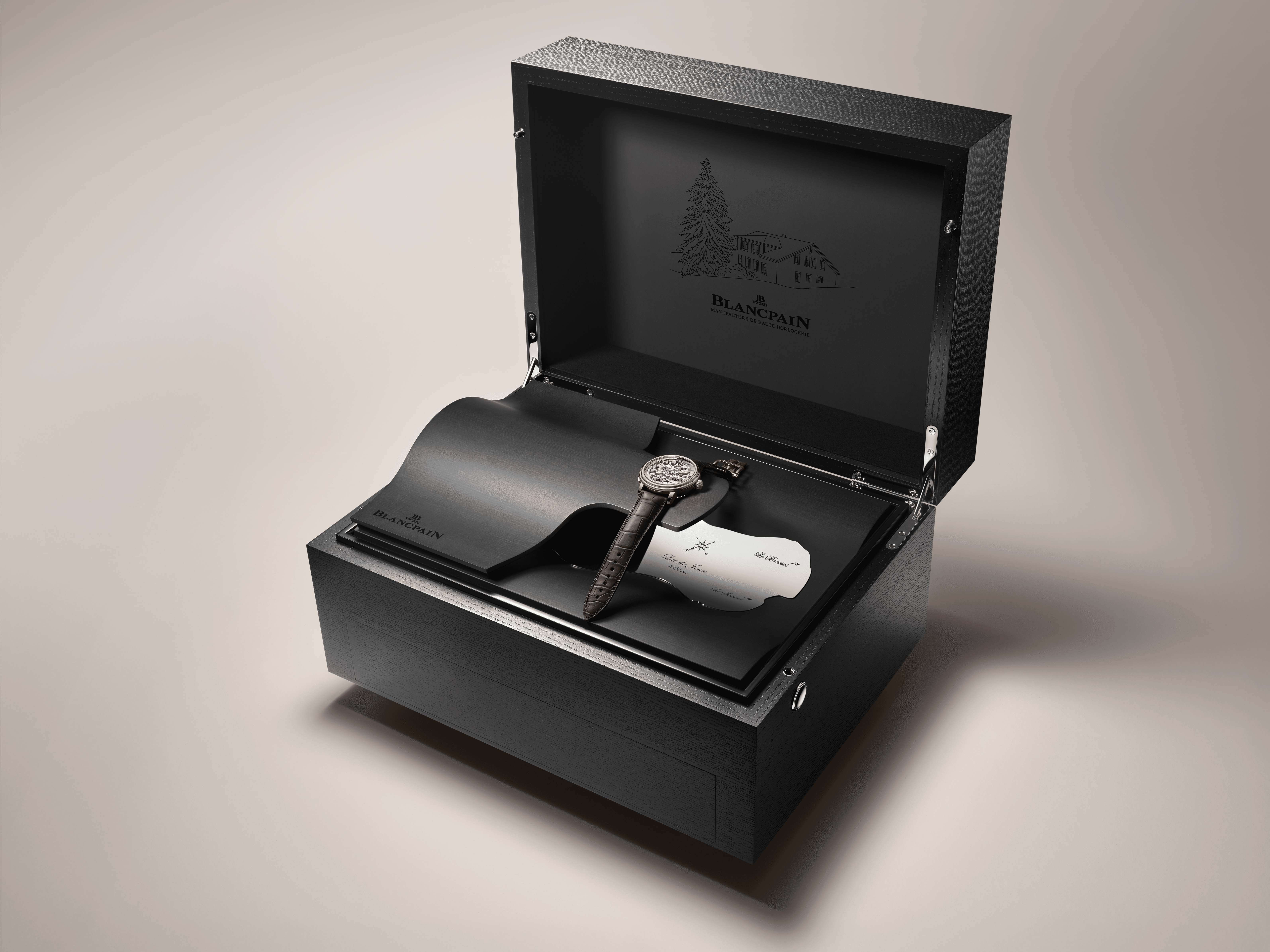
Finally, this watch comes in a wooden box crafted from wood sourced from the legendary Risoud forest in the Vallée de Joux, the case is more than a presentation box—it perpetuates the centuries-old tradition of resonance spruces, prized by luthiers for their exceptional acoustic qualities. In this spirit, it acts as a natural soundboard, amplifying the chime and linking the timepiece to the cultural and artisanal heritage of the valley. Above all this, each piece can be custom-made according to the wishes of its owner, ensuring absolute exclusivity.


