Perhaps the easiest way to understand the Grand Prix d’Horlogerie de Genève is to look at the last two watches to have taken home its biggest prize. One was an obscenely sophisticated perpetual calendar, the sort of watch whose appeal lies partly in the sheer absurdity of what mechanical engineering can achieve when nobody asks whether it really needs to. The other was a single-hand Breguet, conceptually rooted in a watch Abraham-Louis Breguet first devised more than two centuries ago. One pushed complexity towards its outer limits. The other stripped timekeeping almost back to its bones. Both were deemed worthy of the Aiguille d’Or.
Gianfranco Ritschel, former Vice President of the GPHG jury, laughs when the contrast comes up. “You picked up a good example, which are these two extremes of winners,” he says. With the IWC, he saw “achievement in the perfection, in the calculation of complexity of a calendar”, translated into a mechanical object. With Breguet, the jury was looking elsewhere entirely. “The jury member judged the story. The anecdote behind it, which symbolises resilience; reinvent yourself if you want to survive. The watch represents something which is invisible if you don’t know the watchmaker’s story.”
That problem has sat at the heart of the GPHG since its creation in 2001. The awards have grown considerably since then, with the GPHG Academy broadening the pool of people involved in selecting and voting on contemporary watchmaking, while the competition itself now spans 14 watch categories and 84 nominated pieces. The procedural side can be reduced to numbers easily enough; the harder bit begins when the watches reach the table. Ritschel spent years on the jury before moving, as he puts it, “backstage”, where he now contributes to the rules and criteria that shape the competition itself. He clearly prefers it there. One example of that evolution arrived this year with the disappearance of separate men’s and women’s categories. Women wear traditionally masculine watches, men increasingly wear smaller and more decorative ones, and the old division simply stopped making much sense. “These are the discussions we have to let evolve the GPHG,” he says.
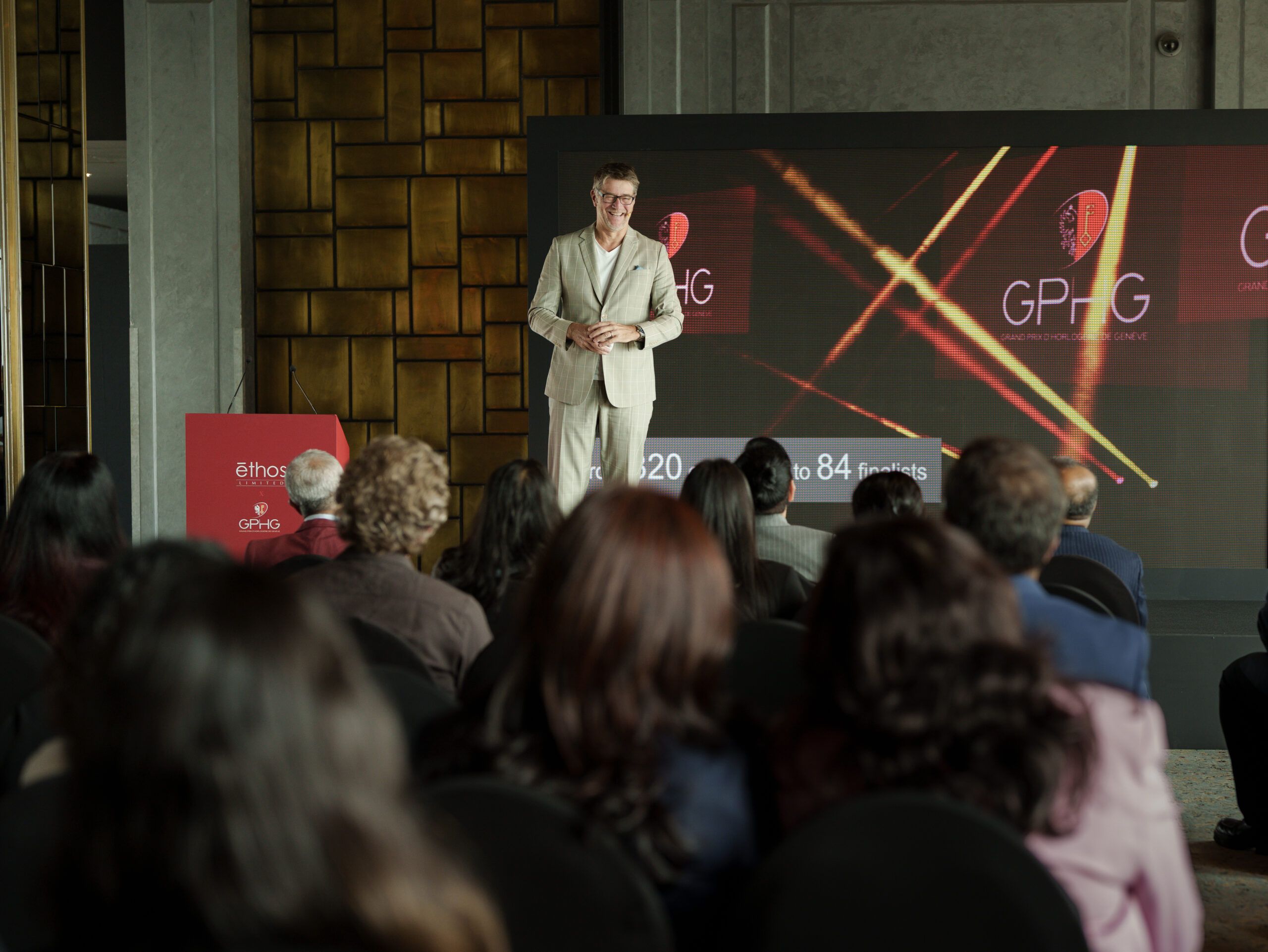
His own approach begins by temporarily forgetting what he likes. “For me, it’s important to take the point of view of the category wearer,” Ritschel says. If he is judging a sports watch, he becomes “the young sporty Gianfranco”, thinking about readability, longevity, efficiency and whether the object succeeds at the job it claims to do. “I try to be not myself, but put me in the shoes” of the person the category is meant to serve. The jury room itself sounds less like a solemn tribunal than a very seriouswatch meet. Pieces are placed in the centre of a table, picked up, passed around and discussed. Jurors disagree, explain details to one another and try to change each other’s minds. Then, as Ritschel recreates it: “Ding. Now shut up and vote.” The ballot is secret. Every hour, four people leave each table and four remain, deliberately breaking up groups before one personality can exert too much influence. “We want to exchange,” he explains, “but not all the time the same people.”
For Pranav Saboo, who joins the jury in 2026, getting to that table requires considerably more homework than simply knowing what looks good. “Read about every timepiece,” he says when asked how he is preparing. Jury members can question the brands directly, going as deep as the construction behind a date display or a particular engineering decision. Just as importantly, Saboo says the other jurors routinely ask things he had not even thought to consider. “My job in the jury is to come, not just show up and say, ‘Hey, where’s the coffee? Let’s look at pieces.’” The opinion he brings, he says, has to be an informed one.
Being informed does not mean reducing watches to specifications either. Ritschel is almost militant about seeing a watch in person. “I never judge definitively a watch on a picture,” he says. “Let me at first touch the watch.” He wants to examine the object from every angle, understand what it is trying to communicate and finally put it on. Sometimes he closes his eyes. “The last judgement is wearing and feeling.” A watch can be sharp or aggressive if that edge belongs to its character; another should feel completely different. What matters is whether the whole thing makes sense together. Price is part of that coherence too. It is not imposed on jurors as a formal value-for-money calculation, but Ritschel says it inevitably enters the conversation. A juror may love a watch before somebody else points at the price and asks whether what sits inside it really justifies the number. “You need a kind of correlation between the perceived value and the paid value,” he says. Expertise matters because a knowledgeable juror should understand the difference between genuine substance and perceived theatre; and the product design/economics nexus between these.
Saboo brings an especially interesting lens to this because his day job is almost entirely concerned with the other side of the equation. As Managing Director and CEO of Ethos, he has spent 17 years learning not just what watch enthusiasts admire, but what customers actually buy. He knows that an ingenious engineering solution can be too expensive, too obscure or simply too difficult to explain at retail. But he is adamant that the jury cannot become a sales forecast. “Personally, I don’t look at whether it will sell or not,” he says. “I’d like to be there to judge whether there is truly outstanding work that’s done there.” If anything, he argues, the commercial success may follow the recognition, because a GPHG nomination or award gives people a reason to understand why a watch deserves their attention.
There is a nice irony, then, in one of the categories Ritschel is proudest of helping introduce. Years ago, after watching the industry chase increasingly complicated watches, he began noticing a return to something much simpler. “In Italian we have a word for this; we say solo tempo,” he says. Time only. “That’s the most elegant to wear, elegant way to wear a watch. The most puristic way.” During his tenure, Ritschel proposed a category specifically for those watches, and says Time Only now attracts more registrations than any other. It is difficult to imagine a cleaner illustration of what the GPHG is actually trying to reward. Complexity can be exceptional; simplicity can be exceptional. A perpetual calendar can win because of a mathematical achievement. A single hand can win because of history, proportion and the force of the idea behind it. The common denominator is not the number of components. It is whether the watch has a convincing reason to exist.
That also makes the question of who sits in judgement increasingly important. GPHG is no longer simply a closed Swiss conversation, and Saboo’s presence on the 2026 jury is particularly interesting from an Indian perspective. His father, Ethos founder Yashovardhan Saboo, was the first Indian to serve on the jury. Pranav had no idea his own invitation was coming. “I checked the email twice,” he says. “‘Is this for real?’” His father did not know either. “It makes it more special because my father was the first jury member, and carrying on that for India, for Ethos, for all my colleagues and for all my stakeholders, it’s a great feeling.” Yashovardhan’s advice was characteristically brief: find your own path, “remember your ethics, keep your credibility high, and have a great time.” As it happens, credibility is exactly where the conversation around India gets considerably more interesting.
India’s GPHG Footprint
Indian brands put six watches from four home-grown names into the GPHG competition this year. None made the final shortlist, a distinction Saboo is careful not to gloss over. “Anybody can enter into the competition, right? To enter the list of competing watches is not the same as winning a nomination.” But he considers the entries meaningful for another reason. “It shows where India’s ambition lies. It shows that India is in sync with the world. That we want to be amongst the best.” Is the country ready to consistently make that final cut? “Probably” not yet, he concedes. “But the most important thing is that it signals ambition.” Ritschel’s response to the same question is considerably harsher, and arguably more useful. He compares India with China, where young brands can already produce extraordinarily sophisticated mechanical watches but still struggle to command automatic respect outside their domestic market. “They’re just missing one point. It’s credibility,” he says. “And that’s the most difficult to achieve. You cannot purchase it. You cannot acquire it with more advertising. It’s over time."
Nor does Ritschel think Indian watchmakers need to spend that time desperately convincing Europeans first. “I don’t think you have to conquer the world now immediately,” he says. India’s domestic opportunity is enormous in its own right, and the more interesting challenge may be finding a watchmaking language Indian buyers feel belongs to them. “If you find a way to let vibrate, to let be proud your people about your local production, it’s already a huge achievement.” GianfrancoRitschel That matters because he sees watches as more than luxury goods anyway. Ritschel calls them “semiotic objects”, things we wear to communicate something about personality, culture, wealth or taste. His analogy is amusingly straightforward: you cannot bring your car into a bar. At best, you put the keys on the table. The watch comes in with you. In India, he believes that role as a personal and social marker is only beginning to fully develop.
Saboo sees signs of that shift in the customers already walking through his doors. “Across the board people are becoming more knowledgeable about what they want to buy,” he says, dismissing the idea that this is simply a North-versus-South or big-city phenomenon. The familiar milestones remainrelevant. “To have a Rolex is an achievement.” But increasingly that watch might sit beside something less obvious. Buyers are asking, “What can help differentiate them? What are independent brands doing? What are microbrands doing?” And that curiosity is flowing in both directions. “When I go to Bangalore, as an example, when I meet collectors there, I always learn something from them,” Saboo says. “Seventeen years into this industry dedicatedly full time, and yet when I meet some collectors, in every collector meeting I will learn something.”
More knowledge also makes everyone around the customer work harder. “You need to know not just what is inside your boutique,” Saboo says of the modern watch salesperson. “You need to know the universe of watches.” The person on the other side of the counter may already have spent days on forums and Instagram learning everything about one specific reference. Ritschel is even less forgiving. If a salesperson can only repeat specifications, he says, “if I would be a store owner, I would replace you with a machine.” Put in a credit card, choose “number 43”, collect the watch and leave: essentially McDonald’s for horology. What the salesperson has to provide instead is context, judgement and trust, understanding the person in front of them well enough to know which part of a watch’s story will actually matter. Saboo is confronting the same problem at scale. Ethos is now developing its own training school as the company expands and hires rapidly. “How do we take that passion with which that watch is built?” he asks. “If we can take even 25 per cent of a watchmaker’s passion and bring it to the guy coming in, our job is done.”
Maybe that is a better measure of India’s progress than simply counting boutiques or Swiss exports. Ritschel talks about collector cultures beginning with remarkably little: a few friends, a table covered with watches, conversation, then another gathering and another. “Just create the initial reason to get together,” he says. Eventually, “it starts alone.” Saboo already sees that culture developing around him, and it is precisely what he wants to carry into Geneva. “I think 17 years of selling timepieces to customers, I think I’m very close to what customers love,” he says. “And I also would like to bring to the table the opinion of India.” For all the discussion about engineering, finishing, design and heritage, he keeps returning to the person who eventually has to care enough to own the thing. “In the end, for all the engineering, design, heritage, the industry is sustainable, all this passion is sustainable because there’s a customer at the end of the table.”
And perhaps that is where India’s GPHG story really begins: not with pretending the country has already arrived, but with having enough ambition, knowledge and confidence to join the argument about what deserves to.


