If you have followed Jaipur Watch Company for any length of time, you know that restraint has never really been Gaurav Mehta’s thing. Over the past decade, the founder and watchmaker has placed everything from vintage coins and postage stamps to Ravi Varma oleographs inside watch cases. Each piece has carried a tale from Indian history, occasionally with enough ornamentation to fill several watches. Now, with the launch of Gaurav Mehta Jaipur, he is giving his more elaborate ideas a new home—and himself considerably more room to play.
The signature line arrives with two collections: Premium Baagh and Gates of India. Both retain the storytelling instinct that has defined Jaipur Watch Company, although their construction and ambition signal a step beyond the brand’s familiar coin-and-stamp territory. As Mehta puts it, the point is to “premiumise” this side of the business and establish “a different pedigree” for its more complex creations. It is also personal. “For the first seven or eight years, there was no designer in the company,” he says. “I was the solo designer. How would I express the best of Gaurav Mehta? The Premium Baagh is the best of Gaurav Mehta. It is my own worldview.”
That worldview is unmistakably maximalist. Premium Baagh revisits the tiger motif that first appeared in the Baagh collection in 2022 and has since become something of a mascot for the company. Demand received a fairly substantial nudge after Prime Minister Narendra Modi was spotted wearing one; according to Mehta, more than 1,000 people are now waiting for the original watch. Some, he claims, have even offered Rs 5 lakh to immediately acquire a model originally priced at Rs 60,000—a very good problem to have, if also a slightly stressful one.
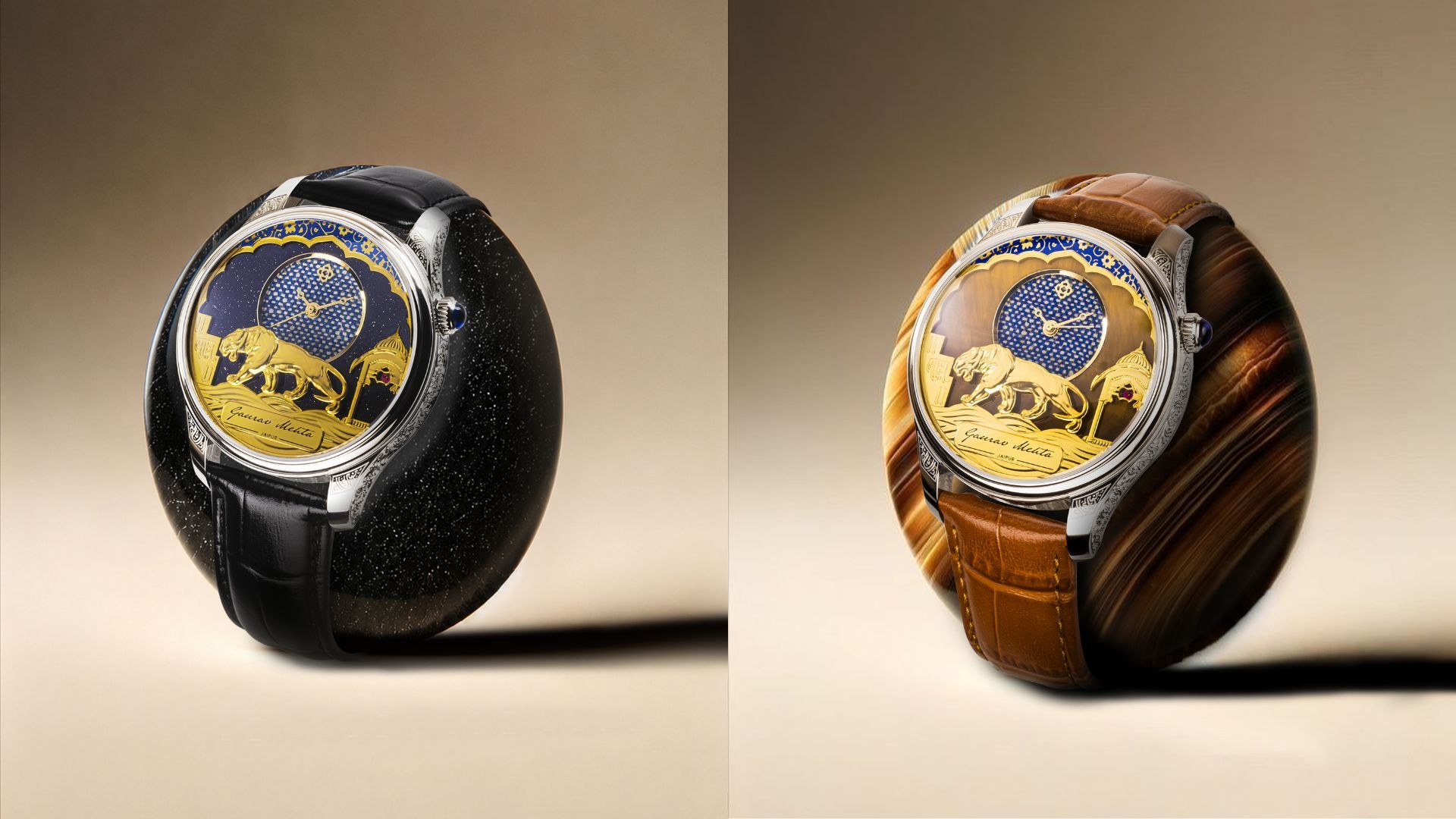
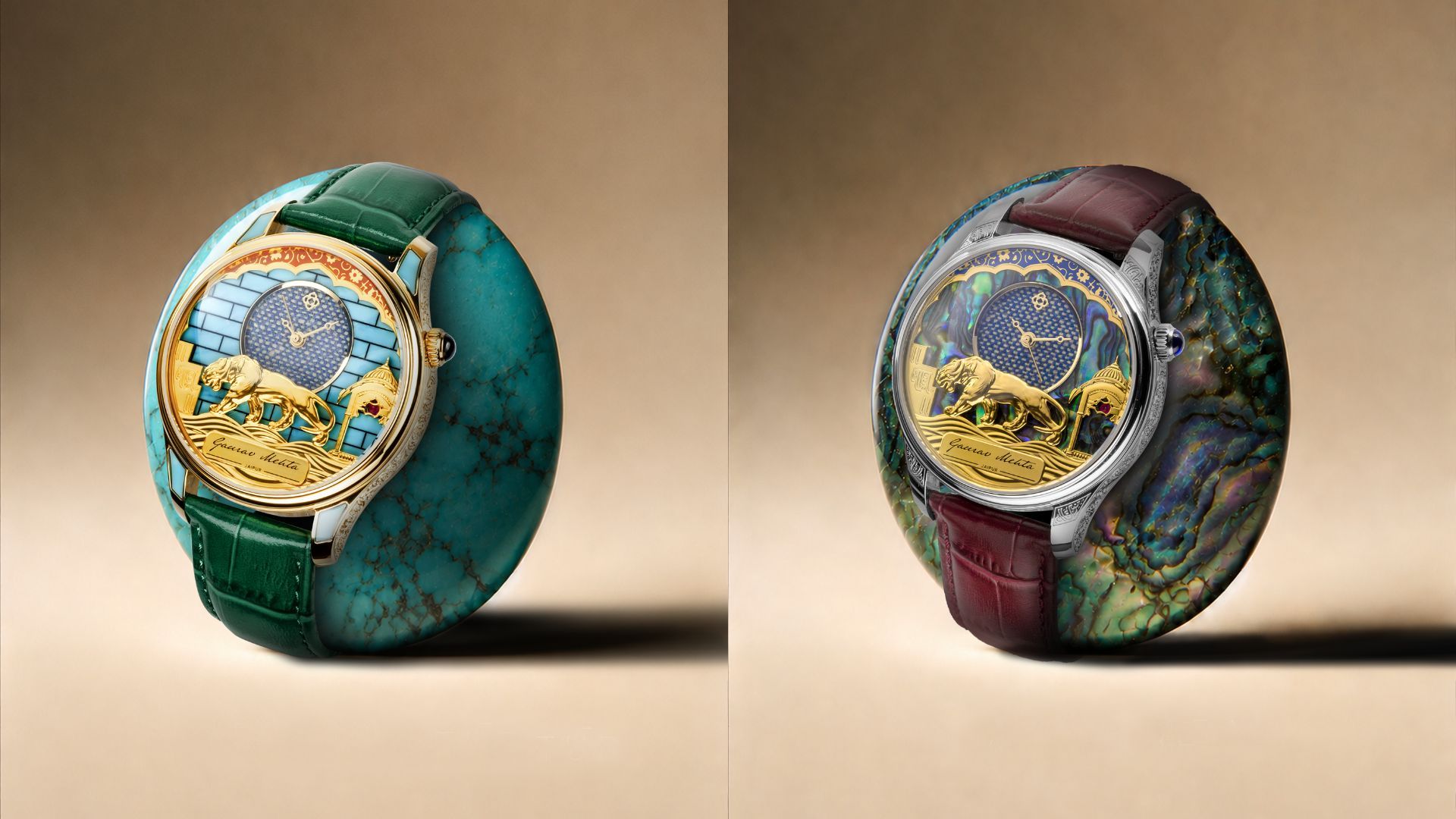
The new watch is not simply Baagh IV with a better suit. Its sculpted golden tiger prowls through miniature landscapes assembled from turquoise, tiger’s eye, aventurine and abalone shell. The materials are not merely colourways: tiger’s eye represents the animal walking through the desert by day, aventurine supplies a starry night and abalone places it beside water. The standout version uses individually cut pieces of turquoise to create a tiny brick wall behind the animal. It is delightfully excessive, but there is a clear internal logic holding the spectacle together.
Around it, the dial becomes a miniature stage set. The off-centre time display is covered in pink muslin khadi, while a small Rajputana-style architectural frame houses a synthetic ruby recovered from a watch movement. Filigree forms a canopy above the tiger, engraved case flanks continue the decorative treatment and a sapphire cabochon appears on the crown, unusually positioned at two o’clock. Look at the watch from the side and its considerable layering becomes apparent. This is emphatically not a dial that reveals itself in a polite two-second glance.
Mehta says the collection grew from a simple thought during the Diwali break: “We need to use turquoise, and we need to do something with the Baagh.” From that November starting point, the watch took shape over roughly eight months. Producing the khadi section and sourcing the tiny synthetic rubies proved particularly fiddly; the latter had to be extracted from old movements before being incorporated into the dial. The top version is housed in 904L stainless steel and powered by a Sellita SW200 automatic movement. A more accessible Rs 75,000 edition uses Miyota’s 8315 automatic calibre, notable here for its approximately 60-hour power reserve.
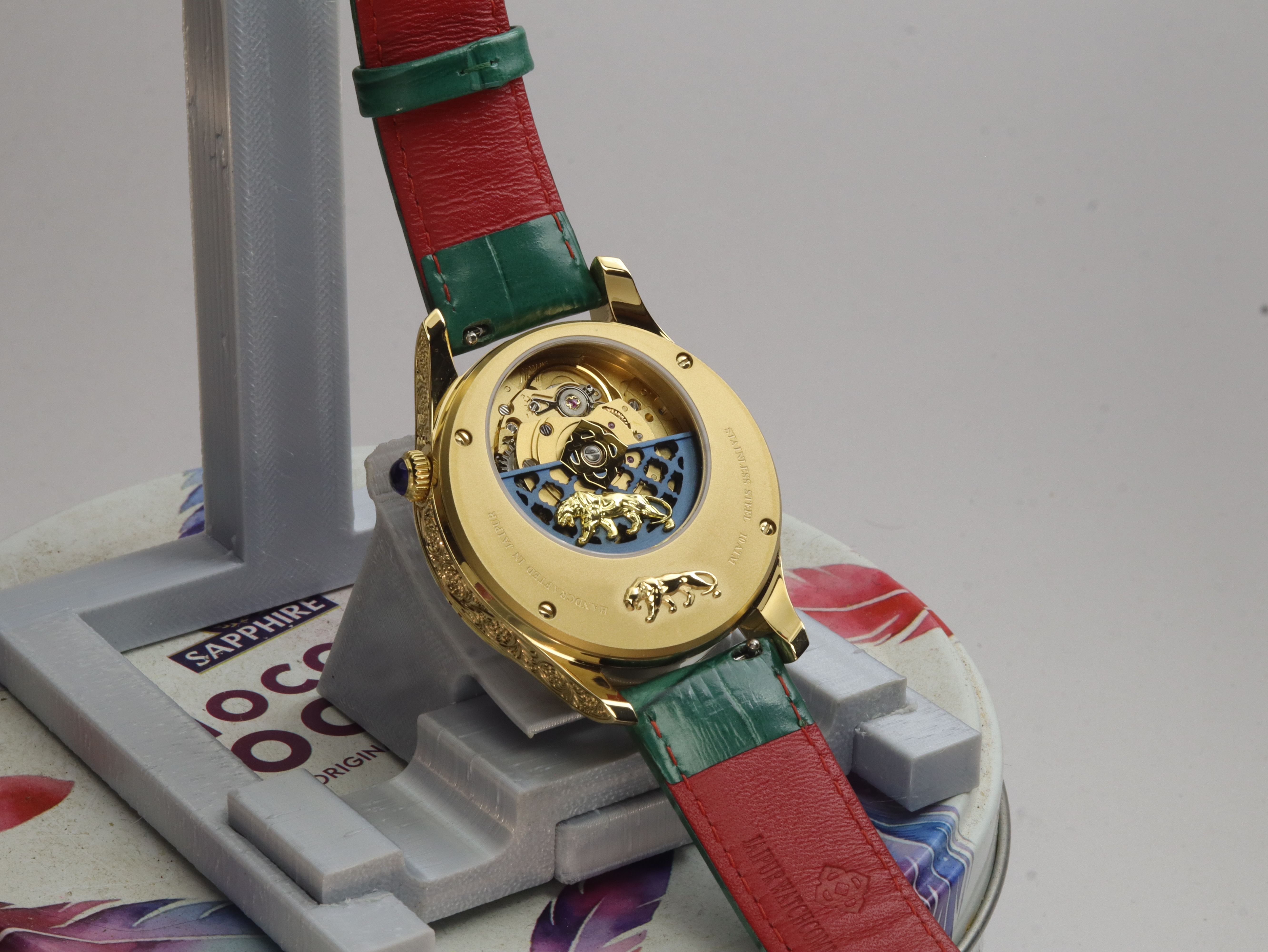
There are five Premium Baagh variants, limited to 100 examples each. Mehta’s favourite is, unsurprisingly, the turquoise flagship. “I’ve never done something like this before,” he says. “For me, going beyond my comfort zone—this was that one.” It also builds neatly upon the brand’s recent activity. The Royal Baagh of 2025 expanded the tiger motif across a sculpted 42mm case, while Filigree IV returned to ornamental metalwork and a vintage two-naya-paisa coin. More recently, the Rare Earth collection paired natural stone dials with a jump-hour display. Premium Baagh feels like these experiments converging: stone, sculpture, fabric, filigree and mechanical movement, all competing for attention without quite descending into chaos.
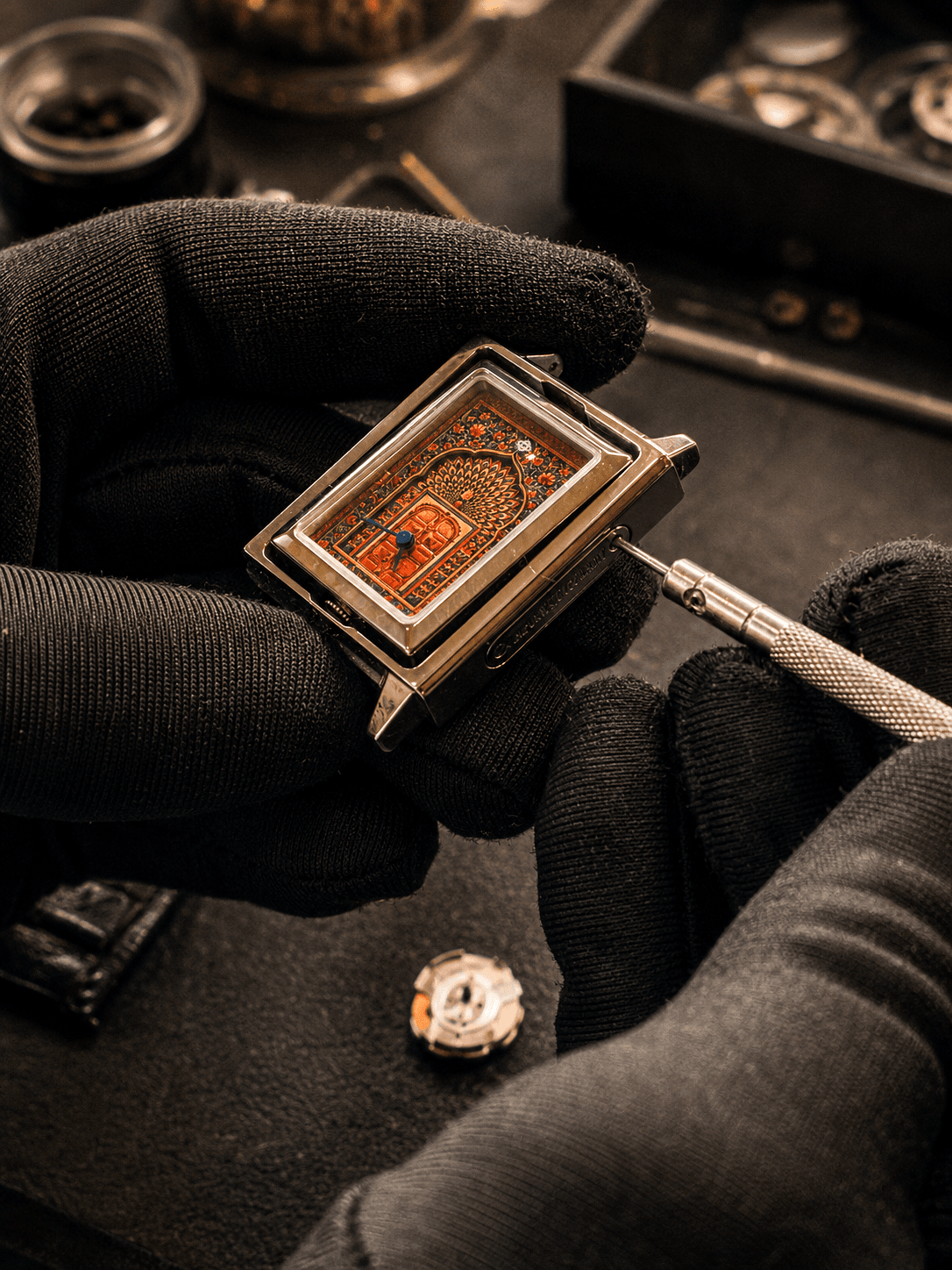
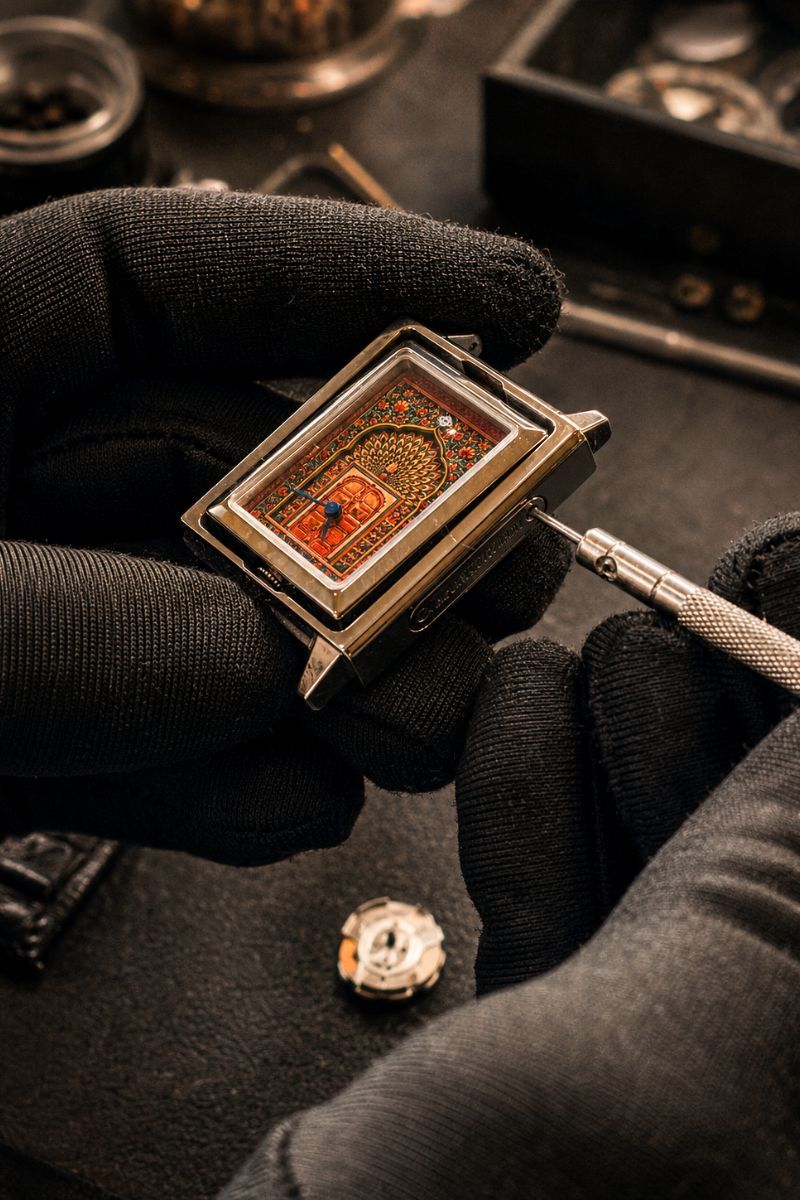
Gates of India, meanwhile, is the more playful proposition. It began with a painting of the Lotus Gate from Jaipur’s Pritam Niwas Chowk that had hung in Mehta’s office for years. He found it at an exhibition at Jawahar Kala Kendra and bought it immediately—“This has to be mine,” he remembers thinking. The painting eventually suggested a watch based on the Lotus and Leheriya gates, but Mehta worried that the reference might be too local. The answer was to make the watch two-sided.
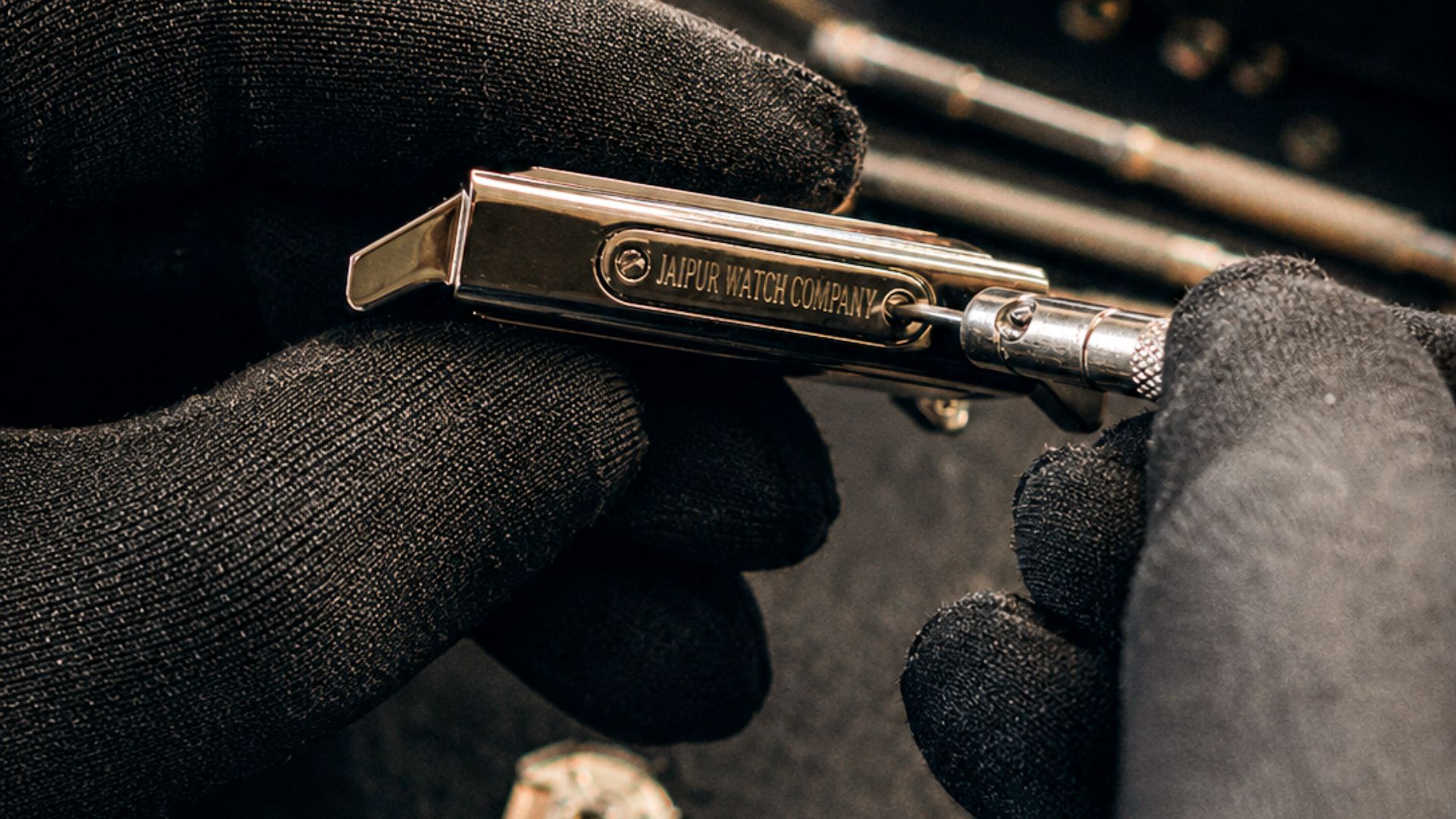
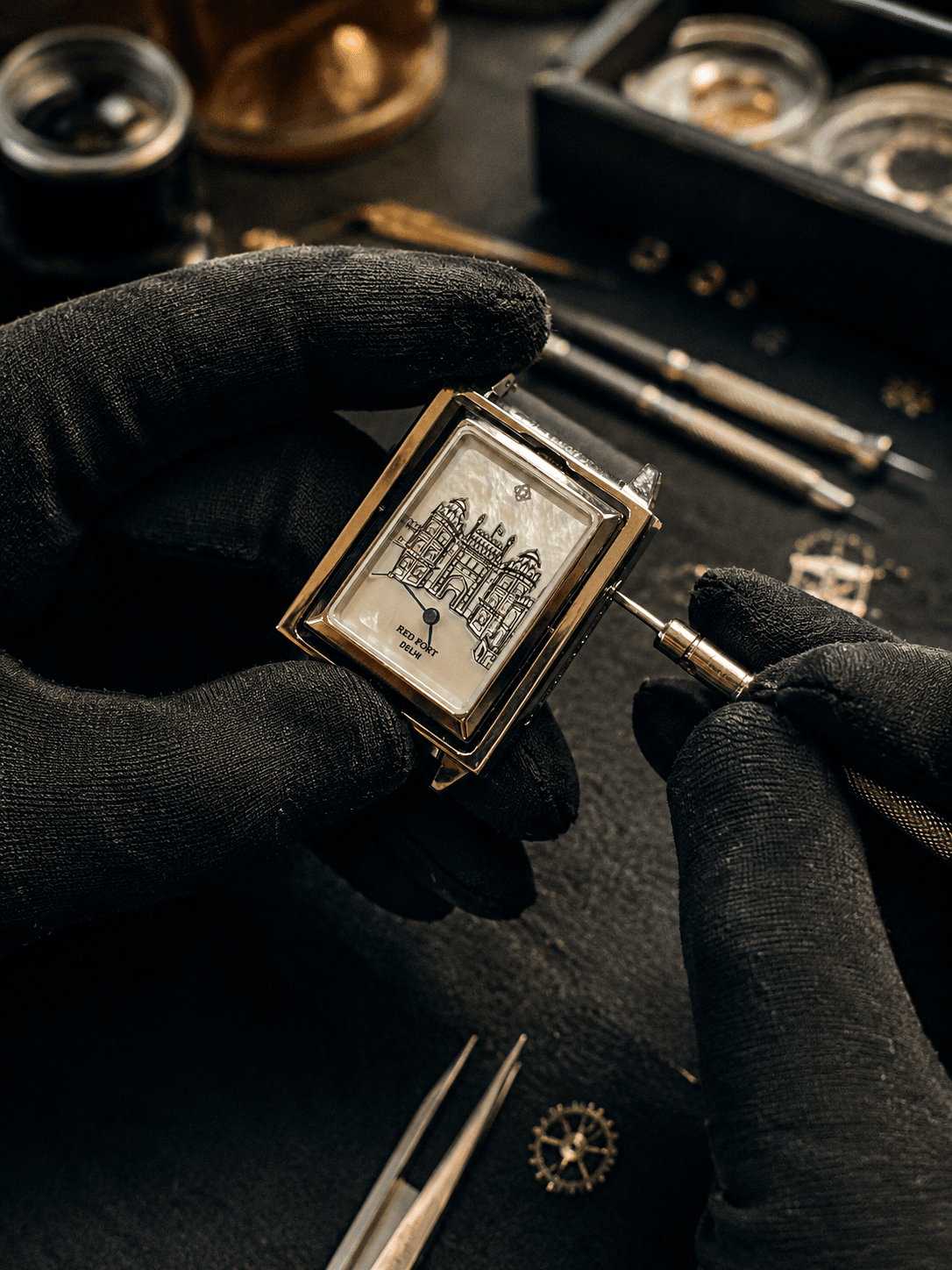
Its rotating case presents the brightly coloured Jaipur gate on one face and a monochrome Indian monument on the other, with options including India Gate, the Gateway of India, the Red Fort and Charminar. These choices are connected to cities in which Jaipur Watch Company has a retail presence, but they also make the concept immediately legible to someone who has never wandered through the City Palace. The two faces contain separate Seiko VX00 quartz movements, making the watch capable of displaying two time zones.
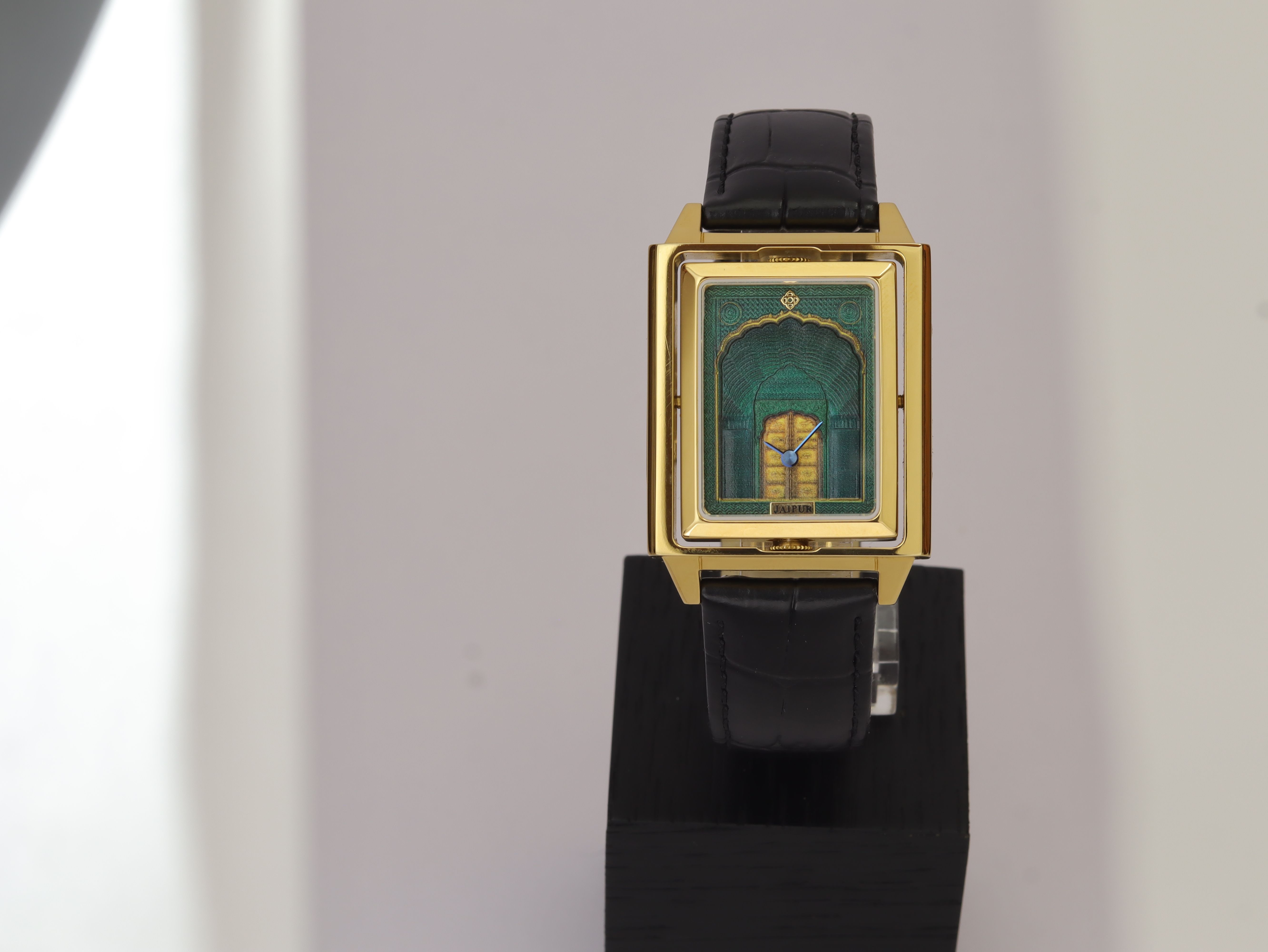
There is an appealing little duality to it. One side is colourful and ornamental; the other is monochrome, architectural and a touch more sober. “It showcases two sides of a personality,” Mehta explains. In practical terms, the freely rotating case lets its wearer choose which one appears on the wrist. The architectural dials are made from brass using embossed and debossed sections, followed by pad and digital printing. On the monochrome face, the monuments are rendered over mother-of-pearl, which gives their surfaces a shifting quality as they catch the light.
Miniaturising buildings of that scale without reducing their windows, arches and columns to an indistinct metallic smudge required several attempts. Fitting two movements into a case that remained genuinely wearable presented another challenge. The initial run will comprise 600 watches across different gate-and-monument combinations, each priced at ₹50,000. They are conspicuous little objects, but conversation starters have always been Jaipur Watch Company’s real stock-in-trade.
That willingness to experiment reflects how much the business—and the Indian microbrand landscape around it—has changed. Mehta remembers a time when the company could afford to release one collection a year, knowing a poor response might place the entire operation in trouble. It now launches close to one collection a month and employs a nine-member design team, several of whom first arrived as interns. “Now we have the space to use our creative freedom and come up with newer concepts,” he says. “It gives us an opportunity to go beyond our comfort zones and develop things which have never been done.”
Gaurav Mehta Jaipur is the clearest expression of that freedom so far. Future releases under the label are expected to introduce higher-end movements, complications and increasingly difficult constructions. For now, these first watches offer two distinct directions: Premium Baagh turns one of the brand’s greatest hits into a layered mechanical diorama, while Gates of India transforms architecture into a clever, wearable double act. Neither will slip anonymously beneath a cuff. Then again, anonymity was never part of the plan.


