
Movado has always understood the power of saying less. In a watch market that often rewards size, spectacle and mechanical chest-thumping, the brand’s most recognisable design code remains almost stubbornly quiet: a clean dial, a single dot at 12 o’clock, and a belief that restraint can carry as much weight as ornament.
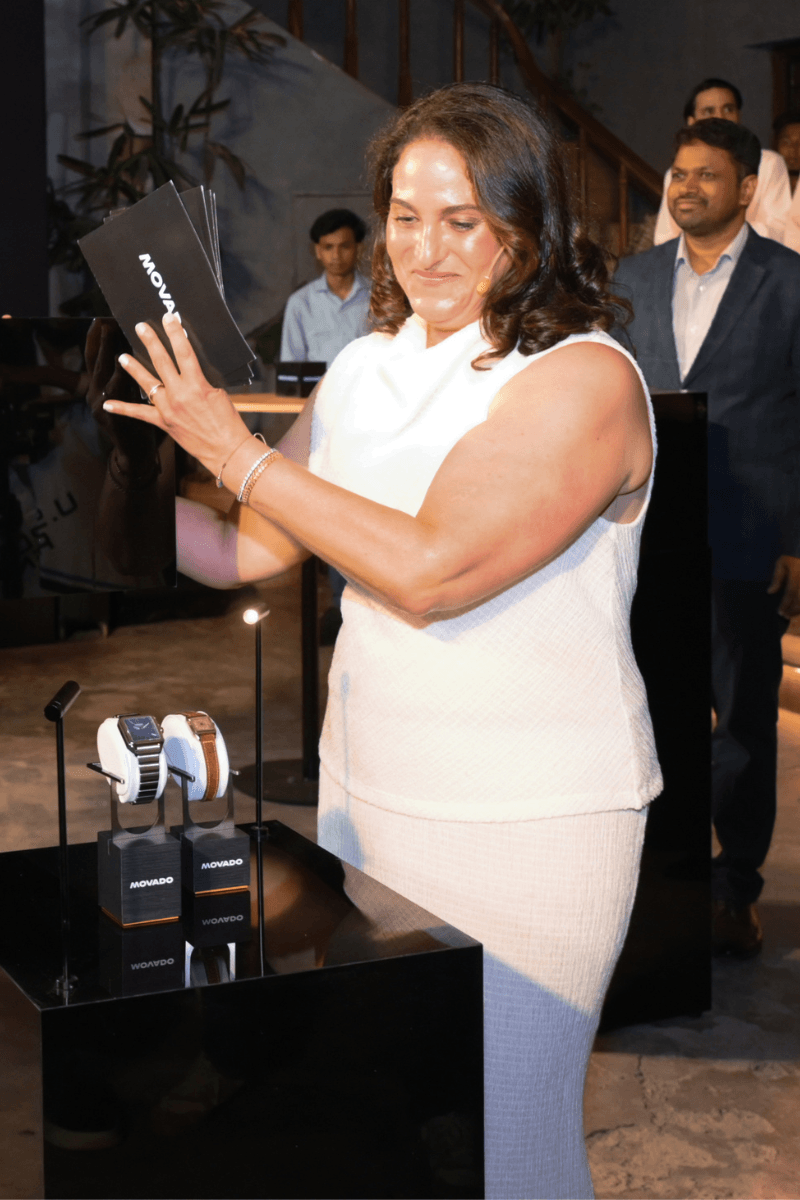
That quiet confidence was at the centre of Movado’s Mumbai evening, The 1917: Sophisticated Then, Now, Always, held at Late Checkout, Lower Parel, to celebrate the brand’s design legacy and unveil the Heritage 1917 watch. The release arrives at a moment when Art Deco is enjoying a visible return across watches, interiors and design more broadly, but the impulse, according to Heather Cohen Sugarman, VP, Public Relations, Events and Partnerships at Movado Group, is rooted as much in Movado’s own archive as it is in any wider cultural trend. Sugarman brings more than two decades of experience across luxury, fashion, accessories and lifestyle, and currently leads global communications, partnerships, influencer engagement and large-scale brand experiences across Movado Group’s portfolio.
As the brand approaches its 145th anniversary, the conversation was less about nostalgia and more about controlled evolution. Sugarman, who has worked on campaigns and partnerships involving names across film, sport and culture, including Julianne Moore, Ludacris, Derek Jeter and Lily Collins, spoke about what Movado considers sacred, what can evolve, and why, in a louder luxury market, the quietest object in the room might still have the sharpest point of view. Excerpts:

Movado has one of the most recognisable design languages in watchmaking. When you revisit that archive, how do you decide what is sacred and what can be reworked?
To your point, there are very few brands that have such a distinctly recognisable and iconic design language that has really stood the test of time. Our approach is to protect the core principles of modernism and the integrity of the Museum Dial, while allowing materials, proportions, and details to evolve over time. The goal isn’t to replicate the past verbatim, but to reinterpret it in a way that feels both contemporary and relevant.
Art Deco seems to be having a noticeable return across watches, interiors and design more broadly. With the Heritage 1917, did Movado see this as part of a wider cultural moment, or was the impulse more internal, rooted in your own team’s archive?
As Movado approaches its 145th anniversary, we’ve been very intentional about revisiting the designs that defined our legacy and influenced watchmaking at the time. The 1917 collection is part of a broader global initiative that looks inward to our archives and heritage, celebrating pieces that were truly ahead of their time. While it naturally aligns with a wider resurgence of Art Deco across design, the inspiration was deeply rooted in our own history, supported by a series of product launches and storytelling moments that bring our past into a contemporary context.
The Museum Dial is almost radically quiet by today’s standards. How do you make restraint feel relevant in a louder luxury market?
Restraint, simplicity, minimalism is actually what makes the Museum Dial feel relevant today. In a world that’s increasingly loud and overdesigned, clarity and intention stand out. The design isn’t trying to compete for attention. The pure Museum Dial is a work of art — it creates a moment of pause, which feels like a luxury in itself. The Museum Dial communicates instantly. It’s recognisable before you even know the story behind it. That visual clarity becomes an entry point, and then the design history and craftsmanship deepen the connection over time.
Movado’s Artist Series has a long history, and last year’s Derrick Adams collection brought a very contemporary, colourful language to the Museum Dial. How do you decide which collaborators can add something meaningful to such an established design code, and is there anything in the pipeline for 2026 that you can hint at?
We look for collaborators who don’t just decorate the dial, but reinterpret it through their own lens while respecting its integrity. Derrick Adams was a great example of that balance. Looking ahead, we’re continuing to explore partnerships that bring fresh cultural perspectives. Nothing to announce just yet, but there’s definitely more to come. Authenticity comes from alignment. The partnership has to feel natural, whether it’s a shared aesthetic, values, or a genuine connection to design. When it’s right, the product and the storytelling feel effortless, not forced.
You’re here in India for Movado. What stands out to you about this market?
India is incredibly dynamic. There’s a strong appreciation for design and storytelling, but also a desire for modernity and global relevance. Consumers here are very visually attuned and culturally aware, which makes it an exciting market to engage with.
Is there a risk that heritage brands over-explain themselves now, especially online? How do you keep the story elegant without turning it into a history lesson?
Not every detail needs to be explained. The key is to talk about what makes your brand stand out and cut through the clutter, what’s meaningful and emotionally resonant, and let the design do the rest.
If someone in India is discovering Movado for the first time through the 1917, what would you want them to understand about the brand?
I’d want them to understand that Movado is rooted in modern design. It’s about Swiss craftsmanship, simplicity, and innovation, all expressed through a very distinct point of view. The Museum Dial, in particular, is more than just a watch face. It’s a piece of design history. It was disruptive when it launched, challenging the idea of what a watch should look like, and that spirit still feels relevant today. Ultimately, Movado is an iconic brand with a clear identity, one that continues to balance design, heritage, and accessible luxury.


