The Cartier Santos-Dumont has never really been my Cartier. I’ve always preferred the elongated Tank variations, particularly the Cintrée and Américaine, whose stretched proportions feel a little stranger, sleeker and more seductive. The Santos-Dumont, by comparison, has often seemed like the sensible historical choice: undeniably important, impeccably designed, but not necessarily the one I’d reach for.
Then Cartier made this version, and frankly, it is stupidly beautiful. The story behind the watch is familiar, but still worth revisiting. In 1904, Brazilian aviator Alberto Santos-Dumont asked his friend Louis Cartier to create a watch that could be read while flying, without requiring him to take his hands off the controls and reach for a pocket watch. Cartier’s solution was a square watch worn on the wrist, creating one of the earliest purpose-built wristwatches and what is widely considered the first modern pilot’s watch.
More than 120 years later, the Santos-Dumont remains remarkably close to that original idea. The rounded square case, exposed bezel screws, Roman numerals, railway minute track and cabochon-set crown have all survived countless changes in taste. Cartier has resized it, slimmed it down and experimented with its materials, but has generally avoided tampering with the fundamentals. That restraint has served the watch well, even if it has also contributed to its reputation as the more conservative member of Cartier’s shaped-watch family.

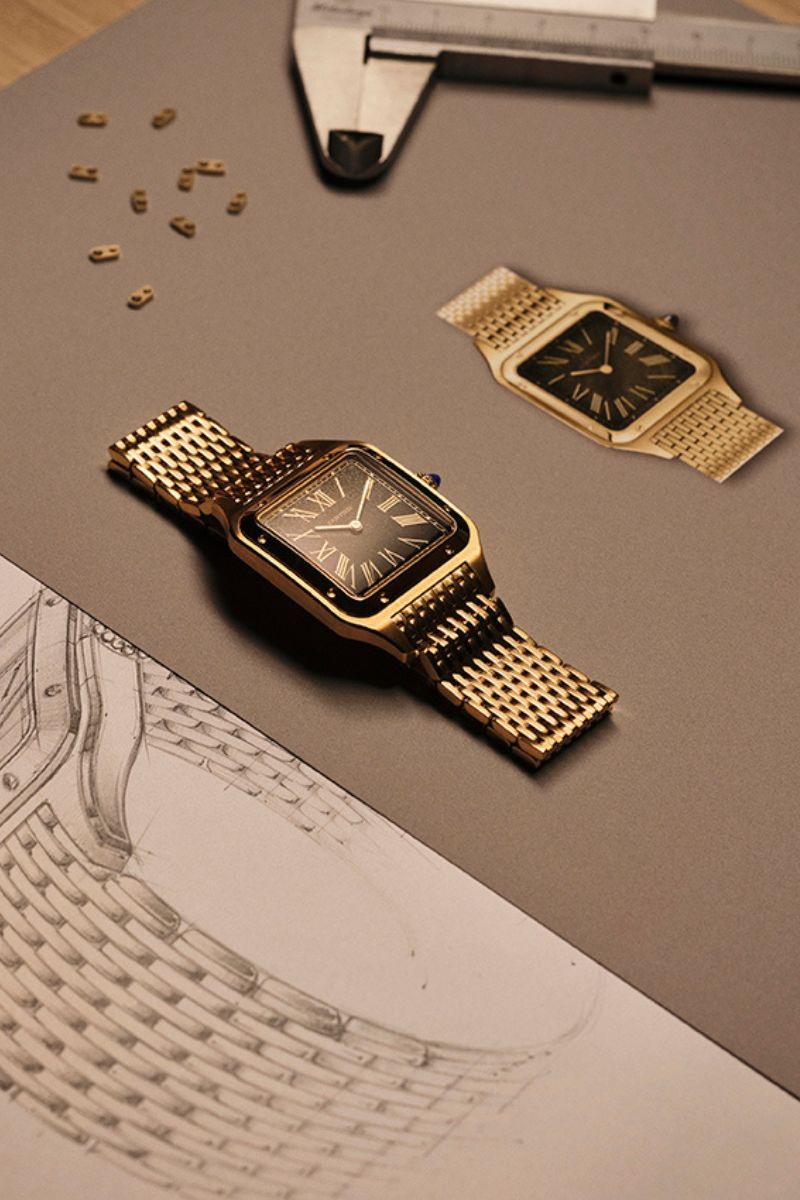
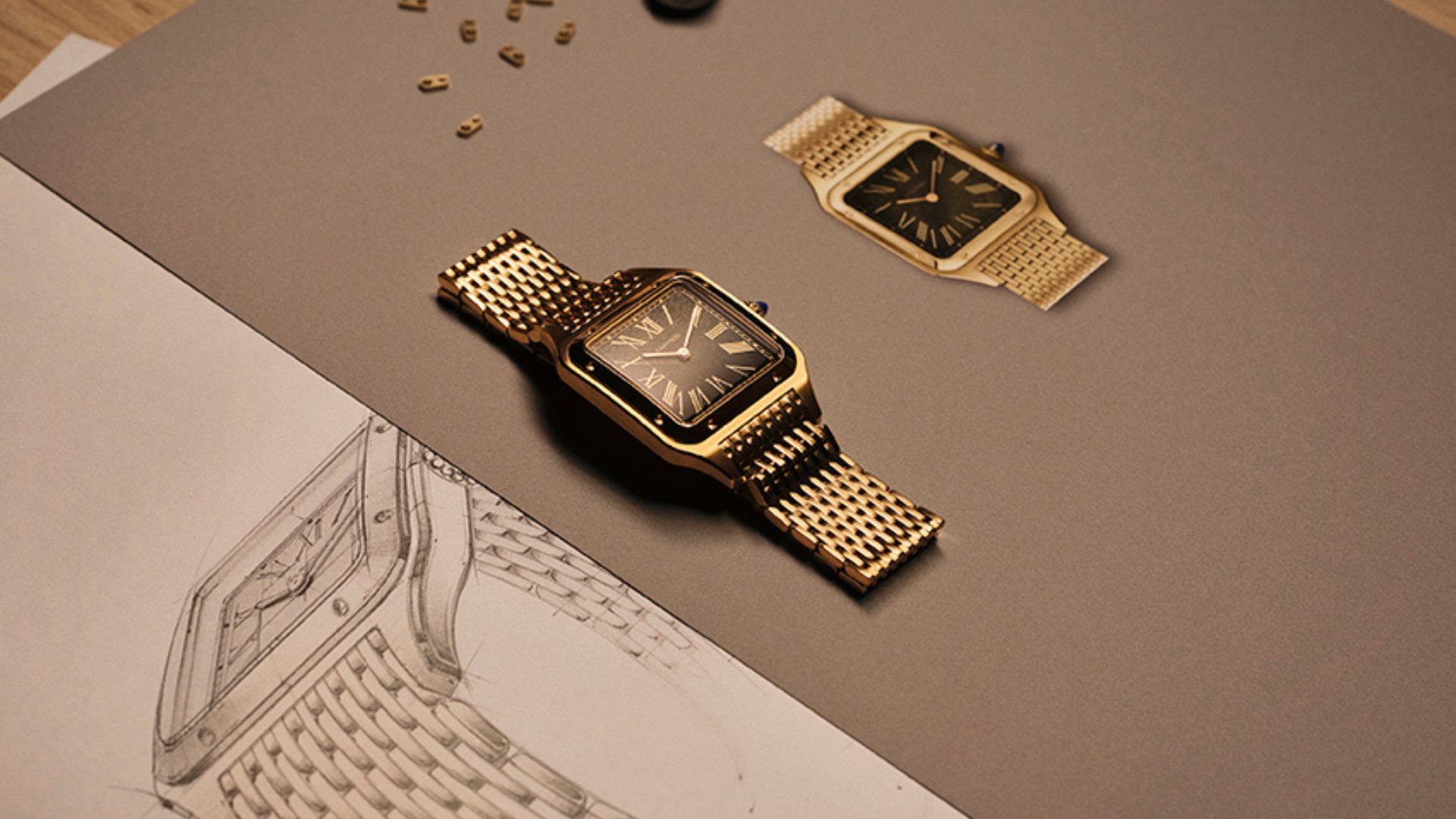
For 2026, Cartier has leaned into the more decorative side of the design. The headline model arrives in yellow gold with a gilded obsidian dial and a matching mesh-style bracelet, joined by two more restrained versions in yellow gold and platinum with silvered satin-finished dials. The LM-sized case measures 43.5mm by 31.4mm and is just 7.3mm thick. Those dimensions may sound large on paper, but shaped Cartier cases rarely wear according to the numbers. The slim profile, curved case and short overall footprint should keep it elegant rather than imposing.
The basic architecture remains pure Santos-Dumont. Eight visible screws sit around the bezel, while the circular-grained crown is topped with Cartier’s familiar blue cabochon. Water resistance is rated to 30 metres, which tells you almost everything you need to know about the intended use. This is not a precious-metal sports watch masquerading as something practical. It is a delicate dress watch and makes no apologies for it.
The gilded obsidian dial is what turns this particular Santos-Dumont from handsome into genuinely arresting. Sourced from Mexico, the volcanic stone contains tiny trapped air bubbles that produce iridescent reflections as the light moves across it. Since these patterns occur naturally, each dial will have a slightly different texture and appearance.
Working with the material is far from straightforward. Cartier cuts the obsidian down to just 0.3mm, leaving it about as fragile as a thin pane of glass. It is then polished to reveal the stone’s metallic-looking radiance before being fitted into the case. The resulting surface appears somewhere between black, brown and molten gold, depending on the angle.

Cartier keeps the rest of the dial appropriately simple. Gold Roman numerals and sword-shaped hands sit against the dark stone, with no date window, running seconds or unnecessary text cluttering the composition. It is still a simple two-hander, but the changing surface gives it more visual depth than almost any conventional lacquered dial could manage.
Then there is the bracelet, which may be the real reason this version feels so different. Inspired by the made-to-measure metal bracelets Cartier developed during the 1920s, it comprises 394 individual yellow gold links arranged across 15 rows. Each link is only 1.15mm thick, allowing the bracelet to flex and drape around the wrist more like woven fabric than a typical metal band.
All 394 links are machined, finished and assembled at Cartier’s manufacture before the completed bracelet is attached to the case and clasp. It sounds excessive because it is excessive, but the intricacy never comes across as showy for its own sake. Instead, the bracelet softens the squared-off case and makes the entire watch feel more like a piece of jewellery.
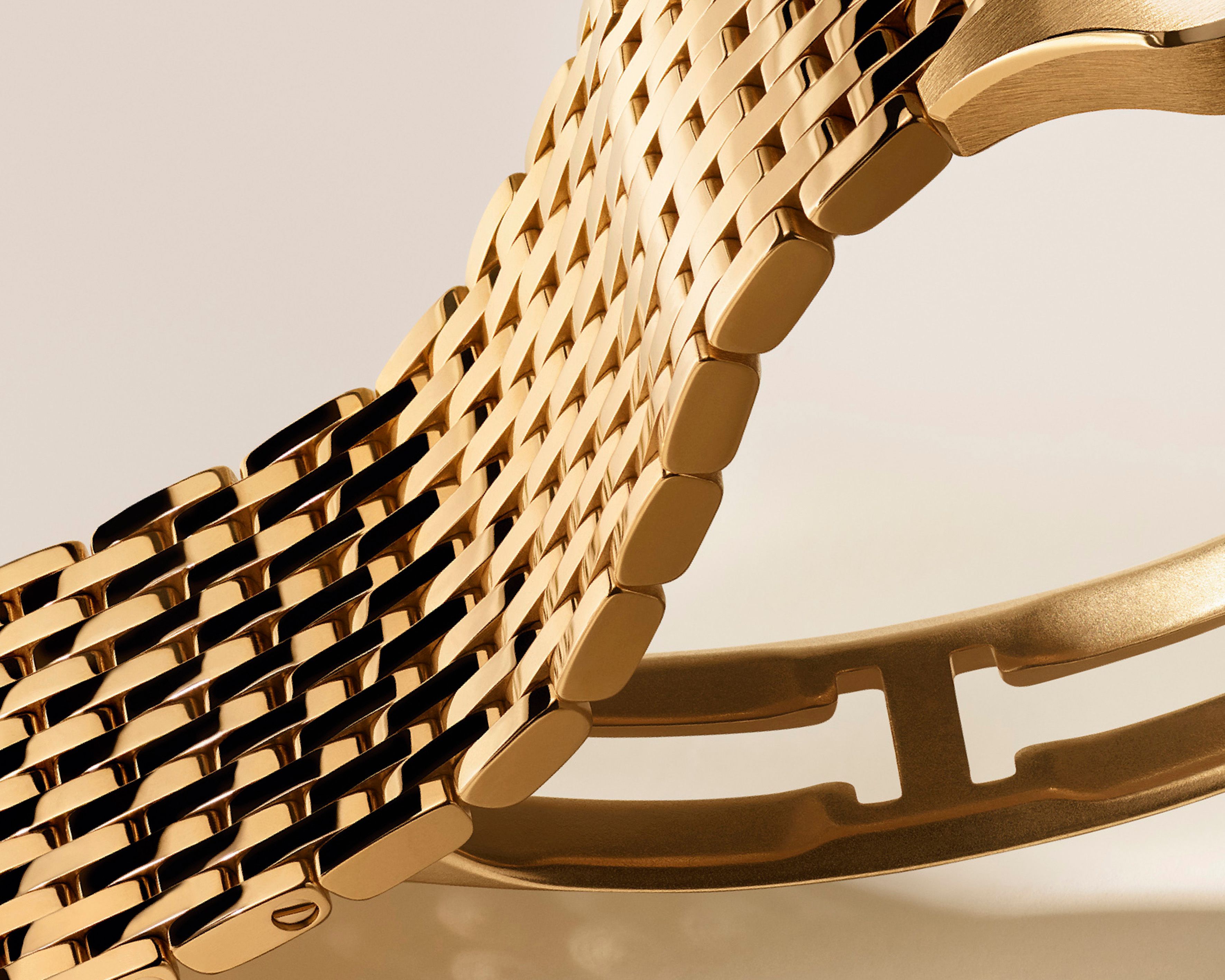
That matters because the Santos-Dumont has usually been seen on leather. Putting it on such a fine, highly flexible bracelet changes its character completely. The watch no longer feels quite so formal or historically reverent. It becomes warmer, richer and considerably more sensual. This is the first Santos-Dumont in a while that has made me look past the history lesson and simply want the thing.
The two accompanying models offer a more traditional interpretation. Both use silvered satin-finished dials with a sunray effect, with one housed in yellow gold and the other in platinum. Each is paired with a matching precious-metal bracelet and retains the same LM dimensions. They are handsome, certainly, but the obsidian model is plainly the one doing the heavy lifting here.

Inside all three watches is Cartier’s hand-wound manufacture Calibre 430 MC. The manual movement helps keep the case to a slender 7.3mm and feels entirely appropriate for the Santos-Dumont. An automatic movement would be more convenient, but convenience is hardly the point of a thin gold watch with a stone dial and almost 400 bracelet links. Winding it by hand feels like part of the deal.
Pricing has not yet been announced, although the combination of precious metal, a hard-stone dial and that bracelet makes it safe to assume this will sit towards the sharper end of the Santos-Dumont collection.
The new Santos-Dumont does not dramatically rewrite the model. Cartier has kept its familiar proportions, Roman numerals, exposed screws and manually wound movement, then transformed its personality through material and texture. The gilded obsidian dial gives each watch an individual, constantly shifting appearance, while the 394-link bracelet brings an almost absurd level of delicacy to the wrist. I may still be a Tank person at heart, but this is the Santos-Dumont that finally makes me understand the obsession.


