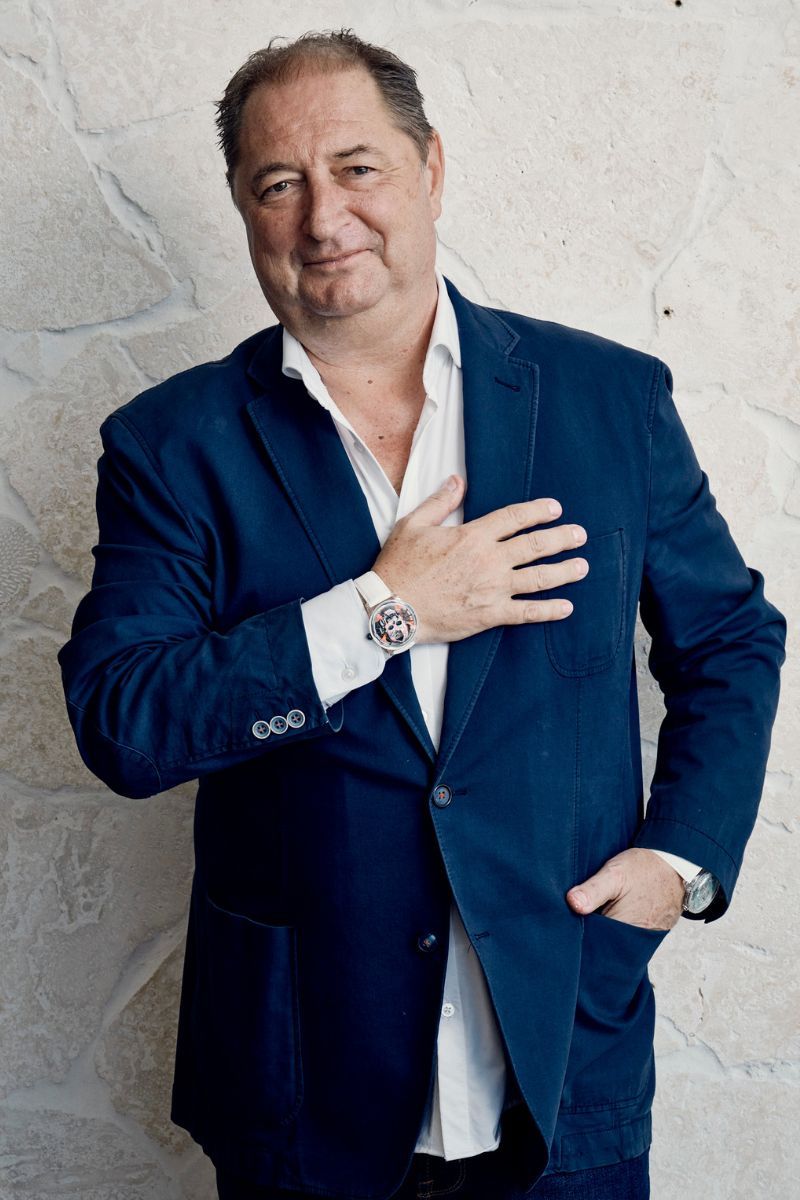

Over the last year, Jaquet Droz has quietly undergone a fascinating evolution. Once the Swatch Group’s most poetic outlier, the maison has re-emerged under the leadership of Alain Delamuraz with a renewed focus on its mechanical theatre — automata, enamel painting, miniature sculpture, and métiers d’art that blur the line between horology and haute craftsmanship. It’s been a year of ambitious reinvention: the Bird Automaton Sapphire, the Lotus Flower automata, and a wave of bespoke commissions that take the brand’s 18th-century ingenuity into the realm of modern collectors.
At the centre of this shift is Delamuraz himself — a man who speaks of luxury the way a chef might describe flavour. Before joining the Swatch Group in 1997, he spent more than a decade running some of the world’s most storied hotels, including the Beau-Rivage Palace in Lausanne, where he became the youngest general manager in the Leading Hotels of the World network. That instinct for hospitality has stayed with him. It colours how he thinks about collectors, client relations, and the art of surprise — qualities that defined his 18-year tenure at Blancpain, where he helped expand the brand’s boutique network, launch its Ocean Commitment initiative, and co-found the Blancpain GT Series.
Today, as CEO of Jaquet Droz, Delamuraz is steering the maison toward what he calls “Vision 8.0” — a philosophy that views each watch as an emotional object rather than a financial one. “There is no luxury without emotion,” he insists, echoing the brand’s founder Pierre Jaquet-Droz, whose 18th-century automata once astonished European courts and the Emperor of China alike. The parallels aren’t lost on him: three centuries later, Delamuraz finds himself in a similar position, bringing mechanical wonder back to a jaded audience.
In this conversation with Man’s World, he speaks candidly about redefining rarity in an era of overexposure, how hospitality principles shape his approach to watchmaking, and why India — with its appetite for art, heritage, and bespoke creation — may well be the maison’s next great chapter.
Over the past year, Jaquet Droz has doubled down on métiers d’art and automata. How do you balance the brand’s artistic identity with the demand for everyday wearable luxury?
Over the last twenty years, the relationship between a luxury product — a piece of art — and the collector has completely evolved. People know more, they read more, they visit more manufactures, so they think they’ve seen it all. They come to us and say, “I already know how this works.” But when they walk in and see our enamellers, the micro-engravers, the sculptors — when they see the patience and the human touch — they always end up saying, “Wow, I didn’t know.” For me, that’s real luxury today — when I can show you something you don’t already know.
Everyone believes they know everything, but we can still surprise them. What we do is unique in the world. We also see collectors evolving. Twenty years ago, they were buying status symbols — a watch to be recognised, to say “look what I have.” Today the real collectors buy for themselves, not for the street. They buy a piece of art for their circle, for their home, maybe for their children. Some people still want visibility, but we’re not chasing that. If you want people to recognise your watch from across the room, we’re not your brand. We want to speak to people who understand art, not speculation. You don’t buy a Jaquet Droz to sell it two years later and make money — you buy it because you fall in love, and you want to pass it on.
Indian collectors are becoming increasingly design-oriented rather than logo-driven. Where does Jaquet Droz fit into that shift?
Perfectly! (laughs) Many of our watches don’t even carry the logo. When I first proposed that, people said, “You’re crazy — how will they know it’s Jaquet Droz?” But that’s the point. You buy the know-how, the emotion, the relationship with the artist who made it. You know it’s a Jaquet Droz because you bought it from us.
I’m not a co-branding guy. If we collaborate, it’s to create something together, not to plaster two logos on a dial. This is another world from the billboard brands. I did that at Blancpain for years — but here, it’s personal. The collector explains the story to his friends: “You’ll never have this watch because it’s mine and it’s unique.” That’s luxury.
You came from hospitality, where guest experience is everything. Who’s harder to please, hotel guests or watch collectors?
Honestly, it’s the same (laughs). Hospitality is an attitude, but it’s also a profession. People think they can open a hotel because they know how to cook or make their bed — but no, it’s a job. You learn details, empathy, timing. At Jaquet Droz we apply the same rules: welcome warmly, give before you receive, follow up. When someone buys a watch, you don’t just shake hands and forget them. You call them a week later — “Is the bracelet comfortable? Did you understand the moon-phase? What did your friends think?” That’s hospitality.
Collectors at this level expect connection, not calculation. And it’s funny — the clients who buy half-million-franc pieces are usually the easiest to please. They’re cultured, they don’t compare or negotiate. They know they’re buying something unique. It’s those in the middle, spending thirty or fifty thousand, who compare brands and ask for data. It’s normal — but once you reach the level of art, it becomes emotional, not technical.
This year we’ve seen striking enamel and miniature-painting dials at Jaquet Droz. Which artisanal techniques do you feel resonate most with younger collectors?
I like to compare it to a three-Michelin-star chef. He has his classic dishes — the “signature menu” — that he’s perfected for years. That’s our gold cases, our birds, our romantic scenes. But sometimes the new generation wants spice — they respect the craft but don’t want to wear the same watch as their father.
So, we add new materials, new colours, new energy. Maybe a sapphire case, maybe something wild like a skull in bright yellow. It’s about evolution without betrayal. I call it disruptive legacy — respecting tradition but adding spice to the sauce. You can’t just repeat what your teacher did. To respect the master, you must push the art forward.
Automata have always defined Jaquet Droz. With so many global launches over the past year, are these halo creations or the heart of the brand?
They’re our heart, absolutely. Our founder made watches for kings — and every king received something unique. When you create for royalty, you don’t make the same watch twice. That’s the spirit we follow. We’re not trying to be everywhere; we even closed all boutiques, multibrand retailers and monobrand boutiques to focus on one-to-one relationships. Luxury today shouldn’t be money-for-product; it should be human-for-human. I want the client to know the artist who made their watch. When you meet the artisan who spent six months engraving your dial, the connection is forever. So yes, automata elevate the brand — but they also keep our soul alive.
Go to the museums in La Chaux-de-Fonds or Neuchâtel. They have automata from 1770 that still work — birds singing, pianists playing, writers writing! When you see that, you understand the genius of Jaquet Droz. Today we reinterpret that spirit in wearable form. One collector told me his gold automaton was too heavy, so we remade it in titanium — lighter, sportier, still poetic. Inside, tiny cylinders push air to make the bird move, flap its wings, open its beak. It’s like a miniature engine — mechanical like a car, romantic like art. That mix is our DNA. Even the Emperor of China was a fan of Jaquet Droz; the Forbidden City still holds several pieces. So we draw inspiration from the past, but always ask: how do we bring that wonder into today’s world?
How do you see these automaton trends evolving?
By creating, always. I tell my artists: take time to lose your time. When you only produce on order, you deliver. But when you dream without deadline, you innovate. Right now we’re experimenting with enamel on sapphire — technically difficult because of the heat, but maybe one day it will work. A collector once asked us to break a mirror, reassemble it, and engrave his reflection inside — we tried! Some ideas are impossible, some succeed, but creativity only grows if you risk failure.
How has your India strategy evolved this past year? Are you expanding retail or deepening relationships with collectors?
India is the country of the future. Every visit I see the knowledge growing — collectors are educated, curious, emotional. I love the long-term mindset: buying not for resale, but for legacy. “This is for my son, or my daughter.” That’s close to our own philosophy. We’ve already created pieces inspired by Indian culture — unique dials, miniature birds, even conceptual designs that may never be sold but show what’s possible. Like our Japanese Garden piece, these are tributes to culture rather than markets.
I remember one watch we built for a famous musician — a full miniature stage, guitars, lights, even a moving tongue. It took a year to make. That’s what I love: co-creating with clients who have imagination. There is no limit. We can personalise almost anything — dial, movement, animation, materials. It depends on complexity. Some projects take months, some take years. But everything starts from a conversation. The only real limit is imagination.
You’ve long championed sustainability. How is that integrated into Jaquet Droz’s métiers d’art ecosystem?
I believe those who have the means also have the responsibility to show the way. At Blancpain we had the Ocean Commitment — protecting five million square kilometres of ocean. At Jaquet Droz the context is different, but the mindset remains. We track the origin of materials, avoid unnecessary leather, and explore recycled options. We’re small-scale, so we can be careful — no plastic, or if we use it, it’s recycled. Even small gestures count. Luxury and sustainability are not enemies; they must coexist.
Looking ahead, what’s one innovation or direction that will define Jaquet Droz in 2026 — and where does India fit in?
Some things must stay secret (smiles). But I can tell you this — we’ll focus more on women. Our watches are already elegant and poetic, but we want more pieces for women, perhaps by women. There’s one prototype I love — a lotus flower that opens to reveal a rotating diamond inside. It’s pure poetry. That’s the spirit of Jaquet Droz: to surprise, to move.
And finally, what advice would you give to young collectors or entrepreneurs?
Challenge yourself, and be ready to change your mind. Darwin said it best: it’s not the strongest or the smartest who survive, but the ones most responsive to change. The world is unpredictable — you must stay flexible, creative, and fast. That’s how you stay alive — and that’s true for people, and for brands.
Interview by Veer Mehta


