For decades now, many-a-household-refrigerators have featured a child’s approximation of a car, etched in crayon. More specifically, an SUV. It’s always been a square box with wheels. A shape signifying a vehicle of intent, purpose and power free of the nuances of modern design which include sloping rooflines and tapering shoulder lines. It’s this attempt to reclaim the joy of unrestricted mobility and freedom, delivered through geometric simplicity and reinforced by the mechanical complexity belying it, that makes the Mercedes-Benz G-Class SUV one of the most easily recognisable and sought-after machines today.
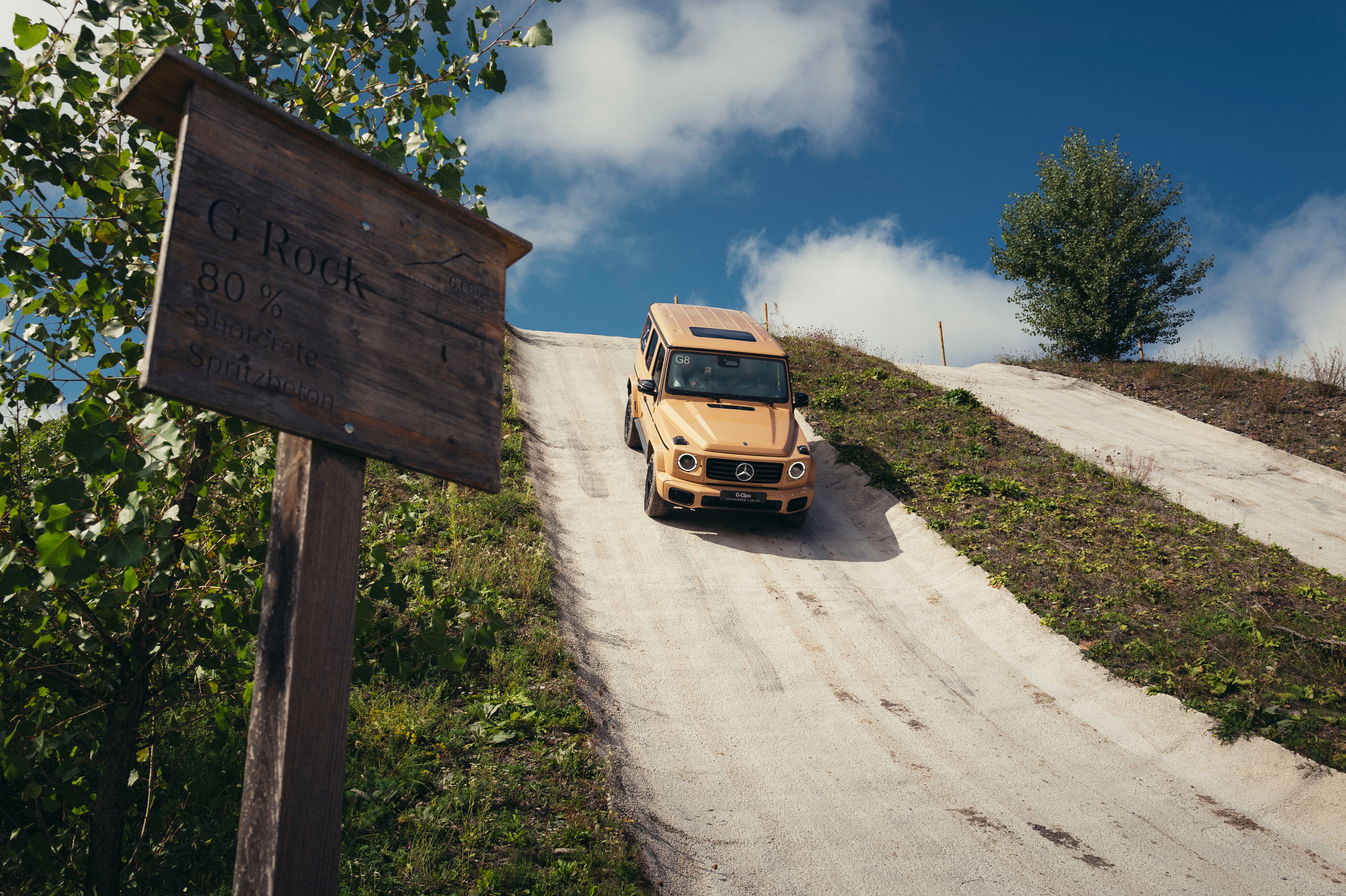
It all starts in Graz, Austria which happens to be home to two lantern-jawed icons—Arnold Schwarzenegger and the G-Class. Adjacent to the Graz airport is a field peppered with brightly coloured G-Wagons. It’s called the G-Class Experience Centre and in a way, it feels like a surreal descent into the G-Class’s subconscious. A place where its custodians let their imagination run wild. There’s a G parked on a near vertical surface, a monstrous G63 AMG 6x6 perched menacingly on a rock right next to a Mercedes-AMG G650 Landaulette which is the most otherworldly creation you can lay your eyes on; a V12-powered G-Class given the full Maybach treatment with S-Class-like reclining seats and hot stone massage functions.
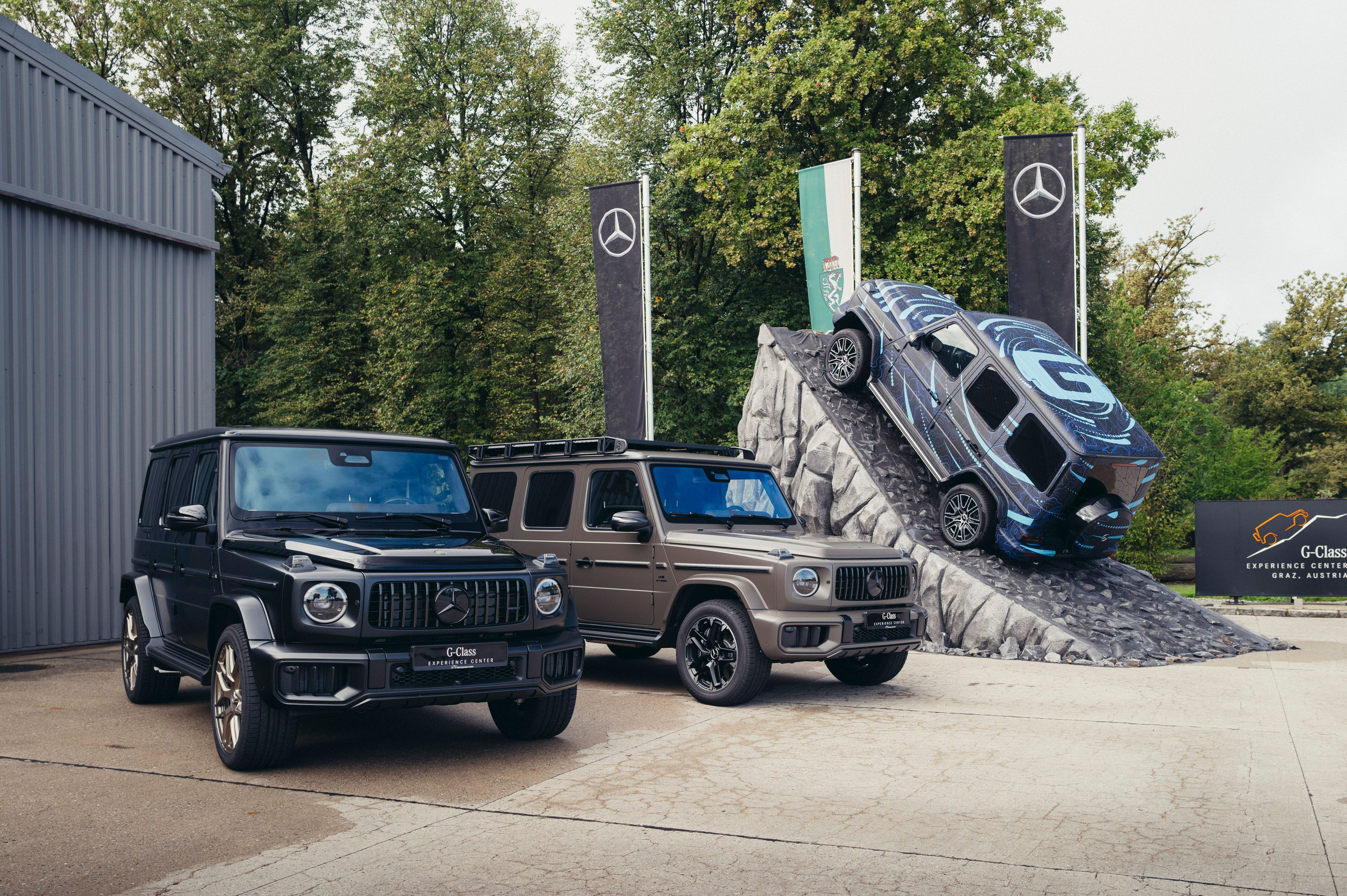
Created in 1979, the G-Class was born of a whim. In the early 1970s, the Shah of Iran, back then a major Daimler shareholder approached Mercedes-Benz to invent a capable off-roader designed for both civilian and military use. For a brand clearly focussed on luxury and performance, in swashbuckling sedans and fuel-injected sports coupés, this was relatively unfamiliar territory as they only had the ridiculously capable, albeit not mass-produced Unimog to serve as a sort of precursor. The brand partnered with Steyr-Daimler-Puch in Graz, Austria, a place that the G-Class has been exclusively built out of since 1979, at the Magna-Steyr plant that’s only a few minutes away from the experience centre.
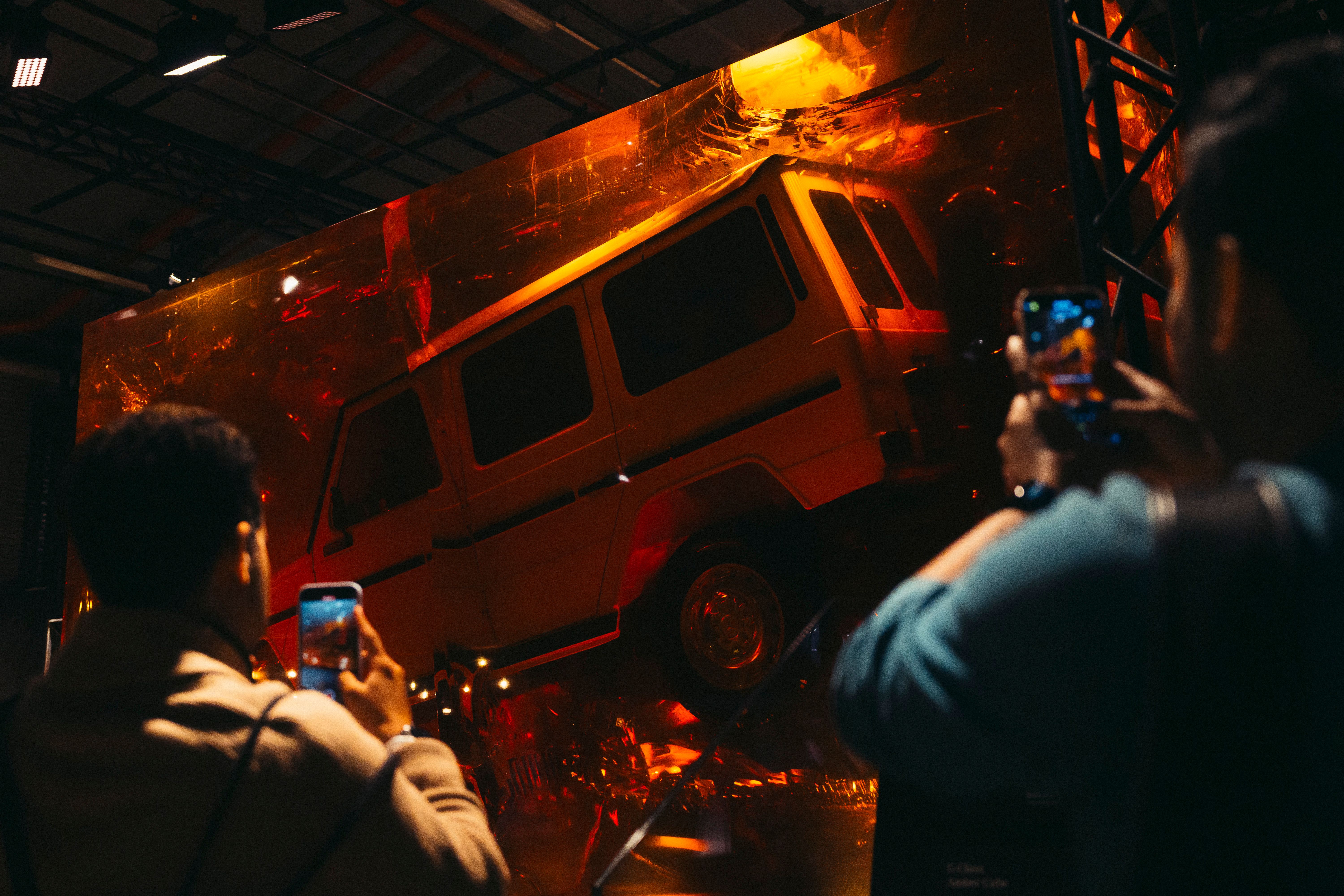
The Experience Centre was built in 2019, to commemorate the 40th anniversary of the iconic G. By this point the G had obtained cult status, having served in 63 national armies and spawned a variety of high-powered derivatives the most sought after of which continues to be the twin-turbo V8-powered G63 AMG. Six years later, the G has its own dedicated electric variant, pirouetting on the spot and barrelling down straights, stealthier and more capable than ever. A little over a year old and it’s already accounting for 10% of all G-Class sales. But despite its steady evolution in the pursuit of horizons both vertical and horizontal, the G-Class has remained true to its origins. Every single one features a ladder-on-frame chassis, a low-range gearbox, three mechanical locking differentials and four-wheel drive. In the case of the G580 with EQ Technology, you get four individual electric motors at each wheel distributing torque dynamically to each wheel. As if to demonstrate this metaphorically, Mercedes has placed a giant 40-tonne resin cube inside a large hangar at the Experience Centre. Inside it is a first-gen G-Wagon, literally frozen in amber and impervious to the ravages of time. Walk further into the inner corridors of the hangar and you can see ensconced behind glass cases, a Victorinox Swiss Army Knife, a Chuck Taylor All-Star shoe, a Lego brick and a few other pioneers of product design that have remained largely unchanged over the decades. Designs that got it right the first time. The G-Class, perhaps more so than even the 911 has followed the diktat of “don’t fix what isn’t broken”. And if you’ve ever driven the G-Class on treacherous terrain, if you’ve ever had the privilege of hearing the finality with which its doors shut, you know that this is a machine that isn’t likely to be broken with ease.
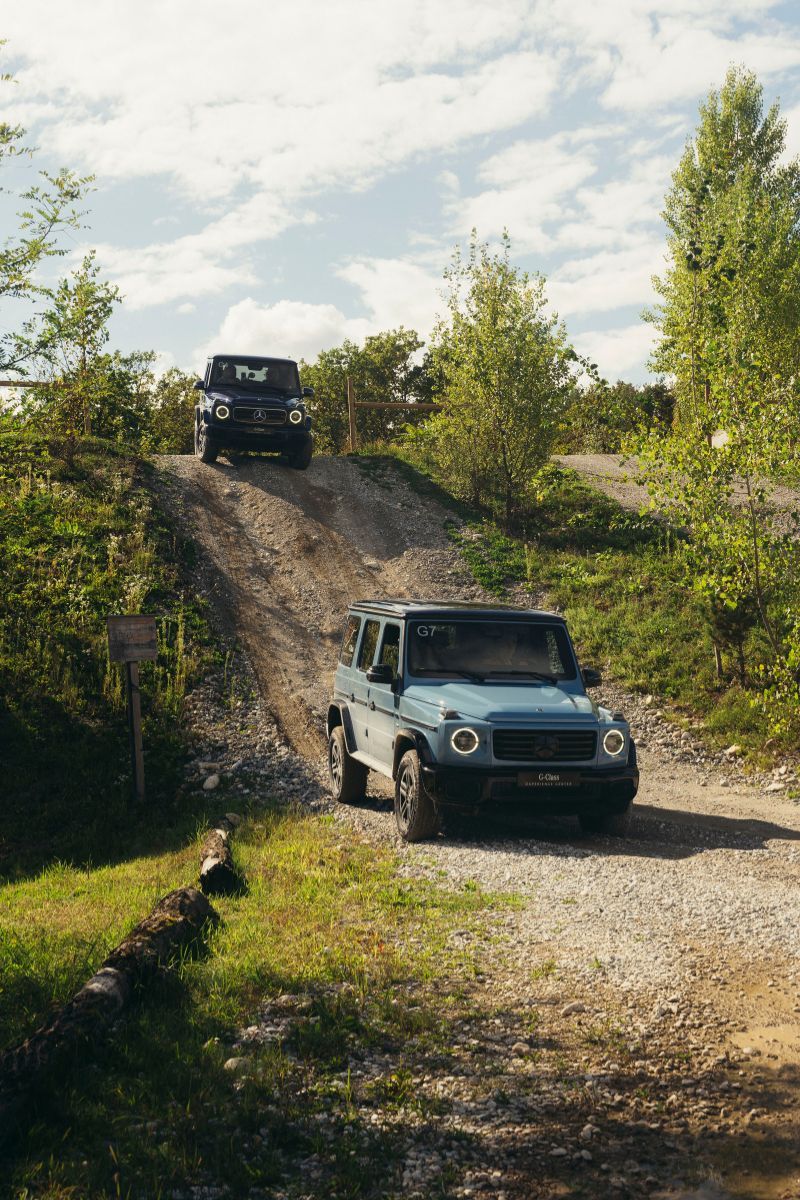
The Experience Centre is divided into four main sections including on-road and off-road driving modules. The day began with the G580 clambering onto a 45-degree ramp, also called a 100 per cent incline which is so steep, you can’t see beyond the crest until the vehicle is over it. The G580 lets you drop into low range at the press of a button. Once engaged, the paddle shifters—normally used for adjusting regenerative braking—take on a new role: modulating acceleration on steep inclines. Choose your setting, ease off, and let the system do the work. No throttle needed. Despite weighing three tonnes, the electric G glides uphill with almost casual effort.
Another button on the dash activates G-Steering, which helps in tight, loose-surface corners. With the wheel turned to full lock, the SUV can pivot cleanly through a sharp 90-degree bend. Then there’s the G-Turn—arguably its biggest party trick—which is even simpler: restart the vehicle, press a button, hold the brakes, and tap a paddle to choose a direction. The G580 will then spin through multiple 360-degree rotations – making a billionaire’s driveway turntable feel unnecessary. There’s simply no other vehicle on the planet that can deliver this much capability with so little driver input. I feel like I’m in charge but only notionally; even a total novice can accomplish incredible feats in the G580, so stupendous is the level of torque and so mind-boggling its technology.
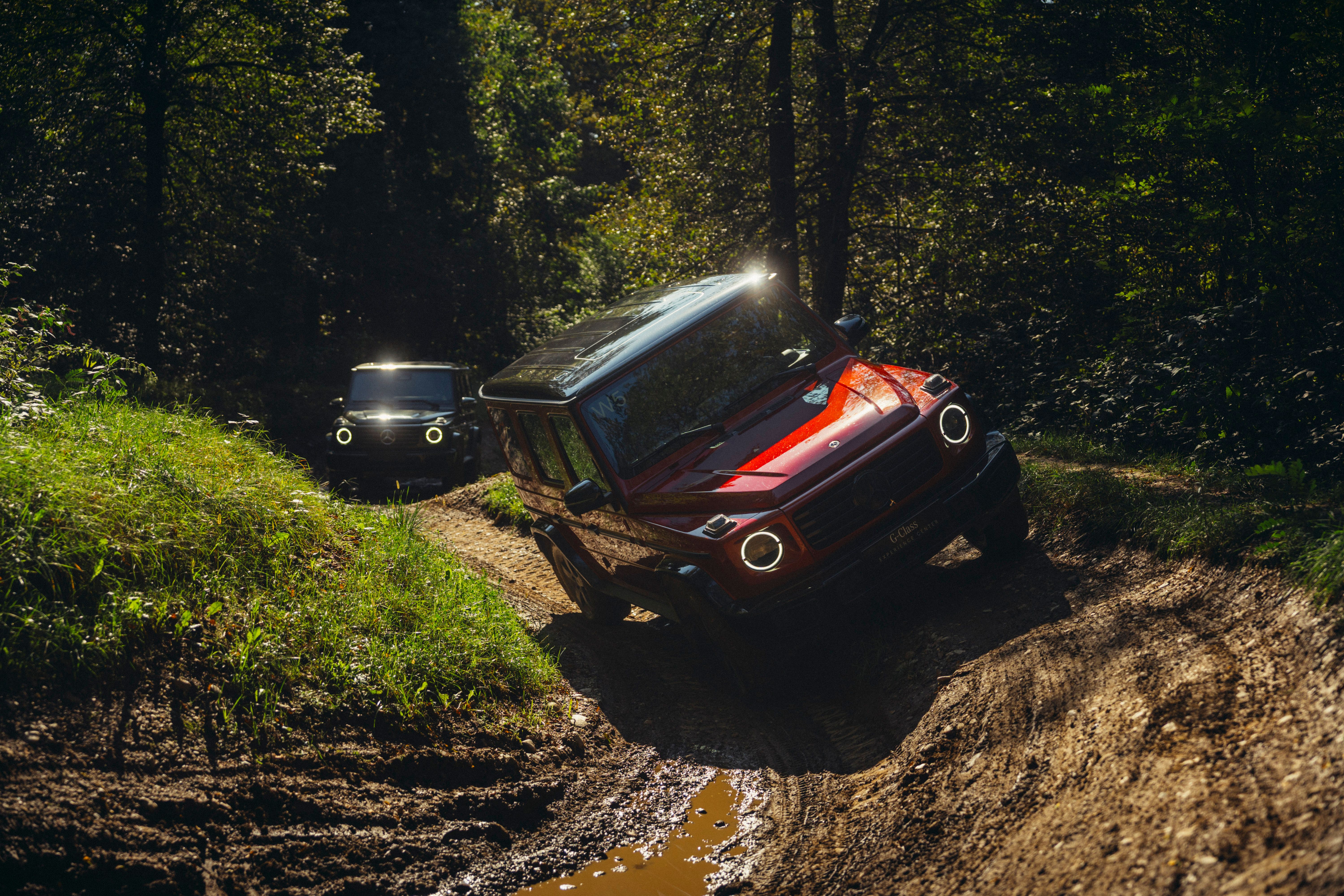
We then move to the forest, hills, water wading and asphalt track section, an area meticulously crafted with steep ditches, flanked by large banks of mud and clay followed by a large water fording section—all of which the G-Class, the G450d clears as if it’s a mere warm-up exercise. At one point, I find myself maneuvering the G over a near vertical side incline. It’s so steep, I’m practically able to touch terra firma from the driver’s window, understandably cautious about overturning a sub-Rs 3 crore car. Not that it would faze the G in the slightest, but I’d rather not find out.
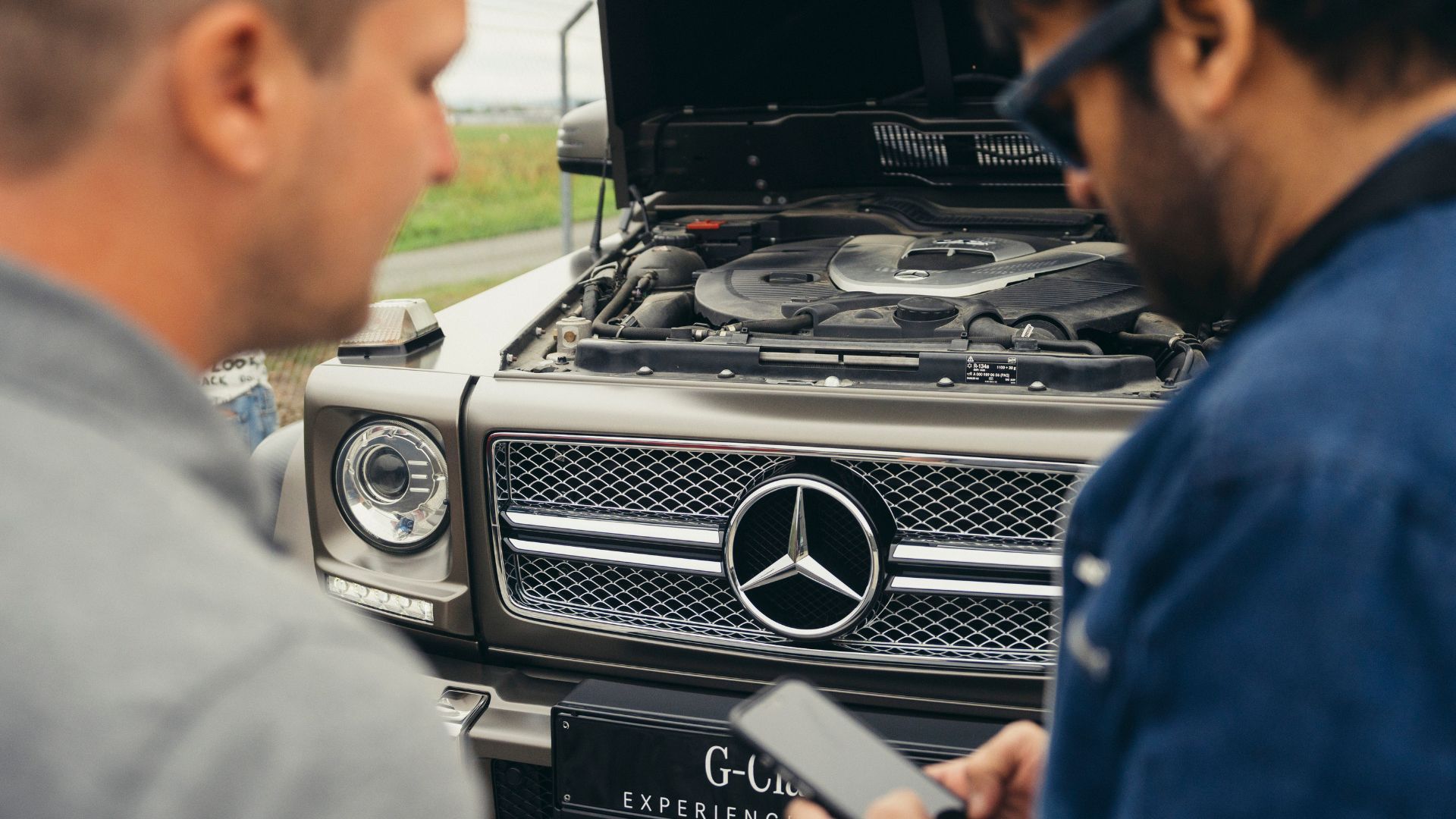
The G-Wagon was never designed to be a corner carver. Whether in G63 form—with its twin-turbo V8 now paired with a 48V mild-hybrid starter motor—or as the all-electric G580 with its 116-kWh battery, it remains a ladder-frame SUV at heart, built more for straight-line punch than track agility. Still, the test centre’s slalom sections showed that both the G580 and G63 can be surprisingly nimble. Limits remain, of course, as the instructor reminded us: “Even the best racer can only manage about 90 kph through here”. And then there’s the G63 itself: a fever dream powered by a 4.0-litre twin-turbo V8. The way it squats, digs in, and launches toward the horizon is equal parts hilarious and awe-inspiring.
The G-Class, in all its permutations, is both a benchmark, a monolith and a symbol of engineering excess. Outside of the Experience Centre, which is designed to offer it, and its owners a proper challenge, its limits are rarely tested. It’s like having an overengineered tool watch, designed to explore the depths of the Mariana Trench—that odds that you’ll put it to the ultimate test are slim—but you’d rather have it on your wrist than not. The G-Class is all things to all people. A status symbol, a survivalist’s escape-mobile, an intensely fortified womb of decadence and on occasion, a tool for intimidation. It’s also a paradox in how it remains frozen in time and yet perpetually darting towards being more fine-tuned, more durable and more capable. As the Styrian sun sets outside the experience centre, glistening off the bright pastel shades of a fresh crop of muddy G-Wagons, it’s hard to imagine any other SUV dethroning this machine. Not because no other SUV appears to be in sight on this particular evening, but because none can scale the heights the G-Class has. Not with such effortless ease.


