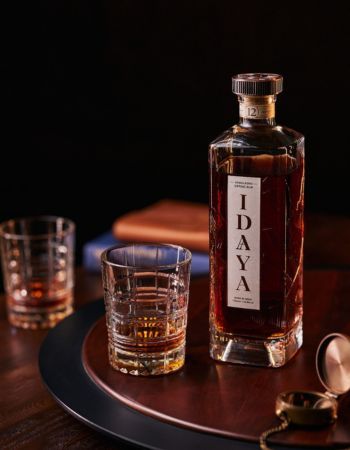
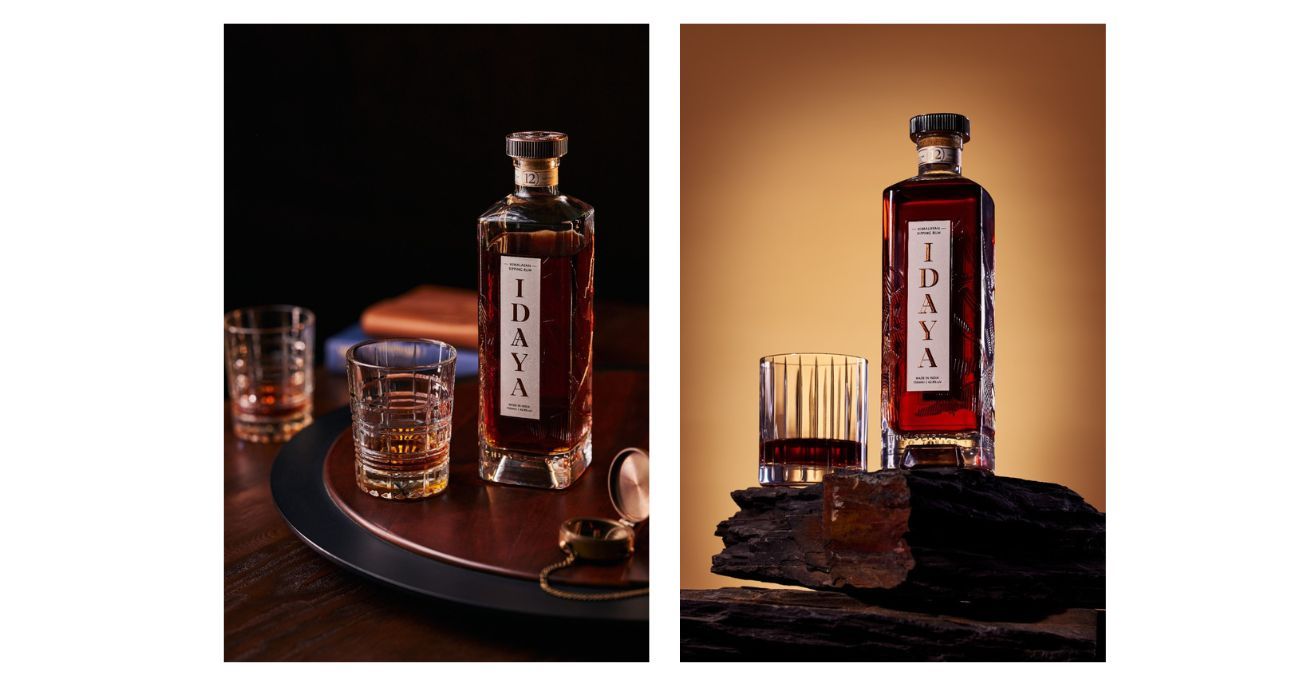
With a background spanning LVMH’s watches and jewellery division and the early brand-building years of Forest Essentials, Karishma Manga Bedi, founder of the Delhi-based company Those Good Distillers, brings her understanding of luxury, storytelling, and consumer experience to Idaaya, the recently launched luxury rum. The name is the coupling of the Sanskrit word `ida’, which means nourishment or vital energy, and `aya’, the last three letters of the word Himalaya, whose water is used in the rum. Blended and aged at a distillery in Samba, near Jammu, the run is made using international expertise and ayurvedic knowledge.
Idaaya is, in the alcobev industry language, a small-batch prestige rum targeted at high-end Indian and international markets. It is meant to be sipped and savoured, challenging long-held perceptions of localrum, which is generally had with mixers like Thums Up and Coke. Priced around ₹7,500 in Delhi, Idaaya is currently available largely through Travel Retail and Duty Free in New Delhi, Mumbai, and Bangalore, and in retail in Gurgaon. The brand plans to expand its retail across key states in India through 2026.

Bedi spoke to Man’s World about her rum journey and future plans.
From LVMH to Forest Essentials to making rum is quite a journey. Tell us about the transition and how it happened.
My understanding of the space of luxury and of the consumer mindset regarding what luxury is and why it is appealing came from my experience working for LVMH in its watches and jewellery department. I married my husbandat a time when he and his mother had just started Forest Essentials. I continued working with LVMH but, within a year, joined Forest Essentials, where I set up and oversaw marketing, communications, the brand loyalty program, and the website. I also got to experience the genesis of what it's like to make a product, what packaging looks like, how to position it, and how to sell it.
My husband and I both have a passion for dark spirits and wine. During COVID, one evening when we opened a bottle of imported rum, we realised there's no high-end rum from India; just Old Monk, which is nostalgia, and a fewothers. We saw it as an opportunity, and one month later, I had a broad idea of what was to be done. The first thing was to return to the world of Ayurveda, because it's the space we, as a family that set up Forest Essentials, understood well. I am not claiming this to be an Ayurvedic product because it is not, but Ayurveda has scriptures that refer to alcohol. While discovering and reading it, I found that the oldest reference to rum comes from India. It's from the Arishtas, written in 300 AD, when an Ayurvedic physician, Vagbhata, first made a fermented sugarcane drink. That became my peg.
Take us through the process of making Idaaya.
I found that Ayurvedic techniques could differentiate the rum when making it. We could subject the ageing cask to two processes, Dhupam and Lepam. The first involves smoking it with spices, while the second involves anointing it with a herb mash. We do this to the sal wood casks we use, which then hold onto the flavour. These processes are exclusive to Idaaya. My study of Ayurveda also helped me understand how casks and vessels were historically treated to clean, purify, and impart flavour.
We then met Chris Armes, who had worked as a master blender for over 20 years, including rums like Ron Zacapa Rum, owned by Diageo. In addition, a friend in the alcobev came on board as a strategic partner to help us understand the liquor business. Needless to say, my husband came on board as an investor.
Our idea was to make a prestige rum for the global market. I wanted a product that was neither too sweet nor too ‘jammy’ in texture. In rum, the older it gets, the drier the taste becomes. And I wanted a drink that was a bit smoky, neither too feminine nor too masculine. Or rum starts as a liquid produced at a craft-first distillery in Panama and aged for 12 years in bourbon casks. Once it arrives at our facility in Jammu, it is blended with an Indian rum made from locally sourced sugarcane juice. The blending is done using the solera system with locally made sal wood casks.
The solera system has been used for centuries to make spirits smoother, more consistent, and more complex over time. Here, the spirit is continuously blended across multiple connected barrels, allowing the oldest spirit to remainin a small proportion for legacy. It offers layered complexity and is considered a best-in-class process for prestige dark spirits such as rum, cognac, sherry, and wine. Because some part of the original liquid is always sitting at the bottom of the barrel, it leads to much higher consistency in the product. It means the 20th batch of bottles is as good as the first.

Why did you choose a complicated process of blending the Panamanian rum with Indian rum?
The question of whether something has been complicated or not has never been considered, given that the objective has always been to create a liquid that would stand shoulder to shoulder with the best in the world. This process led us to create the best version of a sipping rum, which was rich in taste and aroma, was neither masculine nor feminine, and left a long lingering taste without any burn.
Do you think that people would pay that kind of price for an Indian rum? Also, is it a limited batch production?
The liquor industry, globally, is undergoing a major transformation, with consumer preferences shifting towards premium brands. One of the reasons is that people have a better-quality, better-looking product, with betterexperience. It has more to do with rising personal disposable income today, even in India. People are drinking less, but better. For me, liquor is not taboo, but how you drink it; you should drink it with a certain amount of moderation. When you choose moderation, you can opt for a purer blend made with quality ingredients, free of artificial flavours.
Idaaya is for people who are naturally curious. And I feel that curiosity in any person is more of an identity, less about whether something is afforded or not afforded. It has to do with curiosity and a certain amount of aspiration,and whether one buys into that. But it is eventually going back to what I said earlier, drinking something better, but less. When you find that superior product, the drinking experience really changes because you're not drinking to get drunk but to enjoy the moment of sipping something with elevated taste.
We do small-batch production, which means you're not producing large volumes at once. We do a fresh batch as in a couple every couple of months, right now, and the production will speed up as per the requirement, but it will remain a small-batch production.
Gin had its moment in recent years, with lots of people taking to drinking gin and gin-based cocktails. But that has faded now, and people have moved on to Tequila. Do you expect rum to have a similar moment?
Gin doesn't have much creativity in its production, since it's essentially neutral alcohol with flavours added. Vodka is pretty similar within that space. However, dark spirits have that creative flair, whether it's the temperature, malting, roast, or the processes–whether it's a copper pot still or a column still. The creativity impacts the end liquid. Internationally, rum has been experiencing renaissance for some time.
With brown spirits, the lead time is a lot longer. It's a slow burn and a gradual increase. I strongly believe that one of the reasons why this occurs is that the loyalty to the brown spirit is a lot higher than it is to the white spirit. There is a lot of new-age, modern rum that is breaking away from traditional patterns. While there are a few other rums that have an ‘age’ claim or are positioned as premium, I think Idaaya is still a novel product because it aims not just to package and sell, but to offer an experience of what drinking a good spirit is like. There's no timeline for something like this, but I feel there is enough appreciation for quality spirits in India now, and people aren'taverse to trying something new.
India is essentially a whisky-drinking country; do you expect some of these drinkers to convert to drinking rum?
Idaaya, from a taste perspective, is less like rum in many ways, but (very) closely mirrors whiskey of high quality. Drinking Old-fashioned (made with Bourbon) and drinking Idaaya on ice with an orange rind are very close. The point is that there is enough similarity in this product for a single malt whiskey drinker to feel a level of affinity.
I also believe that no consumer drinks only one thing. It changes depending on mood, hour of the day, and offerings available at the bar. One may drink gin in the afternoon, tequila for a sundowner, and rum or a single maltwhiskey at night.
A lot of work seems to have gone into creating the Idaaya bottle.
For me, the product is so classic that I wanted it to have that old-school value. I did not want it to look like a bottle, but a beautiful decanter. I also wanted the narrative of the Himalayas to be presented in a contemporary manner, so we fluted the entire Himalayan range across the bottle. In Ayurveda, copper is the metal of choice, so the cap is made from copper. It is also inspired by a compass. The hidden meaning behind it is that a compass always points north, and it’s about finding your true path or your true belief in a more modern context. There is a hidden feature in the cap: if you invert it onto a cube of ice, it will leave its mark behind. The labelling has been kept minimalisticto let the bottle shine.
Is rum the beginning of your alcohol journey?
When we started, the idea was to create brands that would take India to the rest of the world, and we are on track to build on that vision. Idaaya was the first; it was easier to do at this price point, and it was a conscious decision. More things are coming up, and 2026 will be a big year for us.


