You do not come to NAAR by accident. By the time dinner begins, the drive has already done part of the editing for it. The city has fallen away, your signal has become unreliable, and your brain, finally deprived of its usual rubbish, starts paying attention again. On this particular evening, hosted by The Singleton and built around a one-off menu with chef Manu Buffara, that sense of remove felt central to the whole thing. You were not being sold escape. You had already gone out and found it.
That, really, is the first thing worth saying about NAAR. It is not just a restaurant you book. It is a restaurant you commit to. Co-owner and custodian Akshay Tripathi put it well when he described the place as ‘like lego blocks… a village within a village.’ He also pointed out the obvious but important bit: ‘A lot of people are travelling in at least 3 to 4 hours, driving in and coming here.’ That changes the terms immediately. ‘It’s a commitment,’ he said, ‘unlike in a city that you can call up a restaurant and say I’ll make it tonight.’
There is always a temptation with destination dining to make the distance do too much of the storytelling. NAAR is more interesting because it does not seem especially eager to romanticise the inconvenience. The road matters, yes, but mostly because it alters your attention span. By the time you sit down, you are already moving at a different speed. That slower rhythm suits the restaurant. It suits the hills. And on a night like this, it suited The Singleton too.
It also helps that NAAR does not feel built purely for the guest. ‘This is our house,’ Tripathi said while standing at a small outcropping just outside the restaurant, overlooking an eastward gorge. It seemed to function as a bit of everything: meeting ground, winter campfire corner, and, I’d wager, sunrise yoga spot for someone living or working here. ‘The place is meant for the staff here as much as the guests.’ The point is sharp. Much of NAAR’s atmosphere comes from the fact that it feels inhabited rather than staged.
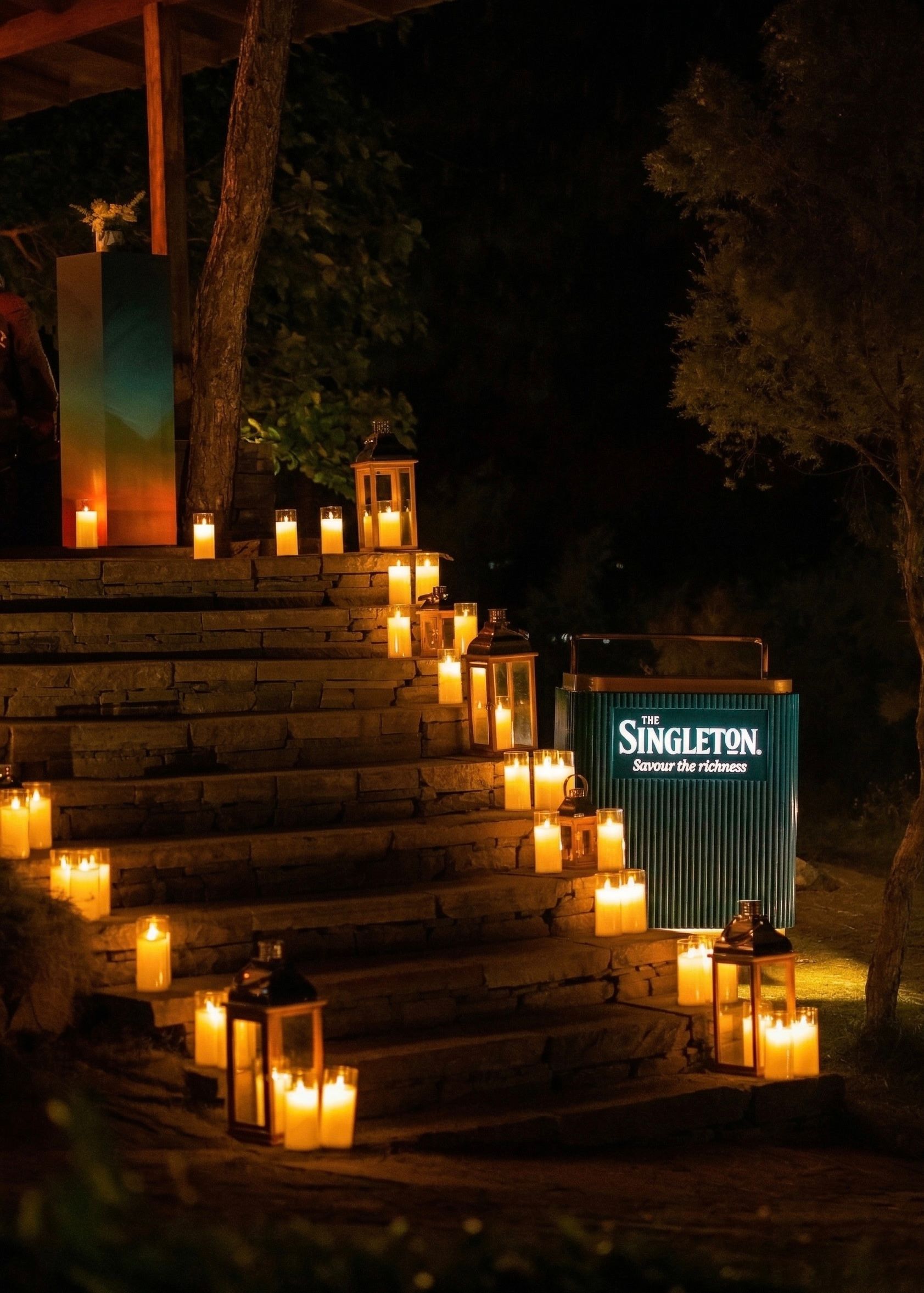
Kasauli, with its winding roads and endless views, is a far cry from Mumbai, or even Chandigarh, where we had arrived from. The mind tends to unravel a little in terrain like this, and mine certainly did. A short walk from the restaurant, or a hike if you asked my hamstrings the next morning, sat the hillside property where we were put up, which also happened to be where the staff live full-time. I found myself thinking about that often over the course of the evening. Many of the culinary professionals I would soon meet likely came up through the same fast, punishing, city-bred kitchens that define so much of modern Indian hospitality. To leave that behind and build a life of work in these quieter hills must be its own adjustment, one that says as much about the person behind the apron as it does about the hands moving in front of you.
That thought felt especially relevant with Prateek Sadhu in the frame. Before NAAR, he was best known as the opening chef and a co-owner at Masque in Mumbai before leaving in 2022 and heading back towards the mountains to build something more intimate and place-led. So when you look at NAAR and sense that it feels calmer, more lived-in, less eager to advertise its own cleverness than many destination spots, that is not accidental. It feels, in part, like the work of someone who has already done the city version of ambition and chosen a different shape for it.
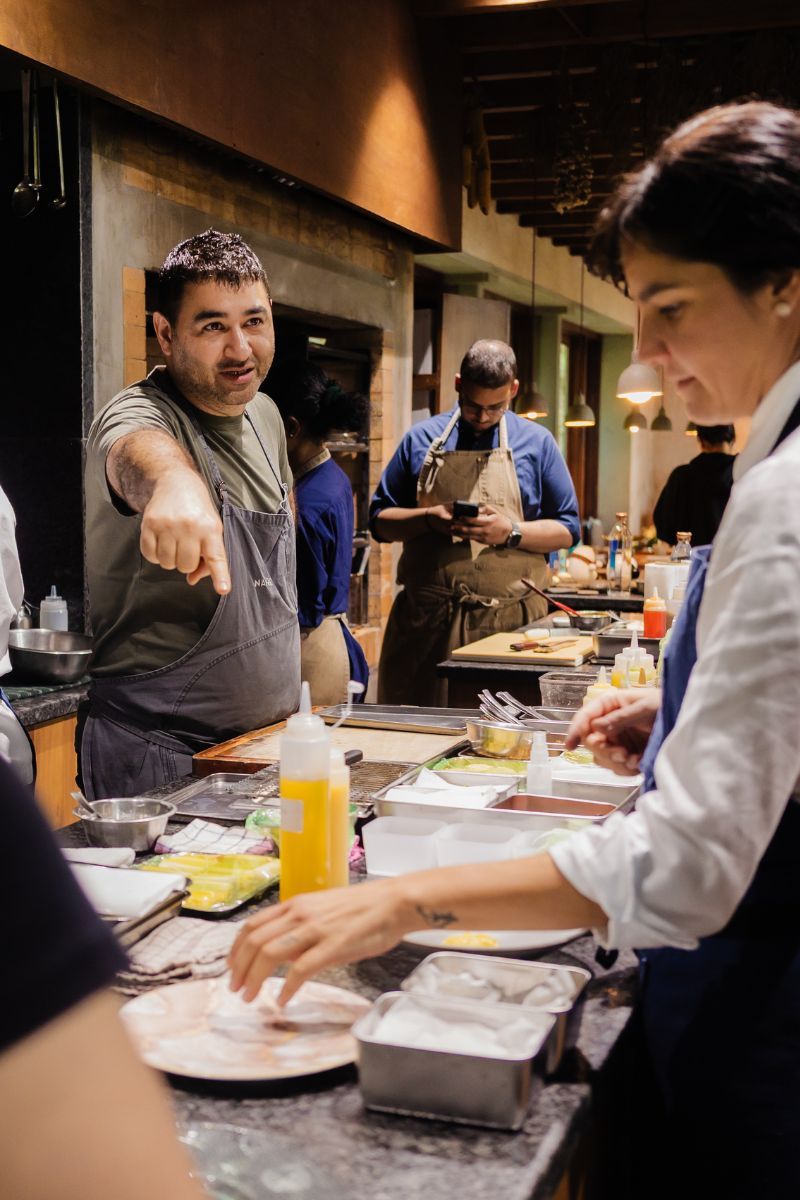
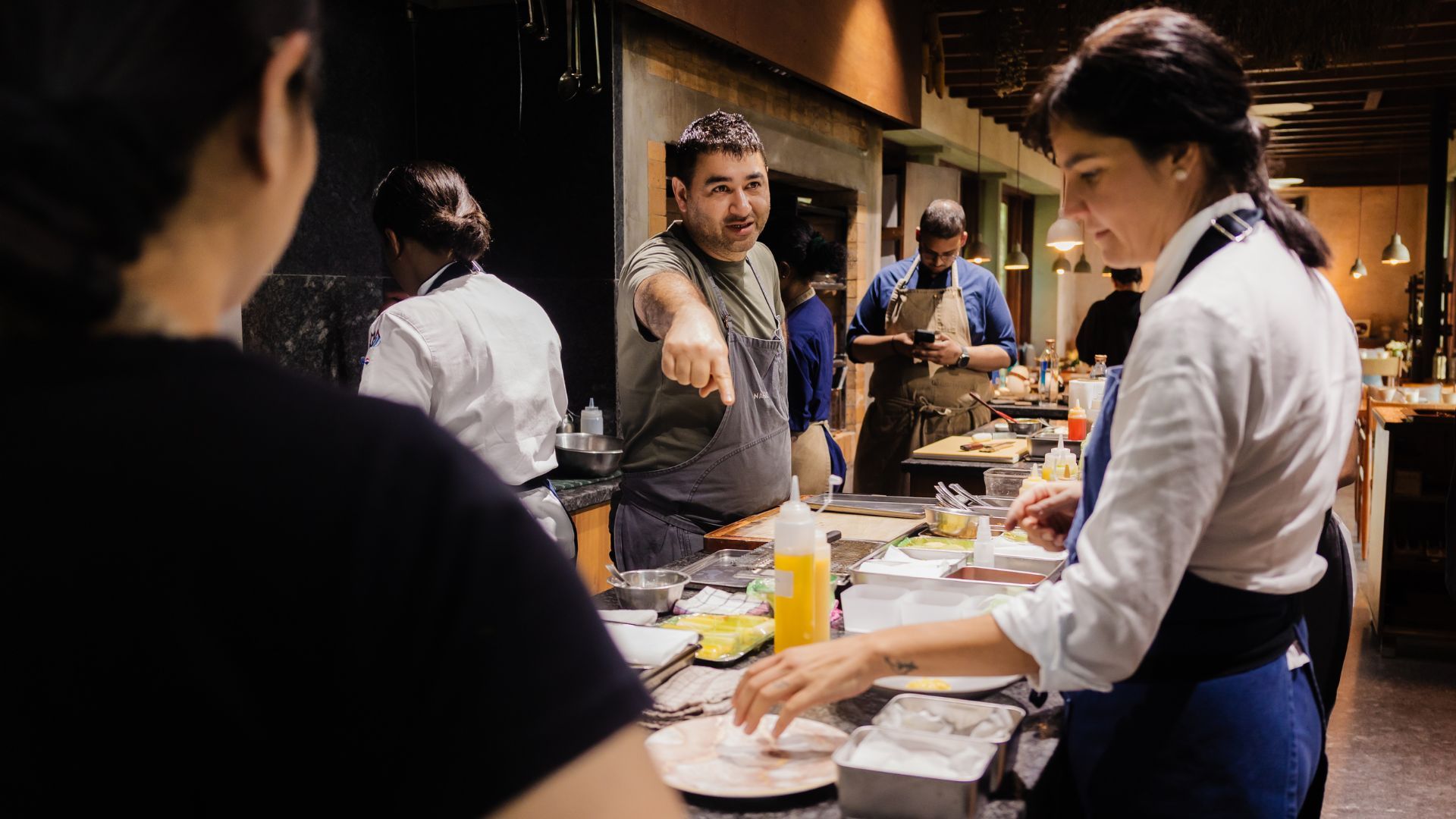
The open kitchen is a big part of why that choice lands so clearly. There is very little mystery to hide behind here; you can watch almost everything. For diners, and especially for wine-and-whisky-happy writers who already spend an unhealthy amount of time people-watching, that is half the pleasure. The brigade moves in plain sight. Plates gather, leave, return. Somebody checks a sauce, somebody turns, somebody wipes a rim, somebody reaches across for the exact thing required only to have it precognitively handed to them. It is not theatre in the usual sense. It is simply absorbing. You are never allowed to forget that dinner is being made right there, in full view, by a crew moving with the kind of ease that only comes from repetition and trust.
That mattered on a night like this one, because there were enough moving parts here to make the whole thing insufferably self-aware if handled badly. A destination restaurant. A premium single malt. A widely admired guest chef. A room full of people who know they are in on something special. Any one of those can make a dinner stiff. All of them together can kill it. Instead, the evening stayed surprisingly loose, and a lot of that came down to the way The Singleton entered the room.
It did not feel tacked on, which is rarer than brands would like to admit. The Singleton was not just there to host the evening and appear politely in the copy afterwards. It helped establish the meal’s tempo. Asked how he approached pairing the menu with single malt and cocktails, Sadhu gave an answer that ended up describing the whole night rather well: ‘For me, it’s about balance and flow. The Singleton has a softness to it, so the food follows that rhythm—nothing overpowering, just layers that open up slowly together.’
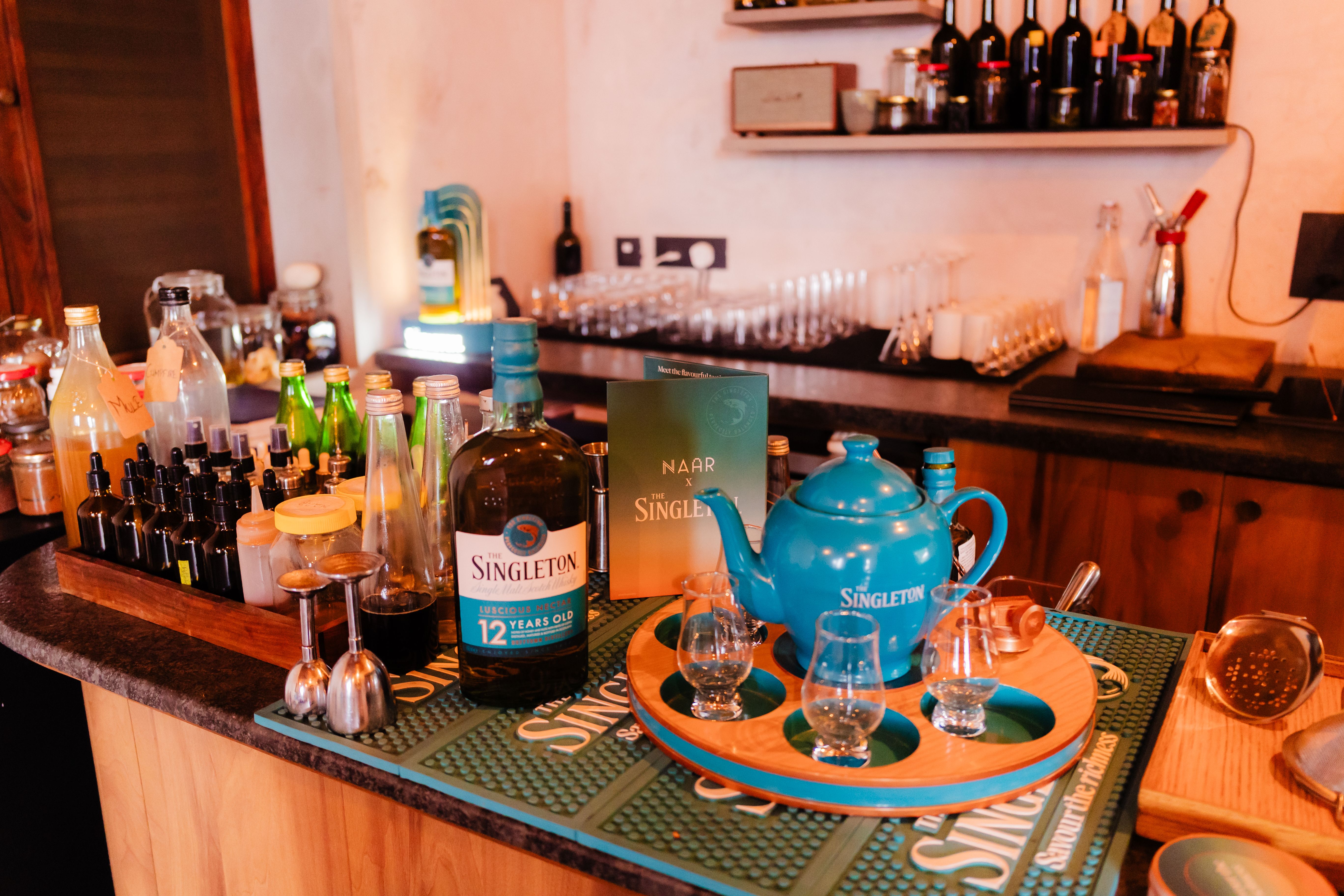
That same instinct carried through to the bar. Dixit’s drinks worked because they were not trying to behave like a second tasting menu. ‘We don’t like focus on more on the spirit part,’ he enthuses, steering the conversation back to ingredients instead. ‘The idea was to play with four different classic cocktails,’ he added. The classic base gave the drinks a useful sense of familiarity, while the broader theme of four trees kept them tied to the same landscape-first thinking that shaped the food. Pine nuts, leafy touches and other botanical cues kept the bar programme within NAAR’s farm-and-foothills-to-table logic without turning the whole thing into a lecture.
That restraint was smart. A dinner like this can very easily be overbuilt. Instead, the drinks had structure and character without demanding a standing ovation for themselves. One guest at the table summed it up better than most official tasting notes ever could, telling Dixit that he had given the menu ‘a very unique twist’ while keeping it ‘not complicated’, adding that it was not ‘trying to hide’ anything. That felt right. The cocktails had enough technique to be interesting, but not so much that they turned the evening into a bar seminar with food attached.
Sadhu, meanwhile, kept returning to memory, rootedness and mood rather than technical posture. Asked which local ingredient on the menu excited him most, he did not reach for something rare merely because it sounded impressive. ‘Rhododendron, for sure—the flower of the Himalayas,’ he said. ‘It’s something deeply rooted in this landscape.’ Then came the better part: ‘It has a very distinct, almost nostalgic flavour, and for me, it captures the mountains in a way that feels both personal and seasonal.’ That is not just a chef describing an ingredient. It is a chef describing a way of thinking. The ingredient matters because it carries memory.
That also helps explain why the collaboration with Manu Buffara felt coherent rather than bolted on for the night. ‘Working with Manu and her team felt instinctive,’ Sadhu said. ‘There’s a shared respect for land and community.’ Instinctive is the word doing the work there. It suggests that the overlap did not need to be forced into meaning after the fact. Buffara’s work has long been tied to seasonality, ecology and local networks, so the pairing made sense without anybody needing to over-explain it.
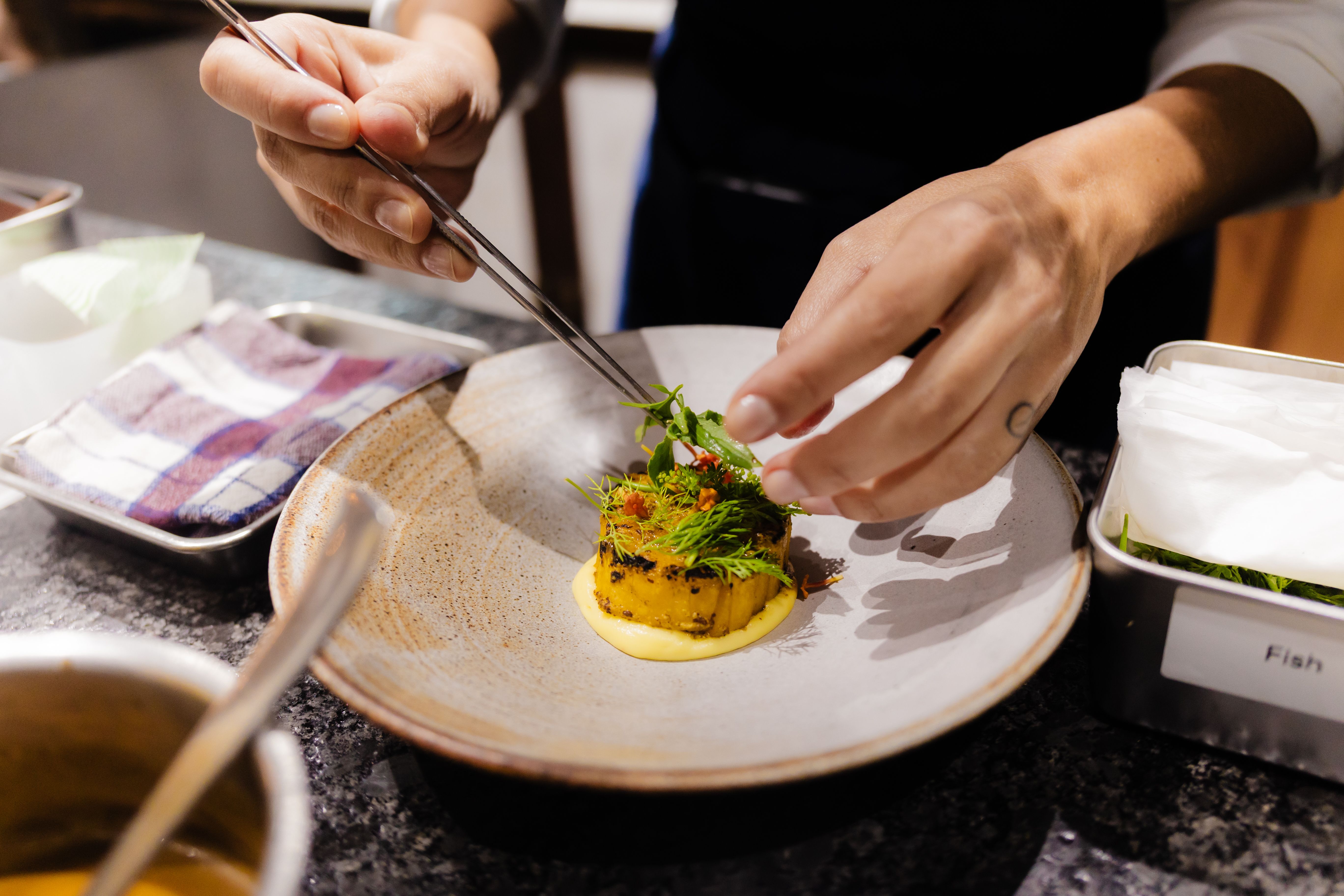
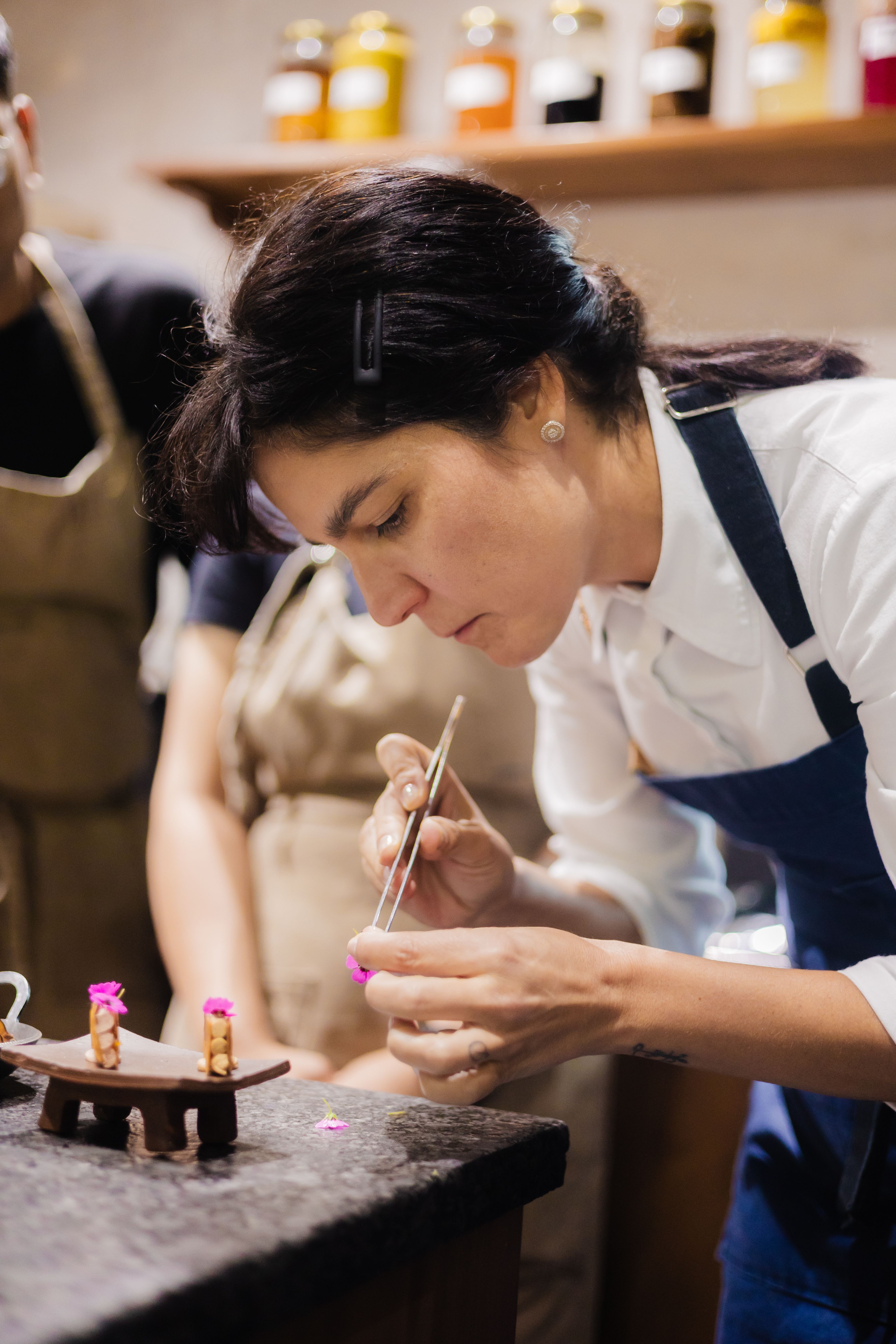
You could read as much off the menu itself, which I later walked away with, signed and folded away like the sort of keepsake one pretends not to care about. It read more like a conversation than a stunt: deodar with walnut salad and crispy patande; vatapa with acarajé and mustard; liver pâté with almond and crispy pancake; Spiti potato with Himalayan dog mustard, nettle and monkey fruit chutney; smoked trout with mandioquinha salsa; duck with pahadi sauce, buransh and sour butter; pork with ‘rice not rice’ and pickled salad; sea buckthorn with honeycomb and timur custard; and priprioca with dulce de leche, nut crumble and yoghurt ice cream. On paper, it had every chance of becoming too pleased with itself. In practice, it mostly felt curious, grounded and nicely free of explanatory overkill.
I will admit that my own preferences were not especially hard to map. The more umami a course leaned, the more likely I was to be on board. Unsurprisingly, the duck and pork were the hits. The duck, with pahadi sauce, buransh and sour butter, had the sort of deep, rounded satisfaction that tends to shut a table up for a few useful seconds. The pork, paired with ‘rice not rice’ and pickled salad, landed in that deeply pleasing zone between richness and sharpness. Visually too, the food had impact. This was a very handsome meal. But what I appreciated most was that the menu did not seem desperate to prove how clever it was. It trusted flavour, texture and rhythm to do the work.
Where Destination Dining Becomes Worth The Effort
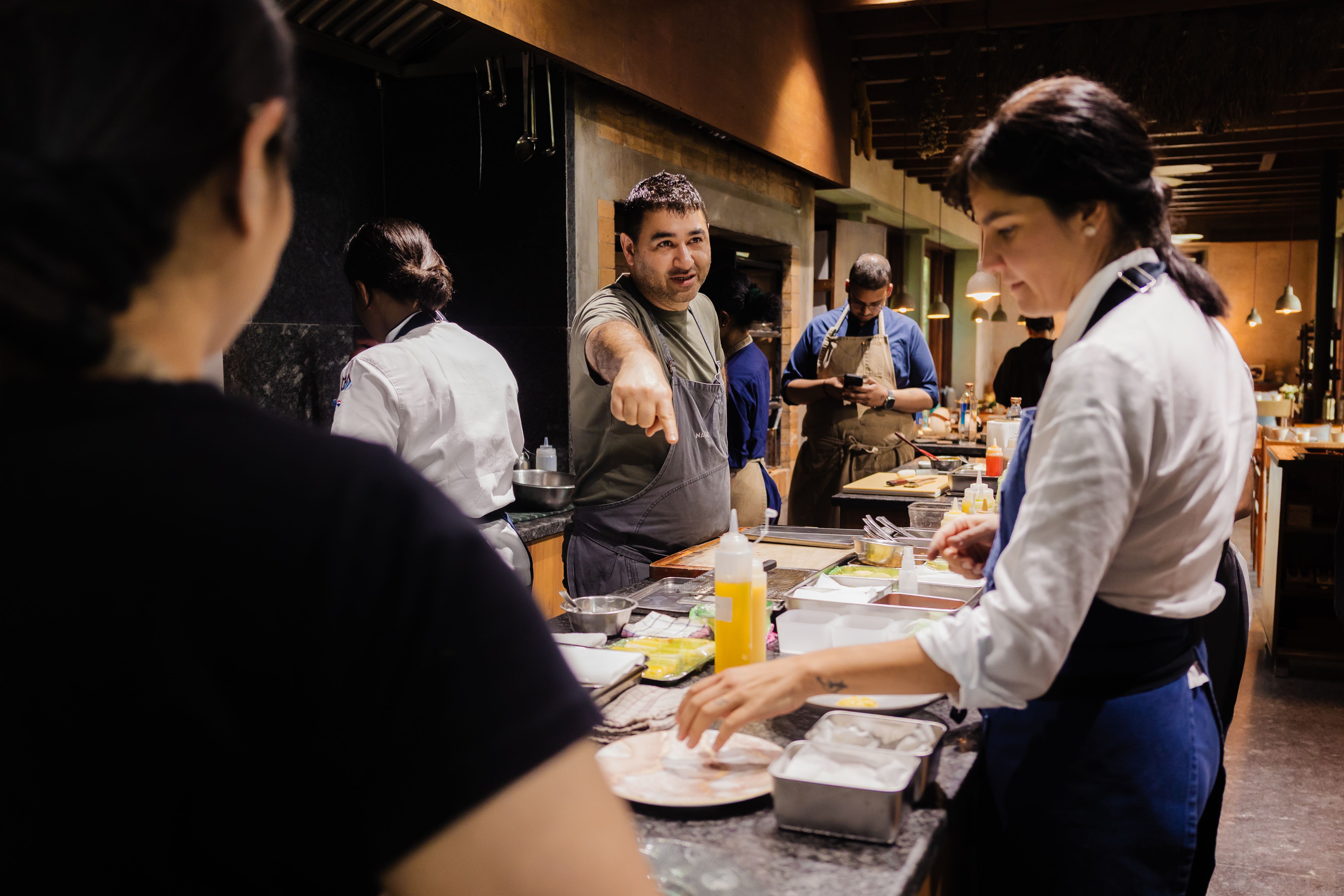
That may be the real achievement of NAAR. It has become one of those Indian restaurants people now talk about as an experience, and usually when a restaurant crosses into that territory it becomes slightly unbearable. The room turns reverential. The service becomes too aware of itself. Every ingredient arrives dragging a paragraph behind it. NAAR, for all its reputation, largely avoids that trap. It has a strong sense of place, but not the sort that keeps tapping you on the shoulder to make sure you noticed it.
Tripathi hinted at that in a more practical way while talking about the life of the restaurant beyond one-off events and headline nights. ‘It’s to do with weather,’ he said, explaining why the menu shifts so closely with what is available and how the seasons shape the experience of being there. Asked which season appeals most to him personally, he pointed to the quieter side of the place rather than the obvious postcard answer. ‘We love monsoons. It’s beautiful, but it’s just a more quiet…’ That felt telling. The appeal, for him, was not spectacle. It was the different emotional register the hills take on when they slow down.
The same goes for the restaurant’s attitude to atmosphere. That night’s The Singleton Social Analogue Jams live music element, for instance, was unusual rather than standard. ‘Usually we don’t feature live music. We have never done it and we’ll likely never do it [again], because it’s not the sense of place that we want,’ Tripathi said. That line stuck with me because it gets at something larger. NAAR is disciplined about mood; it is not trying to pile on experience for the sake of it. It seems to know that the room, the journey, the pace and the kitchen already do enough.
Sadhu’s own thoughts moved in a similar direction. When asked what he hoped diners would take away from the collaboration, he did not mention technique, novelty or the usual talking points of a one-night-only event. ‘I hope they take back a feeling more than anything else,’ he said. “A sense of slowing down, of being fully present in that moment. This collaboration isn’t just about food—it’s about connection. Between people, places, and ideas.”
“What fascinates me is how much of our food lives in memory. The real knowledge sits with people—passed down quietly through generations.” That, more than anything, may be the best lens through which to understand both NAAR and this dinner. Not as an exercise in novelty, and not as a brand-led spectacle pretending to be culture, but as a meal built around forms of memory that remain alive precisely because they are still being handled, tasted and passed on. Dixit’s drinks carried the same logic as Sadhu and Buffara’s kitchen. Nobody lunged for attention, and crucially, nobody seemed desperate to make sure you had understood the concept.
By the end of the night, what lingered was simpler than any grand thesis about destination dining. It was the pleasure of a room that knew how to hold itself together. “Nothing overpowering,” as Sadhu put it. Just layers, opening up slowly. For a place people now willingly drive hours to reach, that may be the smartest thing NAAR does. It does not mistake effort for drama. And on this particular evening, with The Singleton in the frame and Manu Buffara lending the kitchen her warmth, that was enough.


