
There are fitness trends, and then there is HYROX. Over the past couple of years, the hybrid racing format has gone from something you may have vaguely heard your particularly intense gym friend mention to an almost unavoidable fixture of the fitness calendar. Friends are forming doubles teams, training programmes are being rearranged around race weekends and, if your Instagram feed is anything like ours, somebody you know is probably pushing a sled right now.
Performance coach Robin Behl has watched that shift happen from particularly close quarters. Hybrid work was already part of the training philosophy at his studio before HYROX exploded in India, which meant adapting to the format itself came fairly naturally. Since then, he has raced multiple HYROX events across India, including Delhi, Bengaluru and most recently Mumbai, while also helping clients prepare for the peculiar combination of running, strength and sheer volume the event demands. And HYROX is hardly the biggest endurance test on his immediate calendar: Behl is now preparing to take on a 120km self-sufficient race across the Sahara, carrying his own food and essential supplies across four days in the desert.
But Behl is also refreshingly unsentimental about the hype. HYROX may be accessible, highly marketable and very good at getting people interested in training, but that does not mean you should spend seven days a week murdering yourself on a sled. Before his upcoming Sahara expedition, we caught up with him after HYROX Mumbai to understand why the format has caught on, what beginners consistently get wrong, how he approaches training for it himself and why running, recovery and carbohydrates might matter more than another heroic workout. Excerpts:

You encountered HYROX before it became this massive lifestyle phenomenon. What did you make of it initially?
Initially, I compared it a little to the CrossFit Games, because CrossFit blew up in a similar way. I wasn’t sure whether HYROX was going to stay or go. Then, gradually, it really blew up internationally, probably a couple of years before it came to India. What made it interesting to me was the hybrid concept, because that was something we had always incorporated into our training anyway. Even our studio was designed in a way where we could immediately adapt to something like HYROX. The format was new, but the style of training wasn’t alien to us. Now every second person is either doing it or interested in it. Even people who aren’t racing go to watch their friends and come away thinking, ‘I want to do the next one.’
Why do you think it has caught on so quickly?
One of the biggest things is that there’s no prerequisite. You can sign up and go do it. You might finish in 60 minutes, 90 minutes or take three and a half hours. You’re not necessarily competing against anybody else; a lot of the time it becomes you against your own time. The movements are also fairly straightforward and there’s a lot of running. Then you add the optics around it. You have the photographs, the race setup, the edits people make, brands coming in and the whole ecosystem around it. It’s made itself very accessible. At the same time, the entry fee is high, which is interesting. People are still voluntarily paying a lot of money to race. That shows you what HYROX has managed to build in a very short amount of time.
Has the rise of HYROX changed the way you train your clients?
Definitely. Fitness always goes through phases. Bodybuilding culture was huge at one point, and now the way people want to train has changed considerably. As coaches, we have to adapt to what people want to do while making sure they’re still achieving their goals and maintaining holistic fitness rather than simply getting caught up in a trend. The great thing for me is that I can now integrate more running with people who previously hated running. HYROX gives them a reason to do it. And it isn’t simply about practising those eight stations over and over again. To improve one movement, I might need you to do five other movements that support it. People are suddenly much more receptive to that work because they understand why they need it. Even mobility is a good example. People aren’t complaining about mobility work as much anymore because HYROX has so much volume. If your mobility is poor, your body is going to become rigid as you fatigue and you’re inviting injury. So in that sense, it has actually worked out quite well.
If somebody gave themselves six months to prepare for HYROX, what would you prioritise?
First, running. And more specifically, running compromised. HYROX is a compromised race. You might be very good at wall balls when you’re fresh, but you’re not doing them fresh. You’re doing them after you’ve been running and working through other stations. Your legs can feel like rocks by then. So you need to have trained compromised if you expect yourself to perform compromised. The second thing is recovery. HYROX training can involve a lot of volume. You’re running multiple times a week, doing sled work, using the SkiErg, doing repetitions and simulations. You have to make sure you aren’t emptying the tank during training and arriving at race day already fatigued. I’ve seen people go absolutely crazy on sleds and train like they’re going to war. That enthusiasm is great, but you still need to train smart. I would put a structure in place first. Then I’d focus heavily on running, while making recovery and mobility equally important considering the load you’re putting through your body.
What are the most common mistakes you see beginners making?
Spending more time practising the stations than practising their running. That would probably be number one. Number two is having almost zero focus on recovery. Then there’s ignoring nutrition and fuelling, and assuming that training volume is everything. People think, ‘I’m going to train for two hours every day, seven days a week and just push through.’ No. Performance is the whole package. Training, hydration, fuelling, sleep and recovery all matter. You have to look at how you feel and how you’re actually performing. Have you slept properly? Have you recovered? What is your HRV looking like? There are days when resting is going to benefit you more than another training session.

How did you approach HYROX Mumbai yourself?
My situation was slightly different because I’ve been preparing for my desert run, so there has already been a lot of running and conditioning in my programme. I ran 100 kilometres in Jaisalmer in August in 42-degree heat, so the running base was there. I’d also already raced HYROX Delhi and Bengaluru, which meant I knew my strengths at the stations and knew that I didn’t need to go crazy trying to cram everything in before Mumbai. Three weeks before Mumbai, I was actually away surfing for 10 days and had no HYROX-specific training. When I got back, I did a week of very light work where I went through the stations without killing myself. Because the work isn’t done 20 days before the race. For me, that work has been happening over the last 10 years. The final week was about letting my body rest and fuelling properly. I kept electrolytes beside me for the two days before the race and kept sipping them, ate my meals on time and tried to get a good eight hours of sleep for at least the three or four nights leading into it. I didn’t complicate it.
And you raced twice in Mumbai?
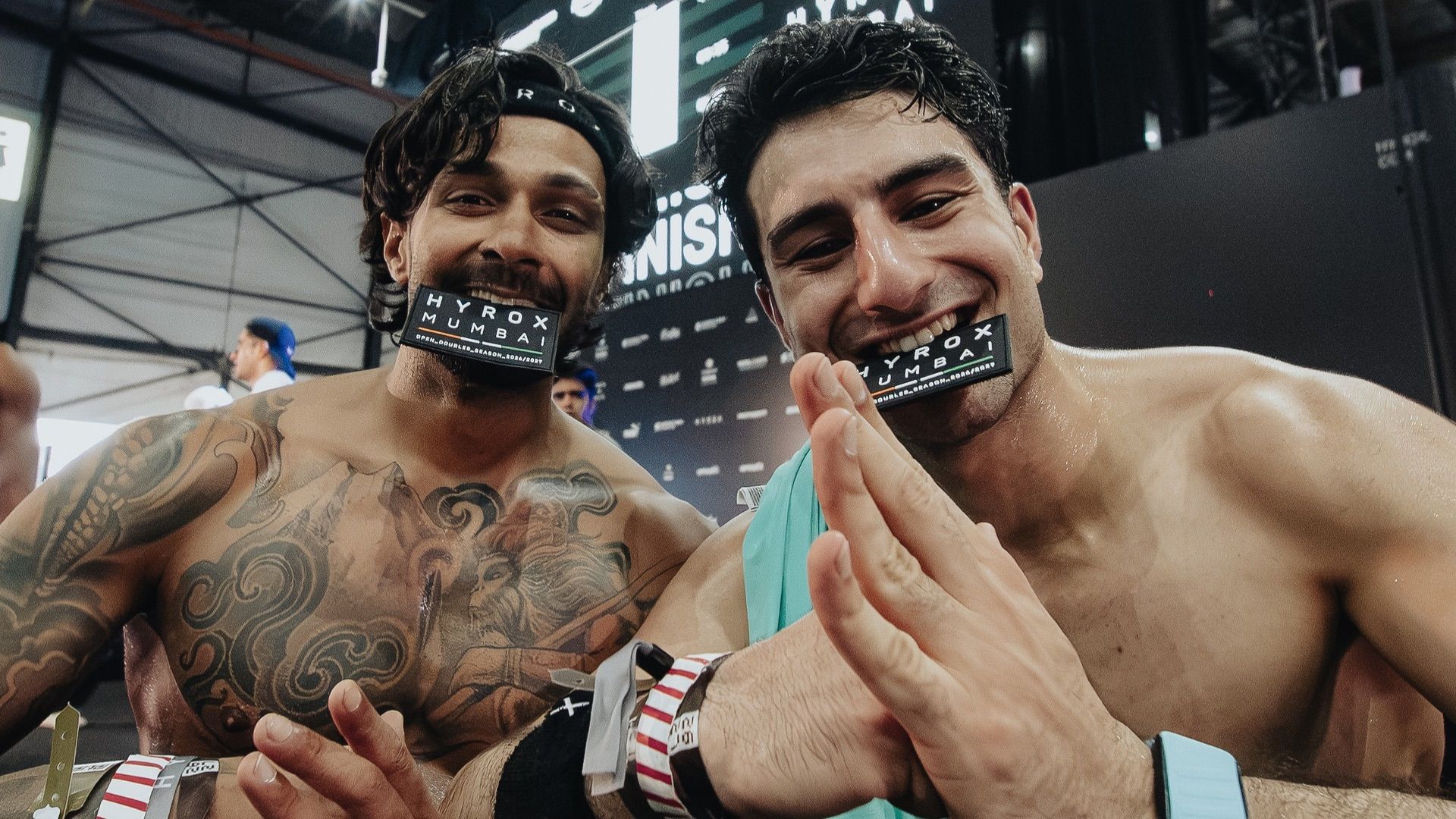
Yeah. In one of the races I finished in 1 hour 6 minutes and improved my previous time by two minutes. Then I raced with Ibrahim Ali Khan. Our original target was simply to go under 90 minutes because he had been travelling quite a bit and we hadn’t had much time to train together. We ended up doing 1 hour 13 minutes. He raced really well. HYROX isn’t an easy race. Even when I do it, there are points where I’m thinking, ‘Oh, shit.’ I’m not cruising through it. I was pacing our race, and at one point I looked at my watch and told him, ‘We’ve done the hard bit. We’ll finish with a bang. Just stick with me.’ He basically nodded and said, ‘Don’t say anything more. Let’s go.’ We split the stations according to our strengths, he stayed with the pace and we got through it really well.
There seems to be an interesting mix of serious competition and people simply wanting to experience it. Is that part of its appeal?
Absolutely. You have people trying to podium and fighting for every second, but you also have people just having fun. You’ll see somebody racing in a suit. You’ll see a 75-year-old man. Someone will race with their mum. There’s a really good community spirit around it. But obviously people are competitive too. If two people from the same household are doing the same race, of course you’re going to want to come home faster. The other clever thing about the format is that almost everybody finishes thinking they could have done something better. ‘I made a mistake there. I could have gone faster here. I’m doing another one.’ That’s good for the organisers, obviously, but it’s also quite good for the person because it keeps them training.
Do you think HYROX has staying power?
I think they’ve marketed it very intelligently and caught the fitness phase at exactly the right moment. Going forward, though, they’ll eventually have to find ways of keeping it interesting. For somebody like me who has already done four or five races, the same format can become monotonous after a while. I don’t necessarily think I’m their core audience, though. Their audience is still completely into it, and as long as they keep pulling more people into that ecosystem, it can keep growing. The Instagram reels definitely aren’t going anywhere.
Is there anything you would change about the format?
Personally, I’d maybe have some kind of basic prerequisite or qualification. Sometimes you’re genuinely trying to race and there are people who are more interested in taking videos or staying close to the crowd, and that can become frustrating when you’re moving quickly. But I’m conflicted about that too, because the accessibility is part of what makes HYROX work. It brings people into fitness precisely because you don’t need to prove yourself before entering. There has to be some compromise between the two.
Finally, what is the simplest nutrition advice you would give someone training for HYROX?
Stay hydrated and make sure you’re getting your salts and electrolytes in. And please, do not shy away from carbs. Carbs are energy. If you’re training at this kind of volume, you need them.


